


On beings and biomes—the pacific walrus
By Megan Mason Dister, legal fellow
“Walruses are coastline embodied,” writes Bathsheba Demuth in her book Floating Coast: An Environmental History of the Bering Strait.
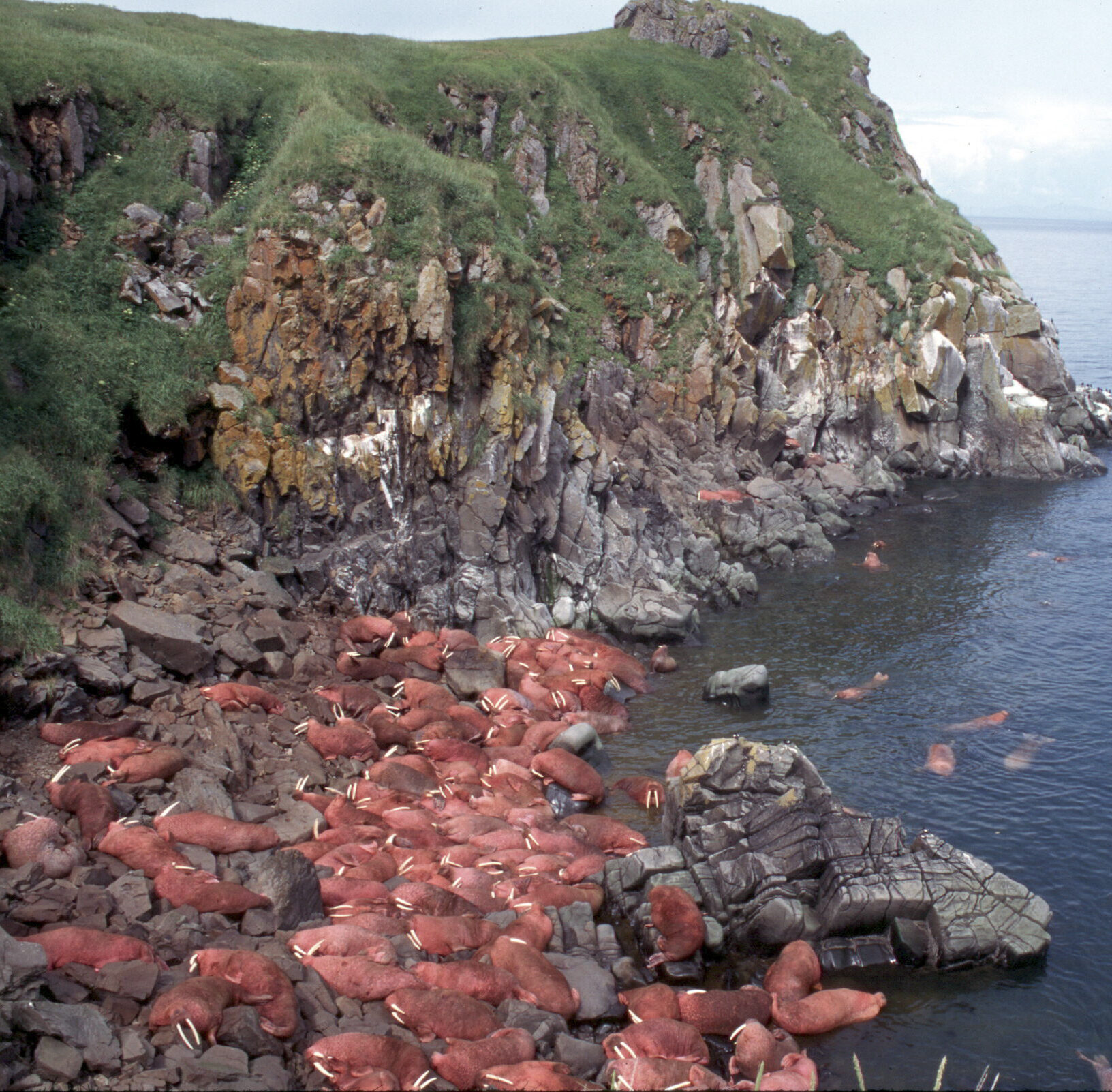
Walruses hauled out on Round Island. Photo by J Schoen.
Walruses move between the deep ocean floor, munching on clams and other benthic organisms, to sandy beaches on Alaska’s coastline. As they move between the ocean and the coast, “[t]hey do labor no person can, transforming submarine muck into useful tissue and hauling it to shore, drawing a line of energy from the sea into the solid world,” writes Demuth.
In the late nineteenth and early twentieth century, the commercial whaling industry exploited this energy pulled from the icy depths of the Bering Sea. Commercial whalers slaughtered walruses in large numbers for their oil, hides, and tusks. They turned to walruses to replace their killing of declining bowhead whales suffering from the industrial scale of the slaughter.
In her novel Sivulliq: Ancestor, Lily H. Tuzroyluke imagines the scene of a Yankee whaling ship coming upon a group of walruses: “In the water, the creature swims like a seal, dancing and swaying in the current, searching the sea floor for cockles, crabs, and sea worms. The four-ton animal is thick with fat, five inches of fat, meaning a cask of oil from each walrus. Casks equal money.”
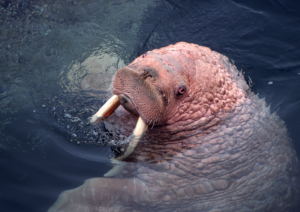
Walrus swimming at Round Island. Photo by Amy Gulick.

Today, the pacific walrus continues to shape its environment, remains a vital subsistence resource, and continues to face threats from human caused challenges like climate change.
Walrus as environmental engineer
“A walrus sets the season of hunters and shapes the sea where it eats, pluming nutrients as she roots for clams—above, a bloom of algae,” writes Demuth.
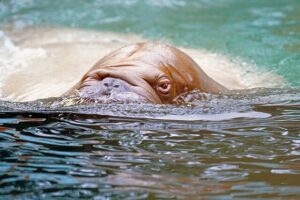
A walrus scans the surface. Photo courtesy of NOAA.
These massive marine mammals alter their environment wherever they move. Male and female pacific walruses grow tusks that can reach over three feet in length. They jab these overgrown teeth into the ice to breathe while swimming underwater and dig the tusks into the ice to haul their bodies. They use their long sensitive whiskers to detect their food. Diving to around 200 feet, they root on the ocean floor for benthic organisms like sea anemones, corals, sea urchins, mussels, and shellfish. As they root on the sea floor, their hundreds of whiskers release nutrients into the ocean.
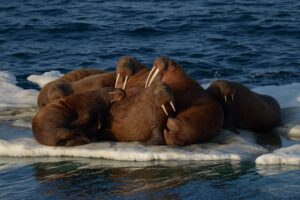
Walrus hauled out on ice floe. Courtesy of USGS.
Walruses are also social beings, transforming landscapes when thousands haul-out together on land. “Walruses are ever in company: fresh from the sea, a lone animal rocks toward the touch of others. They sleep flipper to flipper and communicate by twitching their whiskers, sometimes a bristly kiss,” details Demuth. Scientists describe walruses as the most “gregarious pinniped” because they gather in large numbers and are almost always in groups, whether hauled out on land or ice, or swimming through the water.
The animals use a variety of different sounds to communicate with each other, creating a chorus of noises both on land and in the water. Demuth describes these noises as unique songs “filled with creaks, twangs, whistles, barks, and rhythmic knocking.”
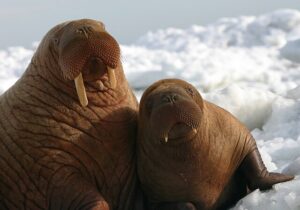
Walrus and calf. Photo by Joel Garlich-Miller.
Tuzroyluke illustrates the variety of sounds walruses make: “[t]he walnut-colored babies cry to their mothers like lambs. The adolescent males croon their mating calls, too immature in age for the females to notice. A scarred ruddy old bull barked at the males. It is a concert, an allegro of walrus calls.”
The Alaska Native communities where pacific walrus live and travel through are also shaped by the walrus.
“For thousands of years, Iñupiaq, Central Yup’ik, Cup’ik, St. Lawrence Island Yupik, and Aleut communities along Alaska’s Bering and Chukchi seas have depended on marine resources to meet their physical, nutritional, spiritual, and cultural needs. This dependence is the foundation of a reciprocal relationship between the people and the ocean that has been maintained since time immemorial,” write Katya Wassillie, Eskimo Walrus Commission, and Melissa Poe, University of Washington.
In a report by the Eskimo Walrus Commission, John Sinnok, a hunter from Shishmaref, explained that “walrus will always be a part of our lives. It always has been a part of our lives.”
Walruses and the future
“For much Arctic life, the future is uncertain to a new degree,” writes Demuth.
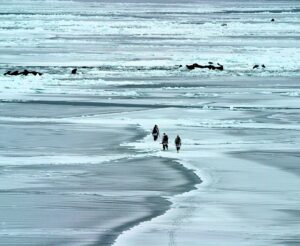
Researchers walk along the sea ice towards a group of hauled out walrus. Photo courtesy of USGS.
The arctic is warming at four times the rate of the rest of the planet. As the sea ice rapidly melts, these creatures who rely on the sea ice will suffer. Walruses are already beginning to change their behavior in reaction to these climatic shifts. The retreating sea ice means walrus mothers are having to travel farther from sea ice to forage, leaving their newborns longer on the ice alone and depleting the mothers’ energy from longer swims.
Instead of being able to haul-out on ice, walrus now seek more haul-outs on beaches. This can lead to more human disturbances. When disturbed, walruses sometime stampede, crushing calves in the chaos.
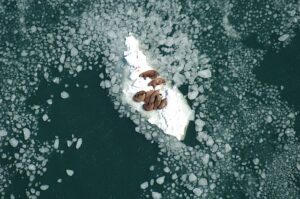
Walrus cows and bulls rest on an ice floe. Photo by Brad Benter.
As the sea ice melts and temperatures rise, there are growing threats to the walrus’ food. When sea ice melts in the spring in the Bering Sea, nutrients bloom from the melting ice and foster growth of animal life on the sea floor. However, without sea ice, this spring bloom does not occur and the walrus’ access to rich bottom-dwelling animals in the region is decreasing. The whole ecosystem of the Northern Bering sea is shifting from a region full of rich bottom-dwelling animals to a place dominated by pelagic fish.
As sea ice shrinks, the walrus’ habitat in the Chukchi Sea is being opened to oil exploration and extraction that will further exacerbate climate change. Growth of oil exploitation in the arctic will threaten the walrus because of increasing risks of oil spills, greater noise pollution, and more human disturbance.
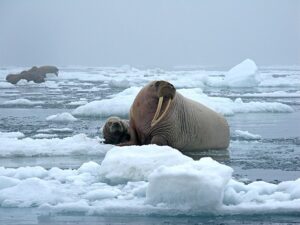
Walrus and calf sitting on ice floe in the Chukchi sea. Photo by Sarah Sonsthagen, USGS.
In the face of these growing threats, we must think of the walrus as a gregarious, beautiful, and life-sustaining creature who belongs within and nourishes expansive communities of life. Just as we did generations ago, we continue to make short-sighted choices that prioritize extractive industry and imperil the walrus. It’s up to us, together, to change that.