


Beings and biomes—murder, mischief, and unkindness
By Dawnell Smith
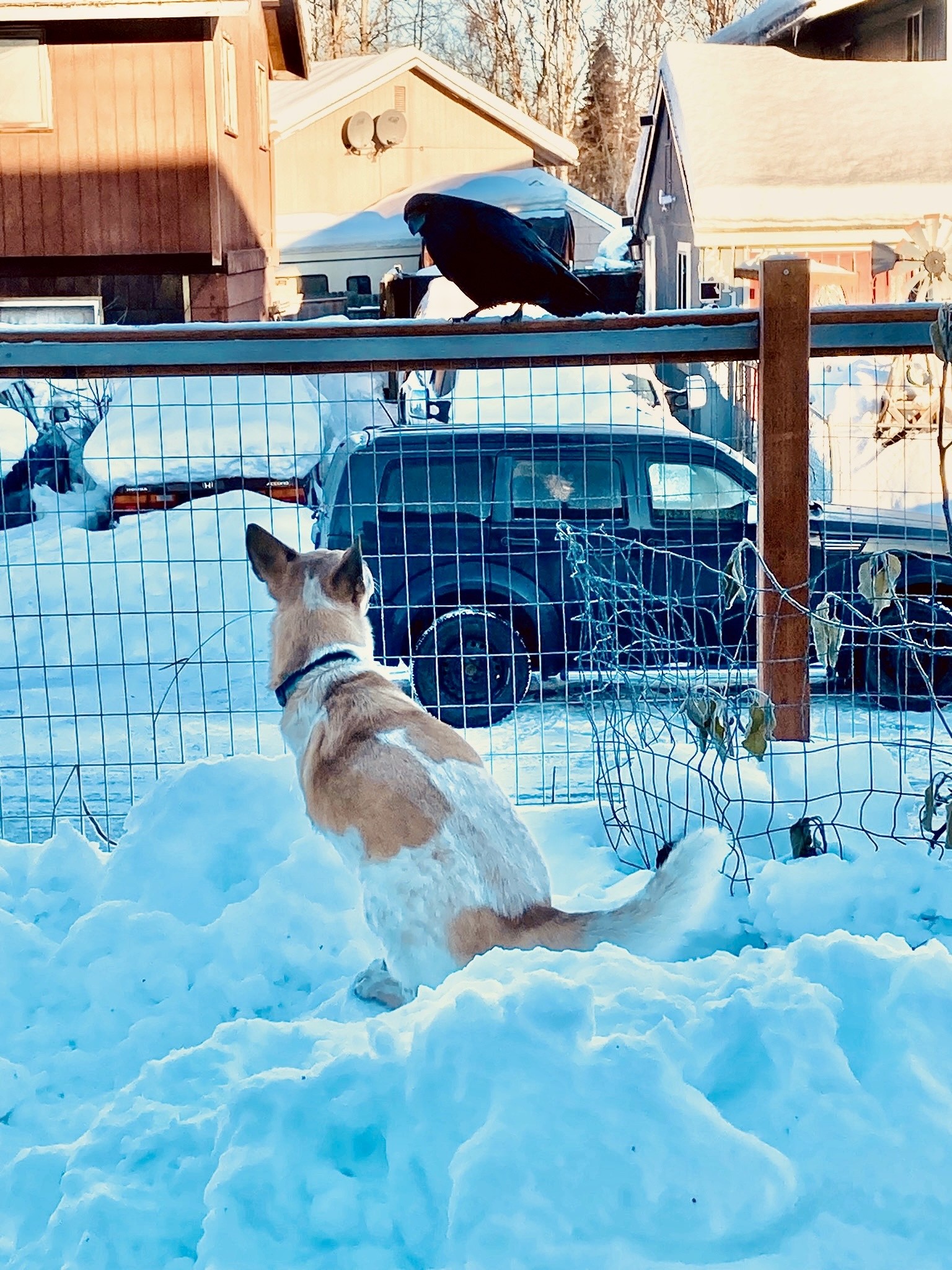
Once upon a time, a raven landed on a fence (meaningless to the bird except to perch) to converse with a three-legged dog sitting on the snow. The raven spoke in low guttural squawks while the dog Annie, rarely quiet and quite capable of squawking herself, mostly listened.
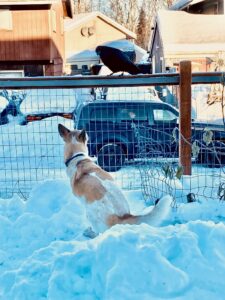
A raven and a dog converse. Photo by Dawnell Smith.
What mayhem is this, I wondered, motionless at the kitchen sink and staring out the small window. Prankster raven, troublemaker tripawd, what good can come from this allegiance?
I didn’t worry about the bird or dog but about the rest of us. Certainly, a single raven does not make an unkindness, but does a dog and raven together make mischief? What manner of conspiracy were they hatching? Had they formed a congress to plot some unsavory tiding?
Alas, the raven cawed one last rumbled message and flew off, and the dog let out a high pitch moan. Only then did I discover the source of their discourse—a fleshy moose knuckle in the snow.
Did the raven get a few bites of flesh or only covet them? Was it a standoff or a debate?
I will never know, but Alaska corvids—ravens, crows, magpies, and jays—gift us stories and unanswerable questions like “what could that remarkable bird brain really know” and “are they trying to tell us something and should we be worried that we’re not paying attention?”
The (un) common raven
Science plunks ravens into the Corvidae family of the passerine or perching bird order. They, like all Corvids, are also songbirds. The people who do this sort of categorizing have identified over 120 species of Corvids, including those familiar to us in Alaska, plus nutcrackers, choughs, jackdaws, rooks, and treepies. They live on every continent but Antarctica. They don’t do long migrations but will relocate for nesting, where both parents help nurture their young from egg to acrobatic flight.
Raven and the moon. Photo by J. Mills.
Ravens tend to hang out alone, in pairs, or in small groups but they congregate for roosting at night. During an Anchorage winter, look to the sky before dusk to see them heading to the hills. As many as 800 ravens have been seen in one Fairbanks roost.
Alaska Corvids appear shimmering black likes ravens or crows or tinged with the iridescent blues and greens of jays, and very rarely white, like the raven with blue eyes who roamed, rough-housed, scavenged, and posed for thousands and thousands of photos while living in the Spenard and Midtown neighborhoods of Anchorage from October 2023 to April 2024. The bird’s leucism—a condition where a gene causes the loss of pigmentation—is uncommon for sure and also considered a good omen.
Raven is a mystical and spiritual being in Alaska Native stories, and the white raven a messenger of transformation and even hope.
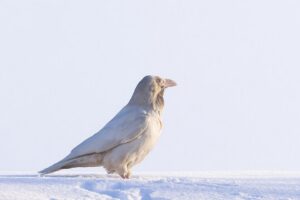
A white raven photographed in Anchorage. Photo by Lisa Hupp.
“Ravens appear in countless myths and religious texts, with a range of meanings, from prophetic to ominous,” notes the last fact in the Audubon’s top ten fun facts about the common raven . “The Norse god Odin has two ravens serving as his eyes and ears: Huginn (‘thought’) and Muninn (‘memory’). Greek legends associate ravens with Apollo, the god of prophecy. The Morrigan, Celtic goddess of war and death, shows up in the form of a raven. Ravens are also prominent in Native American mythologies, where they appear as both the creator of the world and a trickster.”
Until the mid-1900s, though, European settlers killed off most of the ravens on the East Coast. They poisoned or shot them to protect animals they used for food, like chickens and eggs, though ongoing deforestation of the landscape did the most harm. Europeans brought their own views on ravens with them, too—stories of the raven’s association with death, witchcraft, the macabre.
More recently, the U.S. Fish and Wildlife Service, on the behalf of the Oregon Department of Fish and Wildlife, put out poisoned chicken eggs and meat in Baker County, Oregon during a multi-year experiment to determine if killing hundreds of ravens would help sustain the population of greater sage grouse. The Bird Alliance of Oregon opposed the experiment, noting that agencies had not documented a single raven preying on a sage grouse nest.
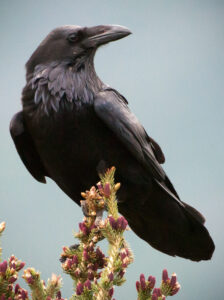
A raven perches atop a tree in Denali National Park. Photo courtesy of NPS.
The results and conclusions of the raven killing experiment have not been released, but it’s not surprising that ravens get a bad rap, even if they’re not the culprit. They’re clever, curious, and persistent. They get into things. They harass eagles.
Yet, until the mid-1900s, scientists gave little regard to bird brains and concluded that birds operated on instinct, not thinking, learning, planning, and remembering. Bird brains did not look like mammal brains, so many scientists explained the visible behavior of intelligence regularly displayed by birds like ravens as automated rather than sapient. That has changed dramatically as researchers steadily document and recognize how the stories about ravens and other corvids are true—they are messengers, pranksters, problem solvers, and thinkers.
As omnivores, ravens eat insects, seeds, nuts, fruits, eggs, small animals, dead animals, and, of course, human food waste, and they also hide extra food in hundreds of secret locations that they remember many months later. They even disguise their stashes and make fake ones to fool potential thieves, demonstrating self-awareness and the understanding that they may be watched. (Of course, they likely try to sleuth out the secret caches of other animals, too.)
Ravens have shown that they think ahead, show empathy. make and use tools, have self-control, build relationships with other animals, and even decide what humans they trust or trick.
Well, it turns out that bird brains have a high neuron density that’s packed heavily into their pallium or forebrain, and ravens and other corvids have some of the largest brain to body size ratios in the bird world. In fact, ravens have demonstrated the cognitive abilities of primates in scientific studies, and even more so in our lives.
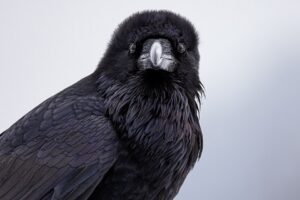
A raven stares down the camera in Anchorage, AK. Photo by Lisa Hupp.
Watch them long enough and you’ll believe you’ve made some friends. The thing is, while it’s hard for humans to distinguish one raven from another, even after seeing them repeatedly, ravens know exactly who you are.
It turns out big brains can come in tiny packages that can look like that rabble rouser perched on a fence post near you.
The crow holds a grudge
A full-grown crow is about two-thirds of the size of a raven, and less than half as heavy. They have rounded or fanned tails rather than pointed or wedged ones, You can find crows in coastal areas from Puget Sound to Cook Inlet, and in towns like Valdez and Homer, where they often harass other birds like eagles, ravens, and owls.
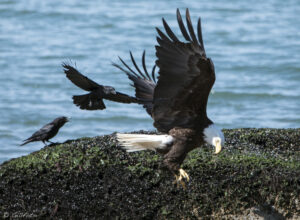
Bald eagle being mobbed by a pair of crows. Photo courtesy of Gillfoto.
“Want to locate an owl?” asked the writer from Kachemak Bay Birders in the Homer News. “Listen for crows, as they are ferocious about giving abuse to owls.”
Turns out they hold grudges, too.
Professor John Marzluff ran an experiment about crow grudges on the University of Washington campus. He donned an ogre mask and trapped seven crows in a net, put leg rings on them, and set them free.
Those crows remembered that traumatizing experience, but so did the crows who witnessed it, and the crows who came after. Upwards of 40 to 50 crows vehemently scolded him when he wore the mask in subsequent years. It took 17 years before he could walk the campus in that mask without being scolded by crows.
People tell stories about being stalked and attacked by crows and ravens, often after doing something the birds didn’t like, like shooing them away with an object, running at them, etc.

Crows sit in a nest under a bridge near Polychrome Pass. Photo by Emily Mesner.
There’s logic to the crows’ response: They recognize and remember the person who threatened them, identify them as a risk, share that information, and aggressively defuse the threat. Crows (and ravens) also form more friendly relationships with people who offer them treats and trinkets, and have even left a rock, coin, or other small thing in return.
Researchers describe what’s going on in these exchanges in different ways, and people have many perspectives on what friendship means, but these encounters mean something to people. The question is, what do they mean to crows?
As the writer of “Are Crows Really Our Friends” said in Audubon Magazine, whatever we want to call these encounters, “with a crow, the relationship happens on the wild animal’s terms. They visit when they want to, and they may disappear from our life suddenly.”
A magpie reputation
Our cat Charlie got on the roof a few years ago. We were worried because of the eagles in the area, but the magpies proved our concerns misdirected. They were the ones shrieking and swooping at him as Charlie swiped back. The cat didn’t have a chance, but we managed to coax him down and get him back inside.
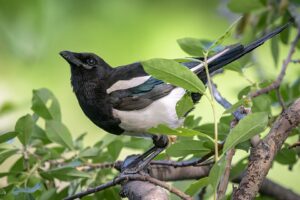
A black-billed magpie perched along the Ship Creek Trail, Anchorage, Alaska. Photo by Becky Mastsubara.
Magpies can drive people crazy. They chase other birds from feeders, dive bomb dogs at dog parks, swoop at people’s heads, cackle and scold and yell.
They’re also stunning. The black billed magpie’s black head plunges into a long and dark tail with iridescent blue-green wings and tips and a splash of white on their belly. Their long tails make up more than half their length.
In Alaska, they live in Southcentral and Interior Alaska, west into the Aleutians, and in Southeast. Coastal magpies tend to fly inland to British Columbia and the Yukon for the spring and summer to nest and raise their young.
Like other corvids, magpies are bold and social birds who will follow predators like wolves and bears to scavenge from their kills. You can find them on the ground, too, foraging insects, or on the backs of moose to pick off bugs.
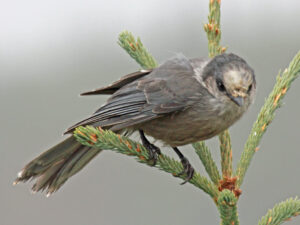
A gray jay peers down from a branch. Photo by Dick Daniels.
Like magpies, grey and Steller’s jays live throughout Alaska and are often called camp robbers because of their tendency to snatch food from picnic tables and camp sites.
The gray jay, a small soft gray bird with a black hood and white forehead, can store food in thousands of places in a year, allowing the jay to breed earlier than others. The Steller’s jay’s striking appearance—a large black head crest, charcoal head and nape, and deep blue body—make it easy to identify, though you might hear the bird first.
The Stellar’s jay announces its presence with a loud call that sounds like an old-fashioned pump handle needing grease. The bird is known to mimic the sound of a hawk to scare other birds away from a good feeding site.
Notice a pattern?
Corvids communicate, mimic, plan, play tricks on others, build relationships, make lots of noise, solve problems, get into conflicts, think things through. They’re a lot like us, but with wings. And they come to us in dreams:
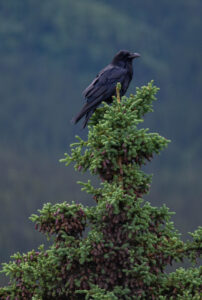
A raven perched atop a spruce tree. Photo by Mary Lewandowski.
Dream of the Raven
By Ada Limón
When the ten-speed, lightweight bicycle broke down off the highway lined thick with orange trees, I noticed a giant raven’s head protruding from the waxy leaves. The bird was stuck somehow, mangled in the branches, crying out. Wide-eyed, I held the bird’s face close to mine. Beak to nose. Dark brown iris to dark brown iris. Feather to feather. This was not the Chihuahuan raven or the fantailed raven or the common raven. Nothing was common about the way we stared at one another while a stranger untangled the bird’s claws from the tree’s limbs and he, finally free, became a naked child swinging in the wind.