


Donor love—Rich Seifert sees the throughline
By Dawnell Smith
Smog, pesticides, burning rivers and oil spills grabbed the attention of Americans in the 1960s, an influential social and ecological context for Richard Seifert’s young adult years. While studying physics at West Chester State College in Pennsylvania, he took an ecology course and coordinated the campus event for the first Earth Day protest in 1970.
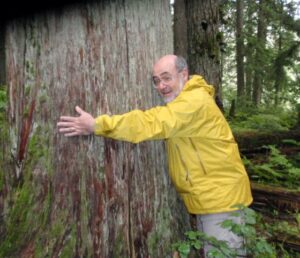
Rich Seifert hugs a western red cedar tree in a Canadian National Park, 2009. Photo by Rich Seifert.
Those threads carried through his life.
After graduating from West Chester, he headed north to study in the engineering physics master’s program at the University of Alaska, Fairbanks. He had always wanted to go to Alaska, and once he got here, he stayed.
The university became a hub of connectivity with the community. After getting his master’s, he worked as a housing and building specialist with the cooperative extension services of the Fairbanks campus. As researcher and professor, he wrote papers and books, and taught courses about how to live and build responsibly and effectively in the Alaska environment. His courses, workshops, and community conversations focused on health and energy concerns like clean indoor air quality, energy efficient construction, and solar energy systems.
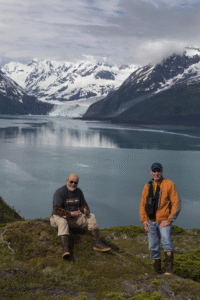
Rich Seifert and Dr. Steve Jewett of UAF, on a trip in the Prince William Sound. Photo courtesy of Rich Seifert.
Tenured in 1992 and promoted to full professor in 1995, he spent decades deepening his relationship with the community and the key institutions that underpin it—the university where he studied and worked, and the hospital foundation where he served on the board and its construction committee.
He wrote everything from letters to the editor and research papers to outreach pamphlets and books, including “The Solar Design Manual for Alaska,” first published over twenty years ago, and his 2023 memoir, “A Life With High Latitude.”
“Alaska changed me more than I changed Alaska, of course,” said Seifert. “Everything here is in a grand scale. Just a fraction of one percent of the U.S. population lives here. It is a tremendous privilege to do so.”
The best laugh ever
Sean McGuire, a friend of Seifert’s for 35 years, describes him as having the best laugh he’s ever heard. “It’s absolutely contagious,” said McGuire. “It’s a deep, rich laugh that puts people at ease.”
If you live in Fairbanks and haven’t met Seifert yet, you’re likely a degree or two of separation away.

Rich on a birding trip in Bhutan. Photo by Kay Hackney.
“He’s connected, he’s generous, he’s likable,” said McGuire, checking off the qualities that make Seifert tick. “Some people make enemies, but he’s not one of those. He’s effective, and he doesn’t get in conflicts with people who disagree with him.”
And there are plenty of people who disagree with him. A search of the Fairbanks Daily News-Miner’s website brings up dozens and dozens of Seifert commentaries and letters to the editor going back to 2012, along with a few back-and-forth public debates with people with opposing views. His opinion pieces over the years have touched on everything from cold climate housing and the problem of mold in homes to the right of citizens to question their government and the trial of the Fairbanks Four. The headlines seem to get spicier in later years:
The sad misadventures of Gov. Mike Dunleavy, Rich Seifert, March 17, 2023
The campaign to send Frank Tomaszewski back to 10th grade, parts I, II and III, Rich Seifert, Sept. 17, July 19, Aug. 13, 2024
Social entomology and political insects, by Rich Seifert, July 3, 2025
The politics in Fairbanks can get heated, but for Seifert, that just means conversations need to be had, assumptions questioned, opinions shaped and shared.
“I’ve been so engaged in Alaska my whole life,” he said, “and it has never disappointed me, even with the intense conflicts and political fire.”
The Fairbanks lunch group

An early photo of one of our lunch group meetings, at the Former Gulliver’s Bookstore. Photo courtesy of Rich Seifert.
Decades ago, Seifert and a friend started a weekly lunch group that met in person to talk about stuff. McGuire said it evolved over the decades, grew organically, and these weekly lunch conversations can regularly draw 20 to 40 people.
Seifert still manages the group, now meeting on Zoom, and adds folks to the list all the time. It’s still just a bunch of people wanting to talk, but now Alaska’s political players want to get in on the conversation. The lunch group interviews local leaders and, nowadays, political candidates who use the space to share their views on local and Alaska issues.
It’s an informal but influential group with a collective solution-focused throughline for looking at and responding to new challenges as well as the old and entrenched ones.
Another longtime friend of Seifert’s, Mike Musick, joins these calls regularly and has for decades. Musick knew Seifert first as a mentor and then as a boss when working for the cooperative extension service developing teaching techniques and materials for the building education program. There, they affectionately called Seifert “Dr. Science,” referencing a 90-second comedic radio segment on public radio.
“Rich is probably one of the more curious people I’ve ever known,” said Musick. “He is always interested in whatever there is to learn.”
The two men have different personalities, of course, or as Musick put it, “university professors profess and builders build,” but their friendship has grown and lasted now for five decades.
“Rich can put thoughts together extemporaneously and is fun to listen to,” Musick said, also noting Seifert’s athleticism and ferocious approach to handball back then. “I wouldn’t have wanted to get in front of a ball with him on the court.”
You can’t do it alone
A few years ago, Musick helped write a legislative citation honoring Seifert’s contributions to teaching building science in Alaska, mentioning Seifert’s book on solar energy, his work on energy policy, his newsletter on northern building, and even the lunch group that the citation lovingly calls “Geeks and Geezers.”
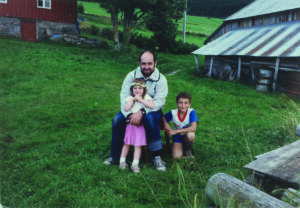
Rich and his children Sarah and Brandon from their year in Norway , 1986.
Clearly, Seifert puts his skin and energy into the community from his early years on. It saddens him that the supportive, purpose-driven environment at the university when he studied and worked there has vanished. People making decisions were more concerned with climbing their career ladders than centering the community, he said. Funding cuts gutted the cooperative extension program.
“Public service, community service is to me the highest purpose, and the goal of the cooperative extension was to show people how best to live here by growing, canning, foraging, building and so on,” said Seifert. “We gave people what they needed to sustain themselves in Alaska.
With the program now a shadow of its former self, his work languishes. The reservoir of knowledge he built and shared on solar, radon in homes, indoor air quality, energy efficiency and much more is no longer taught.
“It’s an educator’s worse outcome,” he said. “The program isn’t supported. The population is declining. No one’s buying houses. People are struggling to buy a home, let alone build one, so everything you contributed is not being used, applied, or being taught.”
Still, that knowledge is out there, and Seifert is still teaching. This month, he’s doing a class on the story of Christopher McCandless and the iconic bus air lifted off the Stampede Trail in 2020 and now at the Museum of the North on the Fairbanks campus.
The bus sparks contentious debate, especially in Alaska, where everyone stakes a claim to knowing what it takes and means to live and survive here. Some people say McCandless did stupid things with stupid consequences and that his story doesn’t deserve the attention. Others see the young man as a seeker on a personal quest who survived four months and died of bad luck.
A book got written, a Hollywood movie made, and even a “Friends of bus 142” website built and maintained. The story does deserve attention if you ask Seifert, and he hopes his class will unpack the ideas, myths, and assumptions caught up in the McCandless story, however you see it. All that said, he knows what it takes to live in Alaska and how quickly dreams and expectations over staking a claim of “going it alone” can collapse.
“If there’s one thing Alaska taught me is that you can’t do it on your own,” he said. “Rugged individualism and the self-made man stories are total BS. It’s always other people and institutions that support you—starting with your parents or family.”
The cost of living here
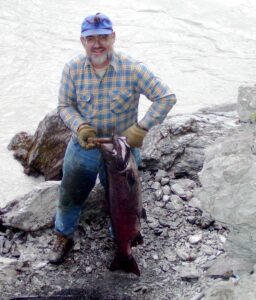
Rich catches his first king salmon, caught in Chitina. Photo courtesy of Rich Seifert.
Not surprisingly, the simple things continue to amaze Seifert, like the repeating energy cycle, how fast spring comes, the relationships among animals, and how hard it is to live here, the cost of it.
“The first people in Alaska were mobile because there wasn’t enough food in one place,” he said. “We’ve tried to do something in Alaska that has made us enormously expensive.”
People staying put, putting in towns and cities, bringing much of what they need long distances, traveling long distances to see the world, plowing over natural places and burning carbon, all these things cost us all the health of Earth. “You couldn’t do any of this without fossil fuels,” he said. “The true sustainable population of Alaska is probably 70,000, not over 700,000.”
Early in his Alaska life, Seifert lived in a dry cabin. Now he has a house he retrofitted for efficiency and with solar panels. But he travels widely, has lived within the systems fossil fuels profit from and perpetuate like the rest of us. The Alaska life most of us live requires that we take more than we give—that it exacts a cost from the land, water, other life forms, and future generations.
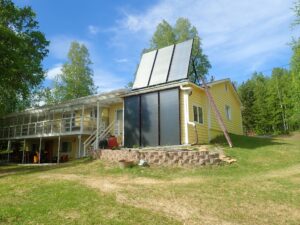
A photo of Rich’s home solar system, installed in 2015. Photo by Rich Seifert.
There’s a reason he commits his energy to sustainable living, whether through a community food market or promoting programs and policies that center on human and ecological health, or just giving his money and time to people and organizations who put their focus on the health of communities and Earth.
He has strong opinions on this: We should all see the throughline on sustainability so we can reduce the cost burden of how we live on those who come after us.
We periodically share donor love by sharing the stories of people supporting our work. We’re grateful to all the folks who, like Rich Seifert, contribute monthly and generously to Trustees and other organizations striving to protect and nourish the health of communities and the lands and wildlife that sustain us.
Join the monthly giving program or learn about other ways to support Trustees here.