


Litigation 101: What are declarations and why are we preparing so many right now?
By Dawnell Smith
You know those courtroom dramas where someone stands up and stuns the room with a declaration that no one saw coming? Well, that doesn’t happen in our work.
Mind you, there are plenty of things to be shocked about in environmental law—the carelessness with which government agencies shrug off the impacts of industrial projects on local people and wildlife; the recklessness of corporate objectives wedded so dangerously to short-term profits that they cause environmental catastrophes with enduring consequences. (We’re not only talking to you Exxon and BP.)
All that said, the declarations in our work should surprise no one. They establish a person’s or organization’s “standing” or legal right to initiate a lawsuit or participate in a case, and they also establish the basis for preliminary injunctive relief, which is a request for the court to stop irreparable harm from happening while it hears the merits of the case and issues a final ruling. These written documents show the court how an organization or person has or will be harmed by an agency’s action—such as the authorization of an industrial road or oil and gas leasing program, or the permitting of a mine operation—and how a favorable court ruling can stop that harm.
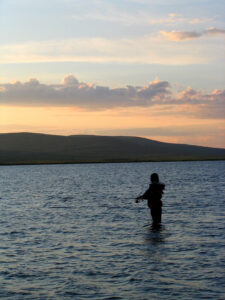
Fishing at sunset on Frying Pan Lake. Photo by Erin McKittrick.
Declarations are stories about people.
“Working on declarations means talking with people who have such deep relationships with the animals and places we’re working to protect in our lawsuits, and their stories are really powerful,” said Megan Mason Dister, an attorney finishing her two-year legal fellowship with Trustees this summer.
Declarants might be people who commercially fish downstream of a proposed mining project that threatens salmon. Or folks with homesteads on or near the path of a proposed industrial road. Or local caribou hunters who rely on a herd with calving grounds on land an agency plans to lease to oil companies.
Standing: up, for, with, in court
Trustees usually represents other non-profits, and we demonstrate their standing by submitting both organizational declarations, from their executive directors or other staff, as well as member declarations, from folks who support and are active with that organization.
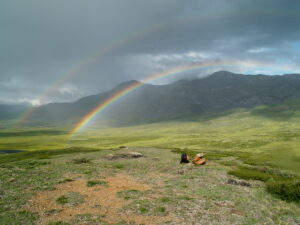
A rainbow over camp near the Killik River in Gates of the Arctic National Park. Photo by Christopher Houlette, NPS.
An organizational declarant generally addresses how an agency’s action or decision interferes with the non-profit’s work to fulfill its mission, like protecting sacred land and wildlife, preserving fisheries, or keeping toxics out of drinking water and air. These organizational declarations also demonstrate the group’s involvement in public processes and outreach work related to the legal claims.
Member declarants often address how the agency’s action affects their personal lives and how the lawsuit concerns their food, health, culture, livelihood, recreational pursuits, business, way of life, traditions, education, future, and so on.
Often the lawyers who help get declarant stories, experiences, and concerns on the page have never been to, relied on, or experienced the places essential to the declarant’s life.
“These places are far away, and I’ll probably never be able to see them,” said Ashley Donovan, an attorney at the end of her two-year fellowship with Trustees, “and these declarants paint such a vivid picture of what these places mean to them, why they care about them, and they can also describe the impacts a project could have on them that those of us who haven’t been there might not even think about.”
Some declarants write out their statements, but most talk to the attorney on the phone. The lawyers record and transcribe those conversations and ask questions to clarify details.
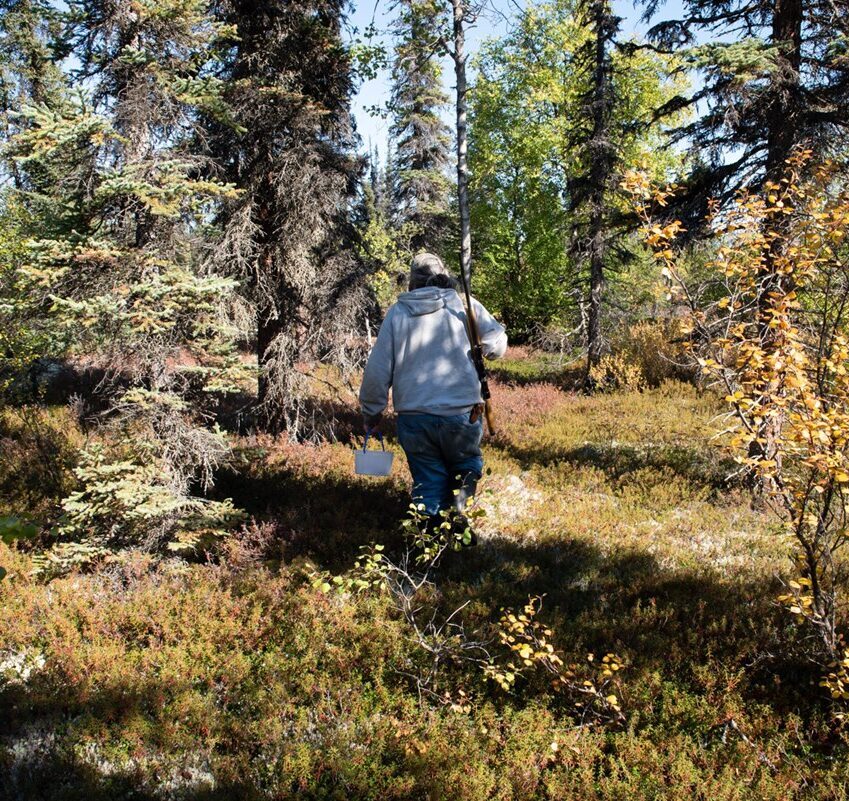
A hunter walks through the woods near Lake Clark National Park. Photo by D. Khalsa.
How many salmon did you get when you last fished on these streams?
Do you have concrete plans to return to this area to hunt?
Can you clarify how you think dust kicked up by 500 trucks using this proposed industrial road every day would impact the financial health of your business?
Right now, Trustees is gathering and updating declarations across a range of cases, including our western Arctic lawsuit and Ambler road litigation.
Every legal action requires declarations, and there’s a lot of legal work going on right now.
The heart of the matter
For lawyers, putting declarations into final form can take some time.
“Some of the people we work with don’t have access to the Internet, email, or even snail mail because they’re busy and in remote places part of the year,” said Dister. “As an environmental lawyer, we tend to represent nonprofits and work mostly behind our computers. We don’t get to meet with the people on the ground as often as we wish we could. So, no matter what the obstacles are, it’s rewarding to listen and document their stories, and it’s a reminder of why I went to law school and am doing this work in the first place.”
It might take days, weeks, even months to make contact, hours on the phone, more hours of getting everything written and reviewed, then finalizing signatures. The best part isn’t shuffling paper, of course. It’s the one-on-one.
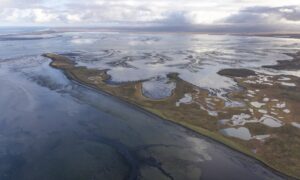
Izembek Lagoon from above. Photo by Zak Pohlen, USFWS.
“Anyone who knows me knows that I’m really into getting to know people and my favorite thing is the introduction when I can ask people about their lives,” said Donovan. “There are so many places in Alaska I will never get to, but I talk to people who have, and I can ask things like ‘how did you even get to Izembek?’”
A declaration is an origin story—what connects a person to a place, how the animals enrich a life, when a relationship with place and its communities of life began.
The law does not allow a river or bird, a wetland or herd to declare the harm done to them. What human declarants do is show how the harm done to those places and beings shows up in their bodies and lives, their communities and future.
A declaration is the heart of the matter.