

Litigation 101: What’s an integrated activity plan and how does it play into Interior’s proposed rule to rubber stamp Big Oil projects like Willow in the Arctic?
By Dawnell Smith
Federal agencies use general management plans and review processes to guide decision making. When it comes to the western Arctic, the U.S. Bureau of Land Management uses an integrated activity plan to generally lay out how and how much of the National Petroleum Reserve-Alaska—the largest unit of public land in the country—gets used for various purposes, including subsistence hunting and foraging, recreation, conservation, and extraction.
Teshekpuk Lake Special Area in the Reserve. Photo by Gerrit Vyn.
The Trump administration’s 2025 integrated activity plan for the western Arctic opens over 82 percent of this area to oil and gas leasing, aligning with the 2020 plan from Trump’s first term, but far exceeding the 50+ percent open to oil and gas prior to that.
The 1970s law that transferred the area’s management from the Navy to the Bureau recognized oil and gas extraction as one of the Reserve’s uses but also mandated protections for conservation and subsistence purposes.
The 2025 integrated activity plan not only prioritizes extraction over conservation and subsistence but also alters the boundaries of the long-time protected Teshekpuk Lake Special Area and eliminated the Colville River Special Area entirely, rolling back protections for caribou, birds, and other wildlife that depend on these critical areas.
We filed a lawsuit challenging that management plan in February 2026.
A rule to end all protections
A calving area of the Western Arctic caribou herd in the Utukok River Uplands Special Area. Photo by J Schoen.
An integrated activity plan outlines guidance for a vast region but does not analyze impacts of a specific project on specific acres of land. It’s common sense that a particular project in a particular place has impacts tied to the kind of ecosystems the project will impact, the wildlife within or moving through the project’s area, people’s use of the area, the way water flows and dust flies, how a project ties to and expands other industrial projects, and so on.
You need actual individual, specific project proposals to know what their potential impact could be on nearby communities as well as the lakes, wetlands, and tundra that nourish caribou, polar bears, migratory birds, and other wildlife.
But Interior recently announced it is moving forward with proposing new rules for issuing permits in the western Arctic. Instead of looking at actual projects proposed on specific pieces of land, Interior wants to pre-approve hypothetical industrial projects that could be equivalent to or worse than ConocoPhillips’ massive Willow oil and gas hub—all without knowing a single thing about the actual proposal or its specific impacts.
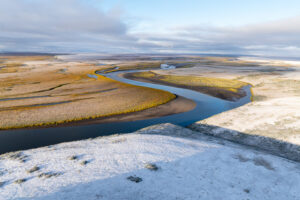
Colville River Special Area’s winding rivers and tributaries. Photo by Gerrit Vyn, Cornell Lab.
The proposal put forth in a petition from the Alaska Oil and Gas Association would shortcut permit approvals by ditching any further environmental reviews, public process, and even an agency’s option to say no—the very means we’ve got for knowing and responding to what the actual impacts would be.
This proposal uses language like “qualifying production sites and associated infrastructure” that meet “predefined criteria,” which are intentionally vague terms for “anything goes.”
Interior wants to push through a rule that skips sound decision-making processes on the basis that it has done a broad integrated activity plan and has approved “similar” projects before, such as Willow, and there’s no need to look at the actual impacts. In short, they want to say that if it “resembles” the ConocoPhillips’ Willow project, well here’s the permit.
Rubberstamping approvals of new oil and gas drilling on a permitting conveyer belt has nothing to do with making good decisions on behalf of the public and everything to do with exploiting ecologically vital public lands in Alaska to benefit the oil industry and billionaires.
You can do something right now
Right now, you can tell this administration that the western Arctic needs protection, not unfettered oil and gas drilling. Go to the Bureau’s site for the project and click Participate Now to leave your comment.
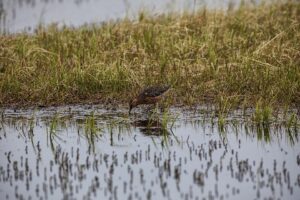
A bar-tailed godwit forages in the wetlands of the Reserve. Photo by Bob Wick.
You should urge the agency to reject any permitting shortcut for future oil and gas production sites in the National Petroleum Reserve in Alaska and say that any new project must go through a project-specific environmental review that fully evaluates the risks to people, wildlife, clean water, public health, subsistence and climate. This review should include looking at how a proposed project would add to the impacts of existing and future projects.
You can also point out that the agency must engage in meaningful public participation for every new proposal and reject any effort to cut corners. For decades, the law has mandated the public’s right to weigh in when the government makes decisions about public land, and you can speak up to keep it that way.
And also, about that name…
Of course, some folks like to say, “Come on, it’s a petroleum reserve,” but a name of a place doesn’t always describe the place and often describes what whoever named it wants from it instead.
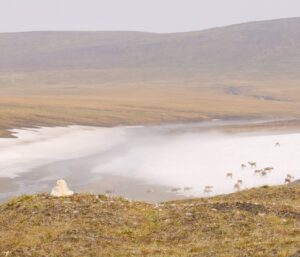
The western Arctic. Photo by Florian Schulz. Courtesy of www.protectthearctic.org.
The gold prospector who named the tallest mountain in North America “Mount McKinley” after the Republican presidential candidate supporting gold, not silver, as backing paper currency didn’t do it on behalf of the mountain, he did it on behalf of his pocketbook. Alaskans still call that mountain Denali, the “high one” or “great one,” because it makes more sense and was used long before that prospector cared about the gold standard.
We call the Reserve the “Western Arctic” or the “Reserve” because it makes more sense—just like knowing how an industrial project will impact people, wildlife, land and water, before approving it makes more sense.