


On beings and biomes—a treachery of stingers
By Dawnell Smith
The Wasp
The wasp and all his numerous family
I look upon as a major calamity.
He throws open his nest with prodigality,
But I distrust his waspitality.
Ogden Nash (1902-1971)
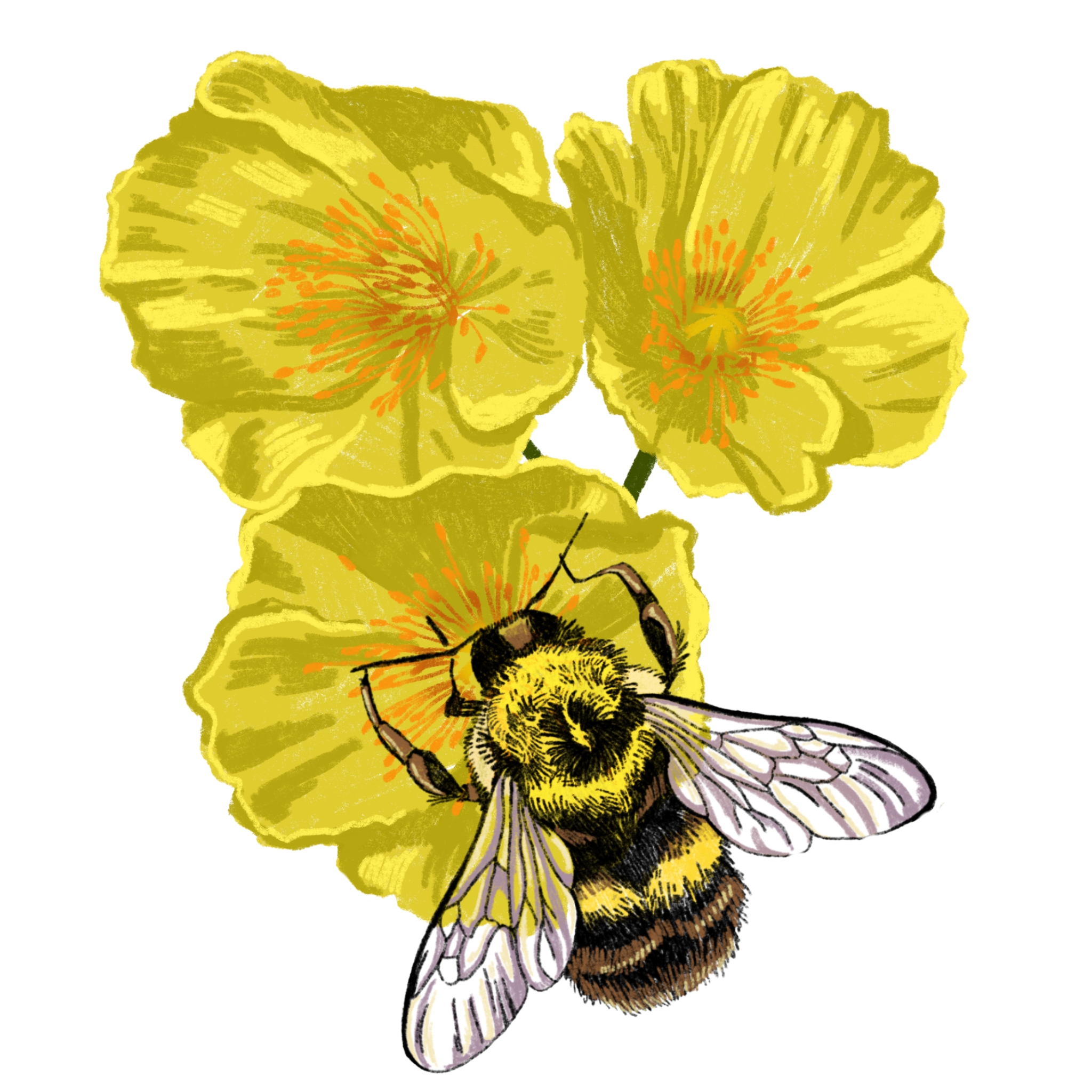
The Arctic bumblebee (bombus polaris). Illustration by Madison Grosvenor.
Ogden Nash grew up and lived in the South and East Coast and made a living writing witty ad copy. He also wrote light verse with memorable rhymes that held some brittle truths about life, like the folly of being on the stinger end of “waspitality.”
Surely by this time of year, many of us have either heard or told stories of wasps routing barbeques, making sunbathing perilous, or turning a trip into the greenhouse into a slow tiptoe quest for a cucumber. But truth is, wasps, like all the pollinators, deserve gratitude, not revenge. They belong to the throng of beings like bees and flies, moths and mosquitoes, butterflies and birds, and even small mammals who pollinate.
Think of them as the nectar seekers. The pollen carriers. The ferryers of future life.
They seek flowers to gather nectar, pollen, resins, and oils as food or materials for nests and sometimes as shelter. Their movements within and between flowers transfers pollen from one part of a flower to another, fertilizing the plant so it can make seeds, fruits, and new plants.
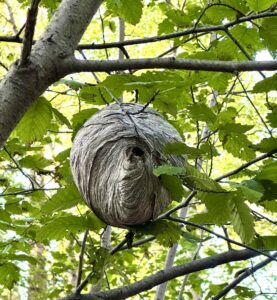
Yellowjacket nest in a tree. Photo by Dawnell Smith.
Some pollinators like bees intentionally gather pollen as food while others like butterflies move pollen incidentally when collecting nectar. Some pollinators buzz about all day, others at night.
Some pollinators co-evolved with a specific plant so that only they can support each other to survive, as with the storied fig tree and fig wasp, but most northern pollinator-plant relationships are more generalized. Bees need flowers, but many can go to a variety of them and interact with blooms of many shapes. Bees get more kudos as pollinators than wasps, but they can’t replace each other. Each of their roles matters to the health of gardens, agriculture crops, natural landscapes, and communities of life around the world.
The bees and the bees
A bee
A bee
staggers out
of the peony.Matsuo Bashō (1644-1694) , translated by Robert Hass
There are over 100 species of native bees in Alaska and likely many more. We do know enough about what bees we have, let alone the threats to their wellbeing and every being who depends on them. (If you want to help collect information on Alaska bees, check out the Alaska Bee Atlas.)
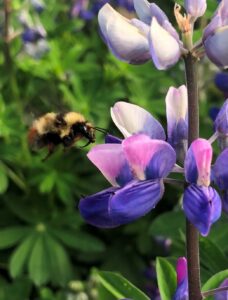
Bumblebee on lupine. Photo by Tracy Lohman.
Alaska’s bee populations include solitary bees like mining and leafcutters, and more social bumblebees who live in colonies.
Mining bees, sometimes called digger bees, look a bit like honeybees, slender with light brown or yellowish hair, and live in well-drained soil where the females tend their own nests. They emerge from their tunnels in early spring to feed on the season’s first blooms, often with snow still on the ground. These bees prove particularly important to blueberry plants.
Leafcutters look about the same size as mining bees, though more stout, with light-hued bands on their abdomen. They cut circular pieces of leaves to construct nests in hollow stems, wood cavities, or abandoned burrows.
Many bees live in the ground, including social bees who use abandoned burrows or other animal nests as their home. More than 20 species of bumble bee live in Alaska. To collect what they need, they grab onto the anthers of certain flowers and buzz their flight muscles to release the pollen, which can accumulate on the hairs of their bodies. This method of pollination proves particularly vital to native berry plants, plus others like fireweed, lupine, geranium and many tundra plants that wildlife depend on.
Without bumblebees, berry and wildflower reproduction would plunge, with great impacts on entire food webs.
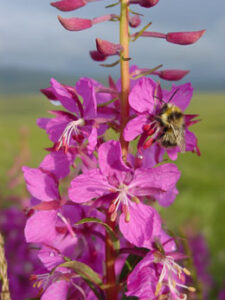
An Arctic bumblebee settles on fireweed. Photo courtesy of ADFG.
When cold weather arrives, the bee colony dies except for the queen, who survives in the soil and emerges in spring to build a new nest and tend the first worker bees.
The particularly adorable Arctic bumblebee, Bombus polaris, lives in the northern reaches of Alaska, Canada, Northern Scandinavia, and Russia. They feed on bearberries, black crowberries, and bog blueberries as well as willow, Arctic rose, red current, and Arctic poppy.
These Arctic bees become food for other animals like sandpipers, eiders, and long-tailed ducks, or suffer nest predation by another bee, the Arctic cuckoo bumblebee, who takes over their nest and leaves their young for the Arctic bumblebees to tend.
Insects are cold-blooded insects, but the Arctic bumblebee has adapted to Arctic conditions through size and power. They are large for bees and bigness helps them retain heat. Of course, first they need to warm up. They bask in sunlight and use the solar qualities of conical flowers, like the Arctic poppy, to concentrate the sun’s rays.
They must reach a temperature of 86 degrees Fahrenheit to fly, and that requires them to shiver their large flight muscles and warm up their thorax to up to 60 degrees above air temperature. That means they can fly when it’s below freezing out.
Good thing they wear thick puffy hair jackets to help hold the heat.
The stinging truth
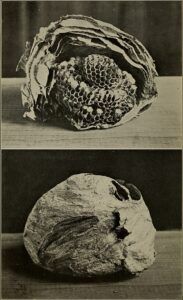
Nest of Common Yellow-jacket (1916). Photo courtesy of State Geological and Natural History Survey of Connecticut.
Three Stings
George got stung by a bee and said,
“I wouldn’t have got stung if I’d stayed in bed.”
Fred got stung and we heard him roar,
“What am I being punished for?”
Lew got stung and we heard him say,
“I learned somethin’ about bees today.”
Shel Silverstein (1930-1999)
There’s a pervasive “vengeance” myth that bees die after they sting us. Truth is, many bees (and wasps) don’t have stingers at all and those who do rarely sting. In the species that do have stingers, only females do, because the stinger evolved into their egg-laying ovipositors.
All that said, here’s the biggest myth buster of all—most bees who sting can sting us many times over. Only a small number of bee species like the European honeybee have barbed stingers that get stuck in our skin. They die of their wounds when they fly away, leaving behind their stinging appendage.
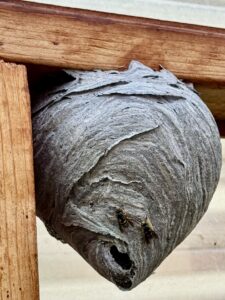
Yellow jackets prowling for intruders. Photo by Dawnell Smith
Which brings us to the social wasps that most people fear and revile. Wasps pollinate flowering plants, including fruits and vegetables, and many species are parasites of animals who damage garden plants and crops, like aphids and caterpillars. Their presence can protect the food we grow.
Unlike the thousands of wasps most of us know little about, the social stinging wasps–paper wasps, yellow jackets, hornets (aerial yellow jackets)—make a big impression. They build nests around human areas and share an interest in the foods we like, but their storied aggression comes from protecting their young, their nests, and their food, not targeting humans.
Alaska is home to at least 11 species of social wasps or yellow jackets. They can look like bees at times, but they generally have less hair and narrow “waists” between the abdomen and thorax. Most are carnivorous, unlike bees, which is why wasps often show up at barbeques, near trash bins, and where you’re filleting fish, but they also supplement their diets with sugar and water from nectar, fruits, and of course your sweets and soda cans.
Yellow jackets have black and white or black and yellow stripes and appear stout, with their legs held close to their body. These predators and scavengers pollinate plants and help control other insect populations.
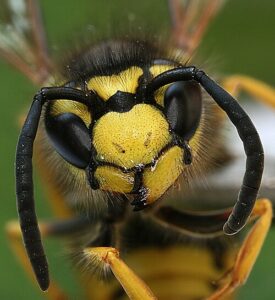
The Vespula germanica, one of the social wasps widely distributed in the Northern Hemisphere. Photo by Richard Bartz.
They chew on woody organic materials to make papery nests with one access hole. These nests can be underground or in tree branches and eaves, which explains how you can accidentally blunder into them, get swarmed, stung, and conclude they have it in for you.
Their stings certainly hurt and there can be many of them. Most of us may swell up where we got stung and feel pain and itchiness for a spell, but others of us can have allergic reactions that can be scary and even deadly. You can do a few things to reduce the likelihood of being on the wrong side of a yellow jacket or bee stinger. The Alaska Entomological Society reviewed an illustrated guide called “The Social Wasps of North America,” and specifically noted the loveliness of the illustrations and the book’s good advice on reducing conflicts.
It starts with awareness, of course, along with patience and field awareness. If you see a wasp nest or flurry of beings who look like bees or yellow jackets ahead of you, give them a wide berth so they don’t feel threatened. But if it’s too late to avoid disturbing them, do a 180-degree turn and walk in the opposite direction in a straight line while covering your face and neck. Fight the impulse to run and swat wildly with your arms, which only intensifies a collective protective response from the wasps and bees defending their hives, colonies, and nests. Like other insects, wasps and bees release pheromones to communicate with and call each other to action, so the fewer “alert, danger” pheromones released, the better for you.
Above all, be like that Lew, who got stung and “learned somethin’ about bees today,” because not only can a little learning save you some pain, but it can also pique your curiosity. These buzzing, flying animals look remarkable and even stunning when you get a good look at them, and their relationships with the world are expansive.
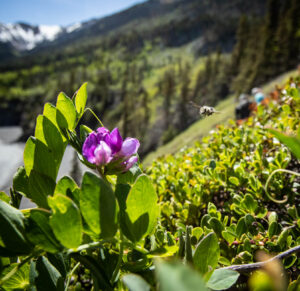
Bumblebee and sweet pea overlooking Turnagain Arm. Photo by Kesia Lee, USFS.
But in as much as there’s so much to learn and know about this treachery of stingers and carries life, we know far too little about the wasps and bees of Alaska. The threats to their continued health range from a loss of habitat and climate change to our use of pesticides and the displacement of the plants they need by invasive species.
What we do know is that their future is inexorably tied to our own. Learning about, and monitoring and protecting them helps ensure that season after season of wildflowers and berries and bountiful plant life will nourish us for generations to come.