


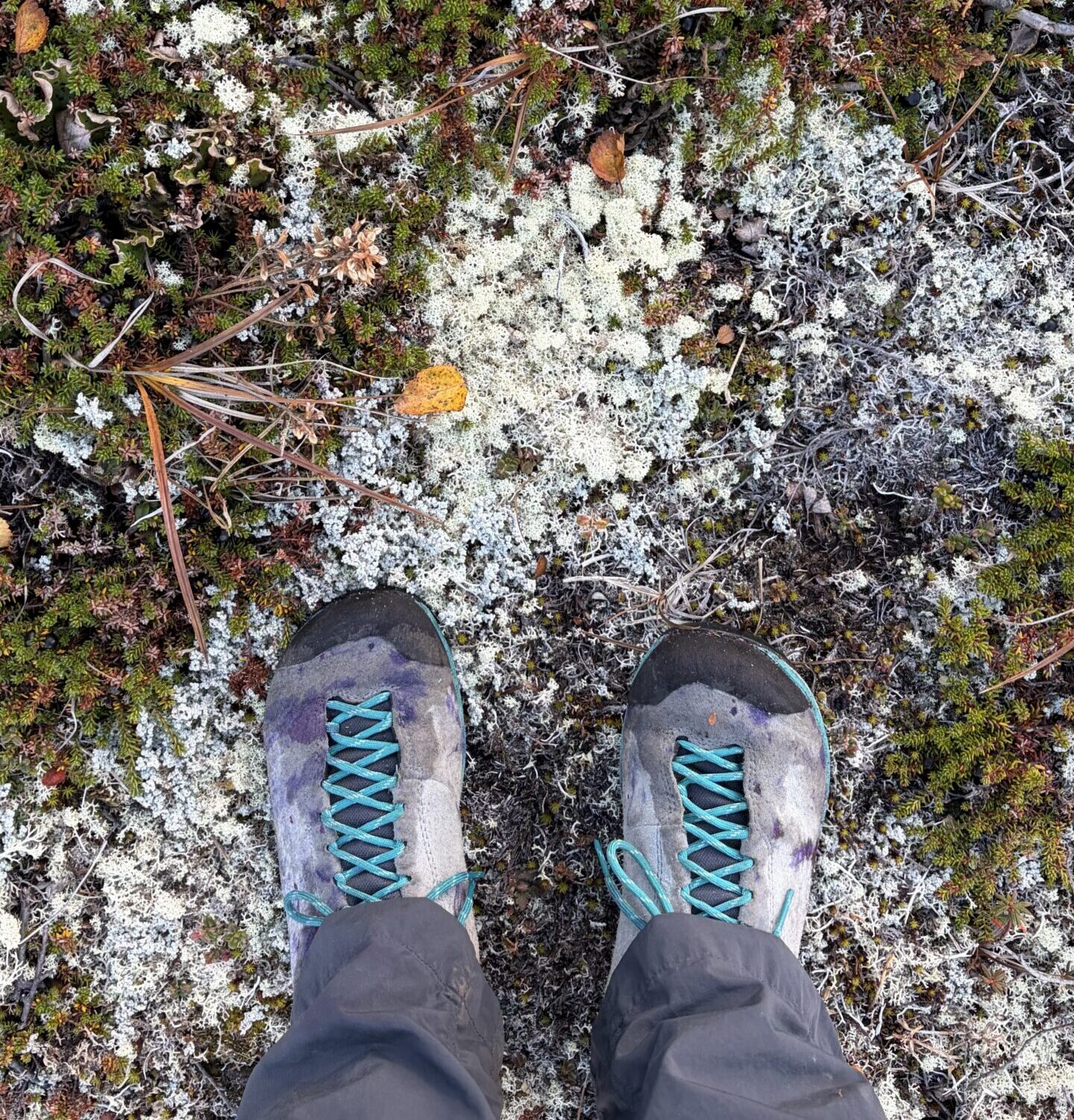
On beings and biomes—lichens and mosses
By Madison Grosvenor
On all my hikes throughout Alaska, while I would love to continually gaze across the endless ridgelines, peer over the treetops of spruce forests, and stare in awe at the winding rivers and cascading waterfalls on the horizon, I am most often staring down at my feet.
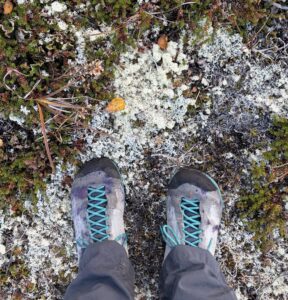
Lichens, mosses, and other tiny worlds at my berry-stained feet. Photo by Madison Grosvenor.
While I do this to avoid tripping and falling, looking downward also sheds a light on the world found on the very rocks and logs I balance upon. A world teeming with life at my feet.
Lichens and mosses coat the landscape. They cling to rocks, creep across fallen logs, and carpet the forest floor, forming intricate little communities easy to overlook.
These miniature ecosystems may lack the grandeur of a mountain range or the constant movement of a river, but they are no less alive, complex, and worthy of our attention.
The more I look down, the more I notice. A cushion of moss is no longer just another feature near my boot. A patch of lichen is no longer just something my hand brushes along as I steady myself on a neighboring tree.
Sometimes, the tiniest landscapes easy to walk by and miss are the most remarkable.
Blanketing moss
“There is an ancient conversation going on between mosses and rocks, poetry to be sure.
– Robin Wall Kimmerer, Gathering Moss
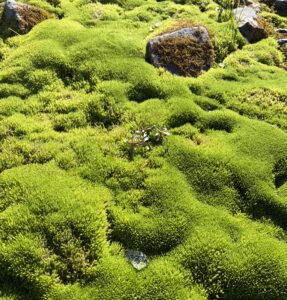
Blankets of moss over rocks. Photo courtesy of Madison Grosvenor.
There are small ancient terrestrial plants that coat the rocks, tundra, and forests around us. This is the magic of bryophytes.
Bryophytes are small plants that do not produce flowers or seeds but rather produce spores. They have no woody tissue and grow only a few centimeters tall.
Fossil evidence suggests ancestors of these plants began to appear in terrestrial environments around 470 million years ago. These plants include mosses and liverworts.
Perhaps you remember running your hand down the soft mats and lush tufts of green moss softening the ground, the rocks, and the trees.
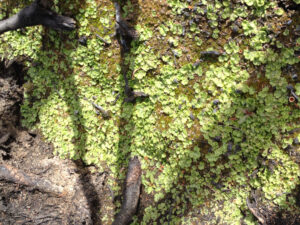
Umbrella liverworts thrive in burned areas and are often the first plants to show up. Photo courtesy of NPS.
Mosses have a leafier appearance than liverworts and hornworts, which are commonly mistaken for mosses. Both small, non-vascular plants grow in similar habitats, but liverworts have flattened, lobed structure compared to mosses. Hornworts are very similar to liverworts, although they can be differentiated by their horn-like sporophytes, which are the structures that produce and release spores for reproduction.
Instead of roots, most of these bryophytes have rhizoids or thread like filaments that extend from the moss body and anchor the moss to surfaces like soil, rocks, and trees.
Bryophytes absorb water and nutrients directly from their surface and transport them directly from cell to cell. They act as natural sponges, retaining moisture and preventing soil erosion.
Living in extremes
Communities of mosses, liverworts, and hornworts thrive in extreme environments, adapting to dry, wet, rocky, and Arctic environments. In Alaska, you will find these plants anywhere from the humid rainforests of Southeast Alaska to the frozen tundra floor. Mosses can even show up in glacier environments, forming gardens in the icy, rocky zones as ancient ice meets ancient plants.
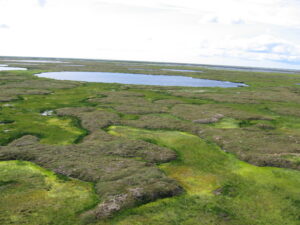
Sphagnum bog in Yukon Delta National Wildlife Refuge. Photo by Fred Broerman.
Sphagnum mosses thrive in Alaska’s wetlands. Also known as peat moss, these shaggy moisture loving mosses grow in waterlogged areas like bogs and peatlands. Low sphagnum mosses help to maintain water levels in Alaska’s bogs and wetlands, even in periods of drought. Their incredible drought tolerance allows them to recover and continue to grow after drying. The ability for sphagnum mosses to retain moisture also means that sphagnum-rich areas can also influence fire severity, limiting the amount of organic matter that burns by keeping things moist.
Sphagnum moss contributes to nutrient cycling by capturing and storing organic matter over long periods of time. As sphagnum slowly breaks down, it forms peat—a layer of partially decayed organic material.
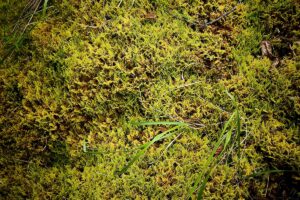
Sphagnum moss carpets much of the boreal forests and wetlands of Denali National Park. Photo courtesy of NPS.
Sphagnum mosses sequester carbon by absorbing carbon dioxide from the atmosphere through photosynthesis, then preserving that carbon in the peat through waterlogged, oxygen‑poor conditions that halt decomposition, creating a stable, long-term carbon store.
These small plants allow for major carbon sinks in peatlands in Alaska’s boreal and tundra wetlands. In other words, these plants keep a lot of carbon from entering the atmosphere where an amassing of carbon emissions has led to impacts like extreme flooding, storms, wildfires, and erosion.
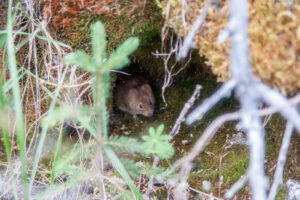
A vole peeks out from its home among the moss. Photo by Kira Heeschen.
While mosses, hornworts, and liverworts help to form larger ecosystems of peatlands and wetlands, they also offer micro-habitats for a myriad of little critters. Voles will burrow into the soft and insulating moss mats to regulate their temperature and hide from predators. Invertebrates like beetles and caterpillars will use moss mats as refuge from wind and cold. Birds in the tundra, like willow ptarmigan, will use mosses for nesting and protection from predators.
From slowing the effects of climate change to lessening the severity of wildfires, these tiny plant communities form a protective tapestry across Alaska’s ecosystems, holding moisture, protecting soil, sheltering critters, and storing carbon as they quietly carry out one of nature’s greatest acts of care within their habitat.
Making a world they can live in
“Rock wools, water fans, earth scale, mouse ears, dust,
ash-of-the-woods.
Transformers unvalued, uncounted.
Cell by cell, word by word, making a world they could live in.”
– Jane Hirshfield, For the Lobaria, Usnea, Witches Hair, Map Lichen, Beard Lichen, Ground Lichen, Shield Lichen
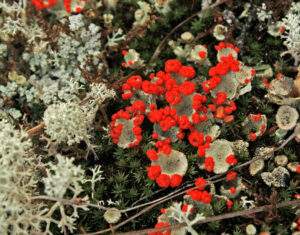
Colorful Cladonia lichen found along the South Fork Koyukuk River in the Brooks Range. Photo by Aart Nugteren.
Crusted, lobed, bearded, curly, flaky, crinkled, hairy, yellow, orange, green, blue, so on—lichens come in an astonishing array of shapes, textures, and colors. Alaska is home to a wonderfully weird world of lichen species, all capable of making quiet changes within their ecosystems.
Lichens are neither plant nor animal. Rather, they are two beings living together as one.
Lichens are organisms that consist of a symbiotic relationship between fungi and a photosynthetic partner known as a photobiont. These photobionts are typically either photosynthetic algae or cyanobacteria.
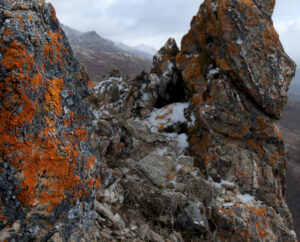
Orange lichen growing on rocks atop Mount Margaret, near Savage River in Denali. Photo by Tim Rains.
This relationship is mutualistic in nature, meaning they both benefit from this partnership. The fungus provides a structure for the photobiont to live in, while the photobiont provides sugars to the fungal partner.
Together, they form something that can live in places where many other organisms cannot.
Lichens grow across Alaska, from intertidal zones to the peaks of the mountains. They can grow on soil, rock, bark, wood, barnacles, and even buildings. They can be pale and branching, leafy and lobed, crusted tightly against rock, or long and hair-like as they hang from forest branches.
Some are wonderfully strange.
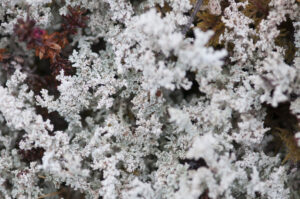
Snow lichen in Bering Land Bridge National Preserve. Photo courtesy of NPS.
Snow lichen is a pale, branching lichen found across Arctic and alpine landscapes. Growing low and close to the ground, it is adapted to Alaska’s frigid tundra. Like many tundra lichens, it contributes to the ground layer of these ecosystems and can become part of the food available to caribou. Snow lichen remains dormant throughout the Arctic winters and resumes growing when conditions warm. Its presence is a reminder that even the seemingly barren expanses of the Arctic are alive with organisms specially adapted to extreme cold, wind, and the long winters.
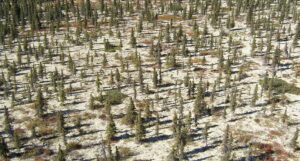
The forest floor isn’t covered with snow. Its reindeer lichen! Photo by Fred Broerman.
Reindeer lichens form soft, branching mats across Alaska’s tundra, boreal forests, and open landscapes. Their pale branches can make entire stretches of ground look frosted even when there is no snow. They are particularly important because they are a major winter food resource for caribou, who dig through snow to reach the nutritious ground lichens.

Methuselah’s beard. Photo by Karen L. Dillman.
In the forests of Southeast Alaska, another lichen creates an entirely different shape.
Usnea longissima, commonly called Methuselah’s beard, forms long, pale green strands that hang from tree branches like pieces of hair. Thriving in humid forest environments, this spectacular lichen depends on healthy forest conditions and can provide structure and shelter for many tiny organisms.
And then there is fairy barf, a favorite of mine.
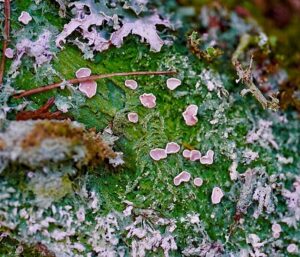
Fairy Barf lichen in Tongass National Forest. Photo by Jenna Wilson-Ashby.
Instead of forming a flat crust or a larger leafy body, these lichens can create delicate, powdery or branching structures that look almost otherworldly, with dustings of mint green and dots of pastel pink. They can be found on exposed soil, rock, and disturbed or otherwise harsh environments, participating in the slow process of building and changing the surfaces of stone and wood on which other organisms will eventually grow.
Whimsical as they may appear, these lichens can be among the first organisms to colonize difficult habitats in Alaska.
Turning rock to soil
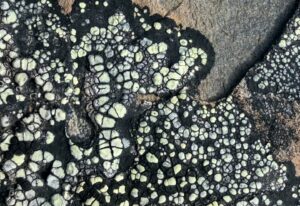
Yellow map lichen on a rock in a boulder field. Photo by Madison Grosvenor.
Lichens are usually the first species to show up in areas considered “barren” or devoid of other vegetation and organisms.
They are the first organisms to show up on bare rock surfaces, volcanic deposits, and even glacial till. The fungal component of lichens will physically attach to rock surfaces. Then, through a process called chemical weathering, the lichens secrete organic acids that slowly break down the minerals in rocks, dissolving rock over long periods of time.
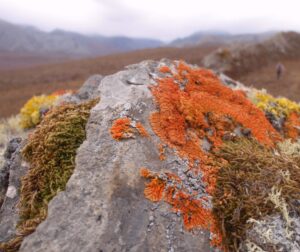
A variety of lichen and moss grows on a rock in Noatak National Preserve. Photo by NPS.
In addition to chemical weathering, the lichens will also cause the physical breakdown of rocks through factors of expansion and contraction. As lichens grow, they go through periods of hydration and dehydration when the lichens’ tissues swell and shrink, creating stress on the surface of the rock and causing small cracks and wear. The root-like structures called rhizines will penetrate these cracks and, as the lichen continues to grow, exerting further pressure, widening the cracks and continuing to break down the rock.
The breakdown of these minerals then initiates the formation of soil in these ecosystems.
Additionally, when lichens die and decompose, they add organic matter to the weathered rock, forming a thin layer of primitive soil on these surfaces that serves as a foundation for vegetation like mosses to grow.
Pollutant gauges
Lichens are extremely sensitive to their surrounding environmental conditions. When the conditions are wet, they hydrate and become physiologically active. When things are dry, they become physiologically dormant. They absorb atmospheric nutrients in order to meet their own mineral requirements and are able to live independently from soil, allowing them to live in extreme habitats like the surface of rocks or branches of trees.
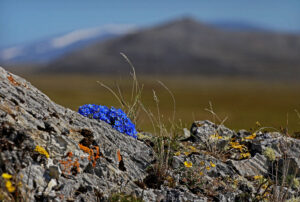
Lichens and forget-me-nots. Photo by Emily Mesner.
Lichen’s responsiveness to atmospheric conditions and ability to take in airborne substances also means that they absorb pollutants, too. Rises in sulfur dioxide levels pose direct threats to lichen species themselves. Some sensitive lichen species develop actual structural changes in response to air pollutants, including reduced photosynthesis, bleaching, the death of the lichen algae, discoloration, reduced growth, or even death.
Lichens are living monitors of air –quality. Scientists have been using lichen species as bioindicators for monitoring the extent of air pollution.
This is especially useful in Alaska, where lichen communities are being used to monitor mine-related and dust-borne heavy metals along the Red Dog Mine haul road. Because lichens absorb substances directly from the atmosphere and surrounding environment, they can accumulate contaminants that might otherwise be difficult to see. It was discovered that lichen abundance and cover had significantly reduced within 4000 meters of the haul road. Bryophytes additionally showed diminished diversity near the haul road.
Nitrogen pollution from fertilizers, fossil fuel combustion, and industry threatens our planet. Lichens can sequester or hold nitrogen, meaning that scientists can use certain lichen species to determine how much nitrogen is present, helping to make otherwise invisible but harmful pollutants visible.
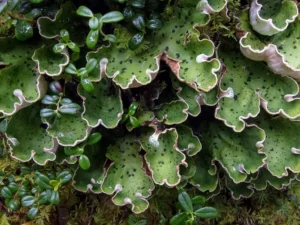
Freckle pelt lichen. Photo by James Walton.
Some lichen species’ cyanobacterial partners can turn atmospheric nitrogen into usable nitrogen compounds, which can enter the soil and food web and support plant growth and nutrient cycling. This essentially enables the nitrogen emissions to become part of biological systems and actually benefit them. Without this conversion to usable nitrogen, atmospheric nitrogen would remain inaccessible and even harmful to most life forms on Earth.
Freckled pelt lichen, a leafy, lobed lichen that often grows over moss, soil, rocks, and beneath trees, is one of many lichens capable of participating in nitrogen fixation. It introduces usable nitrogen into ecosystems where nutrients may otherwise be scarce.
Many things at once.
A lichen can be many things at once. It can be the first species to populate bare rock, beginning the slow process of soil formation. It can gather nutrients from the atmosphere. It can fix nitrogen and contribute to nutrient cycling. It can provide food for caribou and structure for tiny organisms. It can record pollutants in the air and accumulate contaminants from the environment around it.
And yet lichens face challenges from a changing landscape.
In parts of Arctic and northern Alaska, lichen abundance has declined as shrubs expand and wildfires become more frequent and extensive. Lichens grow incredibly slowly, so a landscape altered by fire may take decades to recover its lichen communities. Warming can also change the balance between lichens, grasses, shrubs, and other plants, gradually replacing the open ground where northern lichens thrive.
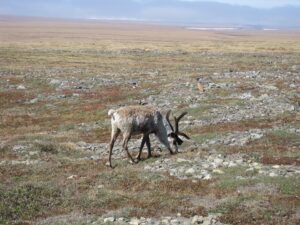
Caribou feeding on lichens in Bering Land Bridge National Preserve. Photo courtesy of NPS.
Because lichens are a critical food source for Arctic caribou herds, changes in lichen abundance can affect the populations that depend on them. Those changes may ripple outward through ecosystems and potentially create significant consequences for both the wildlife and subsistence communities that rely on these herds.
To the untrained eye, lichens may seem like intricate backdrops in a larger landscape, but they are in fact participants in making those landscapes. They weather rock into nutrient rich soil, gather nutrients from the air, reveal pollutants in our atmosphere, and fix pollutants into usable forms that nourish and form the foundations of entire ecosystems. Their bodies record the conditions of the world around them as they continue to shape those conditions in return.
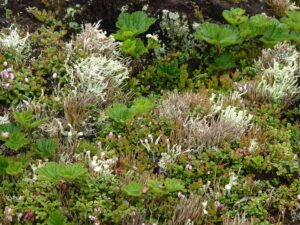
Flowers in the Andreafsky Wilderness, Yukon Delta National Wildlife Refuge.
Photo by Kristine Sowl, USFWS.
Snow lichen survives the cold. Reindeer lichen sustains caribou and, in turn, Arctic communities of life. Methuselah’s beard populates the branches of Alaska’s forests. Fairy barf spreads across otherwise barren surfaces in strange little bursts of color. Freckled pelt lichen quietly contributes fixed nitrogen to the world around it.
This is what makes lichens so extraordinary. They are small, slow to grow, easily overlooked, yet their existence stretches across boundaries. Between fungus and algae, rock and soil, air and earth. Cell by cell, they take in what is scattered throughout our world and turn it into something in which life can thrive.
Why I look down
Maybe this is why I look down. What began as an attempt to prevent injury has become a way of noticing whole worlds beneath my feet. Mosses holding water, lichens breaking down rock, tiny communities quietly making places possible for everything else that comes next.
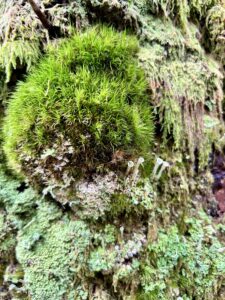
Mosses and lichens on a tree stump. Photo by Madison Grosvenor.
Mosses and lichens remind us that making a world we can live in does not always look like grand gestures. The work is slow; it can even seem invisible. But it is work. It is holding water. Building soil. Sharing and redistributing resources. Making room for another life to take shape.
Perhaps we could learn something from that. We, too, are active participants in the landscapes we move through. We alter them with every step we take, choice we make, and community we help build. If we can learn from the mosses and lichens, we should be able to make a world for ourselves that also makes a world where others can live and thrive, too, leaving even a piece of it better than we found it.
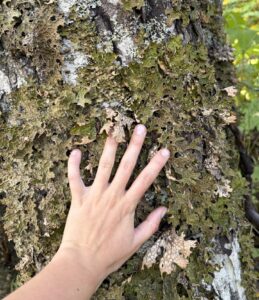
Lungwort on a tree stump. Photo by Madison Grosvenor.
Next time you find yourself staring down at your feet, look closer. There may be a whole world there, quietly showing us how to make a better one ourselves.