


On beings and biomes—the translucent bear
By Dawnell Smith
In Phillip Pullman’s “The Dark Materials” books, the mighty polar bear finds himself exiled from his kingdom. Humans trick him into drunkenness, so they steal his armor, the very source of his soul and strength.

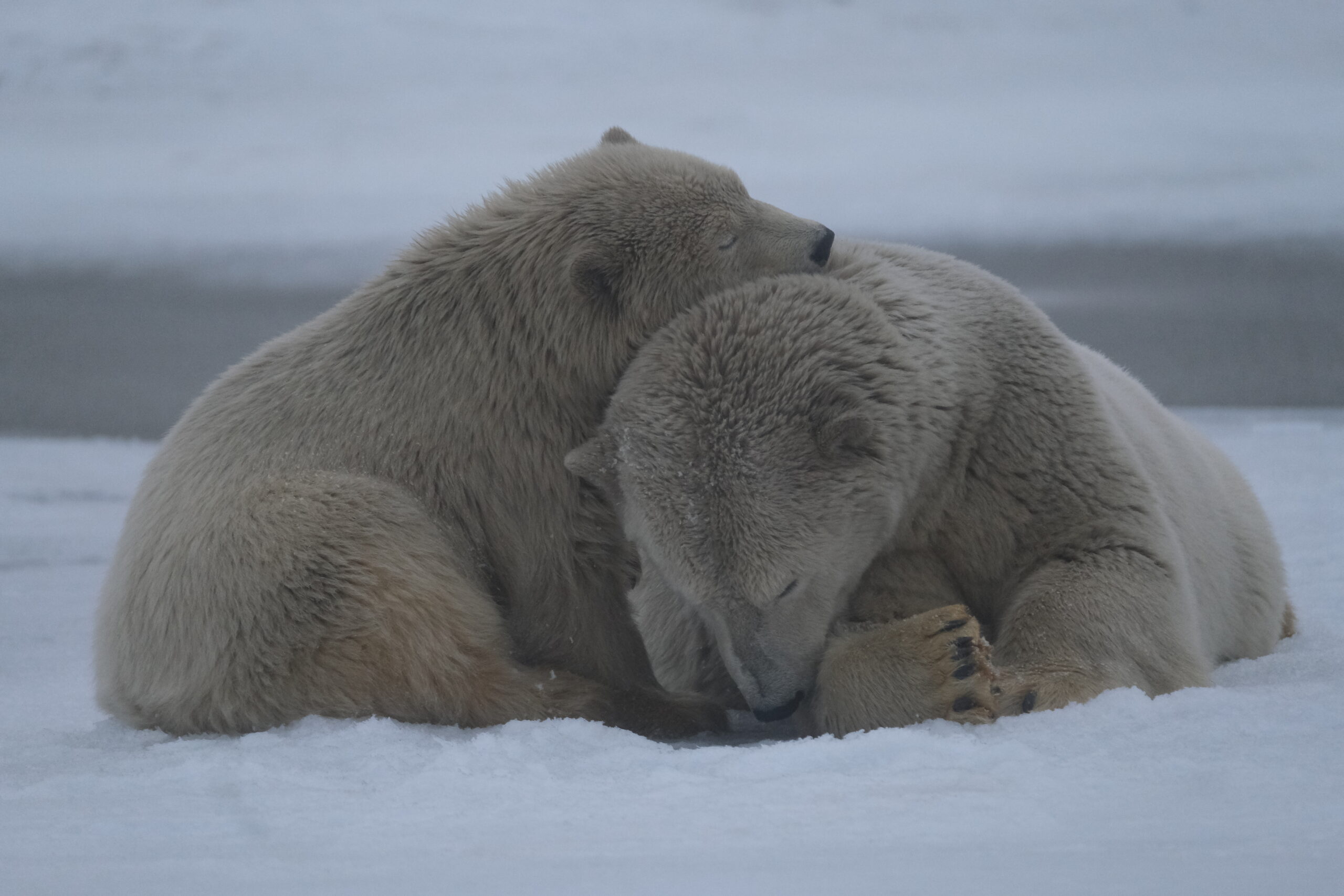
A sow and her cub move in for a cuddle. Photo by Ragen Davey, Defenders of Wildlife.
The principled, charismatic Iorek Byrnison is just a character in a fantasy adventure story, but industrialization has stolen the polar bear’s armor. The relentless encroachment into Arctic regions to drill and mine, plow over and extract, along with the relentless production of carbon pollution extraction and burning fossil fuels generates, has led to devastating sea-ice loss that threatens the health and survival of polar bears across the globe.
It’s easy to cherish the iconic megafauna that is the polar bear—you can find chubby stuffed polar bears and polar bear Valentines in a store near you—but true love means recognizing that this largest of all bears on Earth faces a perilous future and our unfettered, unrelenting industrial expansion is responsible for it.
True love means showing up for them.
Made for ice and 40 below
Polar bear and two cubs on ice floe. Photo by NOAA.
Polar bears belong on ice.
They’re classified as marine animals— the Latin term, ursus maritimus, means sea bear—but they’re also the largest land carnivore, outweighing even the giant salmon-fed Kodiak brown bear. Adult female polar bears reach up to 650 pounds, males up to 1300, though researchers have estimated bears as heavy as 1700 pounds.
These animals can stand 5 feet tall when on all fours, ten feet when standing on their hind legs, but their ears and tails are short and compact to prevent heat loss. With two layers of fur and up to five inches of fat, they can stay warm in and out of the water.
Their teeth are uniquely adapted to their diet of mostly ring and bearded seals, and their wide paws up to nearly a foot across can paddle upward of six miles per hour and for days at a time. The papillae covering their footpads let them grip the ice, and their sharp, thick, curved claws allow them to grab and hold seals.
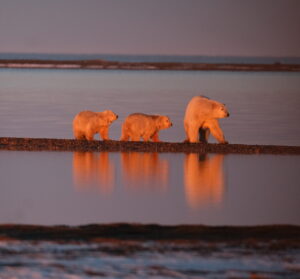
A sow and two cubs walk the shoreline. Photo by Ragen Davey, Defenders of Wildlife.
Polar bears do not hibernate, though they might seek shelter periodically, and female polar bears will stay in dens without eating for up to eight months to give birth and nurse their cubs, who can’t survive outside for several months.
Scientists have found that the main cause of death of cubs is the lack of food or the lack of fat on nursing mothers. Over the last 50 years, female polar bears in Hudson Bay, Canada, have lost 86 pounds on average, according to one study from 2025. Whether polar bears even get pregnant depends on whether they can fatten up
The very ways these bears evolved to thrive in the Arctic—their armor, if you will—has been stolen by the devastating reshaping and degrading of their habitat by the fossil fuel industry and our fossil fuel dependent economies.
Alaska’s polar bears are struggling
Polar bears fall into 19 subpopulations across Canada, Greenland, Norway, Russia, and the United States, with some of the most vulnerable populations found in Alaska’s Arctic. Last year, the U.S. Fish and Wildlife Service released a draft estimate of these populations that put the Southern Beaufort Sea population at 819 bears and the Chukchi Sea population at under 3,000. Even those estimates prove unreliable since they rely on 2016 data, and polar bears are difficult to count because of the cost and logistics of trying to track beers constantly moving over remote Arctic regions.
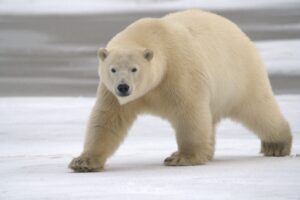
Polar bear walks across the coast of Kaktovik. Photo by Ragen Davey, Defenders of Wildlife.
Globally these two populations of polar bears are the most vulnerable, though all polar bears face existential challenges in finding fat-rich food and sustaining health while also ingesting more contaminants from oil spills and industry, as well as global toxins carried north in air and water.
“With less ice, polar bears are increasingly stranded on land for extended periods, leading to malnutrition, lower reproduction rates and higher mortality among cubs,” wrote Ragen Davey in a review of these recent estimates.
Davey works as the Alaska marine representative for Defenders of Wildlife and spent time last year working on a polar bear identification project in Kaktovik on the Southern Beaufort Sea. The program uses photography to determine whether the number of bears relying on community whale hunts for food is increasing. Whale carcasses can nourish polar bears, but when bears go near towns to eat, they are also facing more conflicts with people.
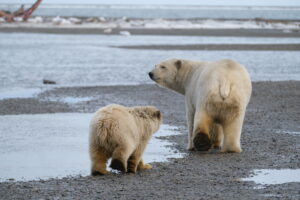
Sow and cub walk the coastline, searching for food. Photo by Ragen Davey, Defender of Wildlife.
For Davey, who previously assessed and removed contaminants in Alaska’s Arctic and did environmental work with Alaska Native Tribes, developing relationships and collaborations with the community of Kaktovik to understand the climate impacts on polar bears felt like a dream come true.
“My parents always tell me that from about 6 years old on, when people asked me what I wanted to do for work, I said I would save the polar bears,” she said. “The draw I have to polar bears has guided a lot of my life decisions.”
Davey grew up to make science her career and use what she learns, knows and studies to advocate for polar bears and explain their plight to others. Helping polar bears survive means helping others understand why these bears who occupy our imaginations should also occupy our hearts and minds when we make decisions.
“It’s easy to think the bears are far away and these big changes won’t matter, but the polar bear is the apex predator, and every other animal population and species will suffer as they suffer,” she said. “The ripple effects reach us all.”
One thing after another
Davey and other polar bear researchers and advocates emphasize that the cumulative impacts of many threats put polar bears at particular risk. People understand that they shouldn’t eat too much canned tuna because of the mercury, she said, and the same goes for animals like polar bears.
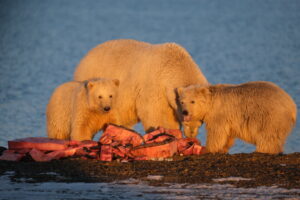
The family unit feasts on a pile of whale blubber. Photo by Ragen Davey, Defenders of Wildlife.
Industrial activities of all kinds, from thumper trucks pounding the land with seismic blasts while looking for oil and gas to the operation of drilling rigs and industrial roads and pipelines bring toxins, contaminants, landscape degradation, and industrial noise. Spills and pollution in the Arctic affect polar bears directly, but heavy metals like mercury, pharmaceuticals, heating oil emissions, synthetic forever chemicals, and many other toxins move by air to the Arctic ocean where they’re consumed by fish who are eaten by seals who are hunted by polar bears.
This biocontamination can accumulate in organs like the liver and brain, in turn weakening the immune system, disrupting the endocrine system, and impairing reproduction. When polar bears forage on land to survive and eat foods other than the seals they’re adapted to eating, they’re more exposed to disease-causing pathogens.
With all these burdens in play, how can they adapt to a lack of sea ice and their best food source for longer periods of time while also coping with a weakened immune system? How can they fatten up when fighting off parasites and viruses? How can their populations sustain themselves when fewer cubs are born or survive?
Polar bears already take shape in our imaginations as a powerful metaphor for strength and wildness; they also now symbolize the devastating consequences of refusing to acknowledge and address the warming Arctic’s harmful impacts on us all.
Are polar bears doomed?
A study by Nature Climate Change in 2020 concluded that most polar bear subpopulations would go extinct by 2100 if nations took no action to curb carbon emissions and refused to change their “business as usual” approach to fossil fuel use and extraction. We’re no longer in a “business as usual” in U.S. policy—we’re in a reckless industrial blitzkrieg—but the main takeaway remains the same. The pathway to protecting polar bears and Arctic life requires two things of us: protect where these bears live and reduce carbon pollution.
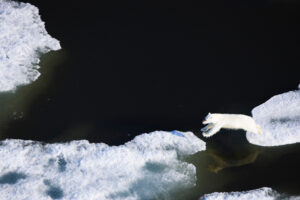
Polar bear leaps from floe to floe. Photo by Florian Schulz.
Our work to protect the Arctic centers on providing clients, partners, the public, and, yes, polar bears and sea ice a legal voice in agency processes and in court. Polar bears are listed as threatened under the Endangered Species Act, and multiple laws require wildlife habitat protection for the wellbeing of local communities and the public at large, but clearly corporate and political interests will do everything they can to evade, distort, ignore, and gut those laws.
This work we do together still matters. In Svalbard, the setting for the polar bear’s kingdom in those “Dark Materials” books, there has been a huge drop in sea ice since the early 1990s, yet polar bears have gained weight since 2000. The authors of the study published in Scientific Reports can’t say for sure why the 770 bears on the remote Arctic island 500 miles north of Norway in the Barents Sea seem to be holding their own, but they believe several things could explain it.
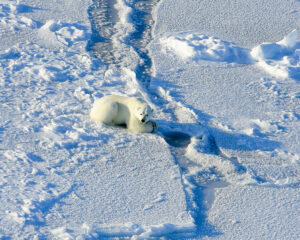
A polar bear hunts at a seal breathing hole. Photo by Mike Lockhart, USGS.
First, seals are congregating around fewer ice shelves, making it easier for polar bears to hunt them. Second, and maybe more heartening, the Svalbard polar bears have been hunting walruses and reindeer, two species whose populations were on the brink of extermination until people advocated for their protection.
Norway banned the commercial hunting of walruses for ivory in the early 1950s and adopted policies to reduce hunting pressures on reindeer in the 1920s. Both populations rebounded.
Asking, “are polar bears doomed” is the wrong question. The right one is, “how do we fix what we broke?”
Translucence
One more cool thing about polar bears: Their skin is black and absorbs heat, and their fur isn’t white, it’s translucent. Their fur lets the appearance of the environment pass through, said Davey. On snow and ice, polar bears look white. On land they can take on hues of brown, gray, yellow, or green. They may look as if they’ve been rolling in dirt, but they’re in fact reflecting the environment.

A cub looks across the water. Photo by Ragen, Davey, Defenders of Wildlife.
There’s a lesson in that. What’s happening to polar bears reflects on our past and future, too. Sea ice loss challenges the food and ways of life of Arctic communities. Warming rivers and streams have made it hard for people to find salmon. Contaminants show up in the food and water people consume. Erosion, flooding, and severe storms destroy human habitats.
Despite all we know, what we’re witnessing right in front of us, and what we see coming, decision makers continue prioritizing unsustainable economies and a destabilizing denial of facts to clutch “business as usual” and put corporate profits over the wellbeing of local communities of life.
Countering this delusional notion of “wealth” or “progress” with a shared armor forged on caring for each other and all beings can make a profound difference. It’s a human child, Lyra, who uses her truth-telling device to show Iorek Byrnison where his armor is hidden, so that he can retrieve the source of his strength and soul–and his kingdom, too.