


Stacy Studebaker—the pull of sand and sea air
By Dawnell Smith
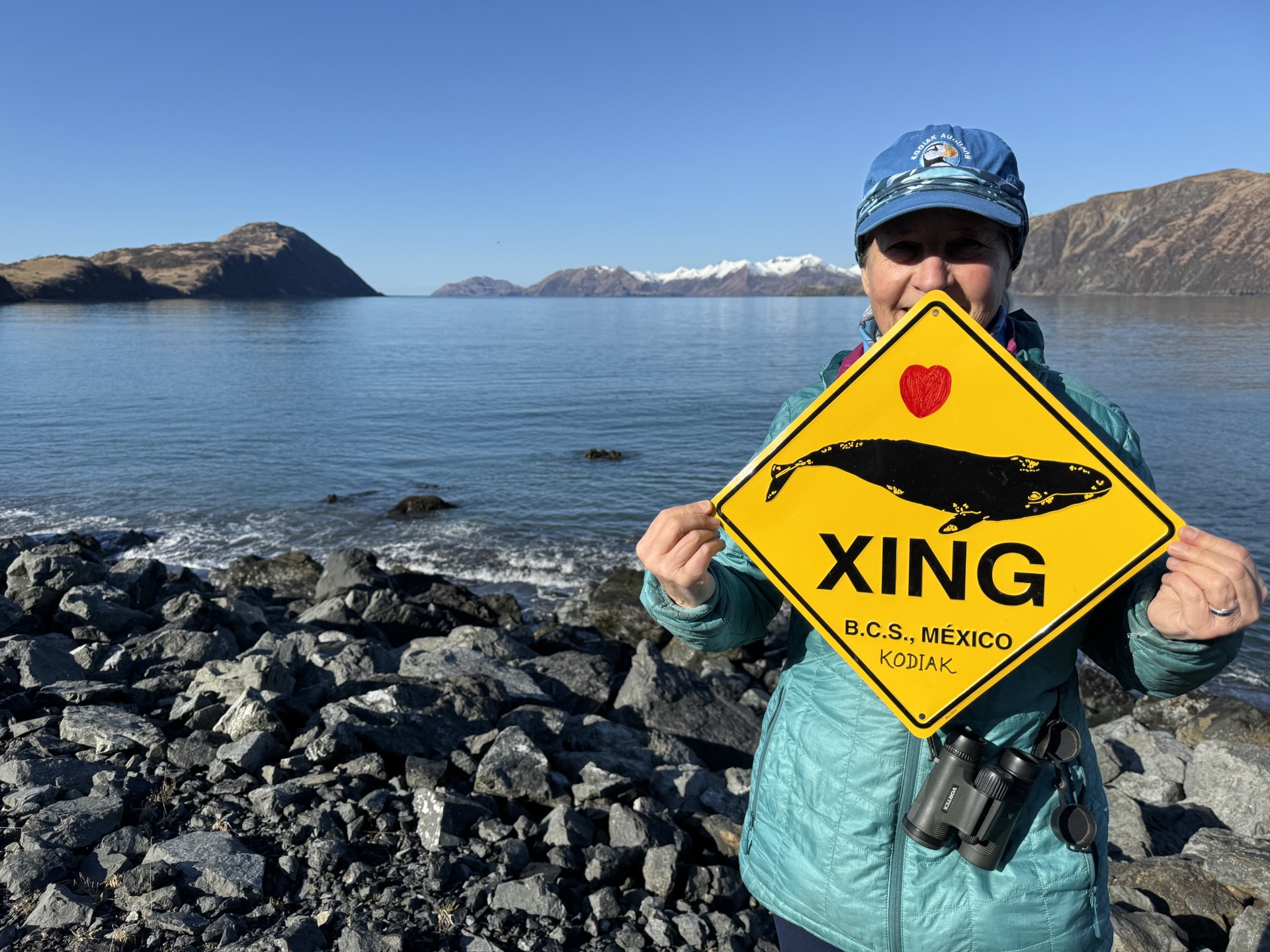
Come summertime, Stacy Studebaker and her husband Mike Sirofchuck drive 40 miles south from their home in Kodiak to their cabin on Pasagshak Bay to hike, fish, and watch birds and gray whales off the beach. The place beckons her—the sea water, whales, birds, forest, coastal plants, the whole lot of it.
Stacy in Pasagshak Bay in 2023. Photo by Mike Sirofchuck.
The first five formative years of Stacy’s life spent “running around mostly naked on a beach in La Jolla,” she said, where her relationship with sand and sea air found purchase in her heart and bones.
Her family sold the house and moved east for work, but the ocean never fell far from her horizon. Studying in New Hampshire or taking a job in Alaska were inevitably paths to the sea. During one influential period in the early 1970s, after graduating with degrees in biology and fine arts, Stacy went to Yosemite National Park where her mother did public relations work for the concessionaire, Curry Corporation.
“I worked for an environmental education school that my mom helped start called the Yosemite Institute and that’s where I got my grounding in national parks,” she explained. “Thank goodness, because once again, circumstances really set me up for conservation and appreciation for national parks and public lands.”
Thus, her journey to a remote island in Alaska had begun.
Alaska bound
In Yosemite she grew obsessed with John Muir and read everything she could find. Once she got to his writing about Alaska, she knew she must head north. Her time in Yosemite led to a gig in Glacier Bay National Monument (now a national park and preserve) doing botanical research with the late Greg Streveler, a biologist who became a mentor to her. That role evolved into summer positions as a field botanist and then ranger naturalist.
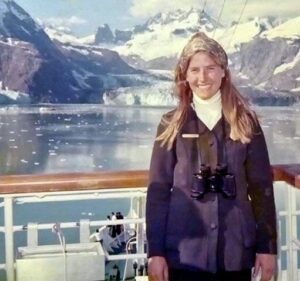
Stacy wears the polyester pantsuit park service uniform in Glacier Bay National Park. Photo courtesy of Stacy Studebaker.
“That was when women still had to wear the polyester pantsuit from the 70s,” she said. “Can you imagine? Who do you think people listened to when they walked up and saw you in a pantsuit next to a guy in the traditional park service uniform?”
Eventually her mentor Streveler recommended Stacy for a research project on how to expand the bare bones campground in Katmai National Monument (now a national park and preserve) in a way that would keep people and bears safe. Her task involved interviewing people arriving at Brooks Camp on Grumman Goose amphibious airplanes. “We had so few folks visiting the park back then that I could meet every tourist at the beach,” she noted.
She had already started graduate studies in environmental education and secondary science education in New Hampshire by then, working summers in Katmai as a seasonal ranger and naturalist while finishing her degree. Along the way, she jumped at every opportunity for adventure. When another storied biologist, the late Will Troyer—who people sometimes called the “bear wrangler” for his work collaring bears—asked her to help him with a survey of animal populations, she eagerly hopped on board.
“He had a Super Cub and would fly coastal surveys to count eagle nests and mountain goats, so the plane would dip and turn, and luckily I had a strong stomach” she said. “One time, we were flying the coast along Shelikof Straight when I looked east and asked, ‘What’s that big island over there?’”
Kodiak.
A teaching legacy
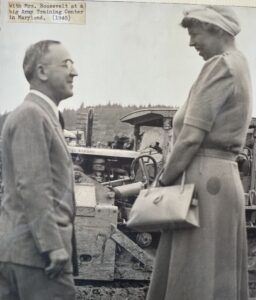
John Ward, Stacy’s grandfather and the Commissioner of Education, with Eleanor Roosevelt in 1940. Photo courtesy of Stacy Studebaker.
Stacy came to teaching like she did to the coast. Her grandfather, John Ward Studebaker, served as U.S. Commissioner of Education from 1934 to 1948 and chairman of the U.S. Radio Education Committee. She talks about his work with pride because of what he achieved and also because of her belief in how education enriches people’s lives and helps build and sustain communities.
“He devoted much of his time to children’s literature and arithmetic and built countless public schools and libraries across the nation,” she said.
She took a similar path, but her calling took her to sand, mud, bones, and botany rather than policy meetings and state dinners. With a graduate degree in hand, she looked far and wide for teaching jobs in Alaska and caught one in Kodiak where she taught high school biology and earth science from 1980 to 2001.
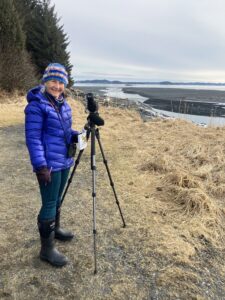
Stacy birding at the mouth of the Buskin River in 2026. Photo by Mike Sirofchuck.
Retiring from full-time secondary teaching didn’t temper her insatiable curiosity and drive for learning and sharing knowledge.
Alaska writer and educator Nancy Lord has known Stacy as a botanist, birder, artist, writer, and friend since they served on the Alaska Conservation Foundation board together. Lord remembers how they both peered with delight when they found a small brown bat resting on the windshield of the car after finishing a hike.
“She’s a lifelong learner and lifelong teacher,” said Lord. “She brings an artist’s eye to everything she sees and does. I’ve really loved the times she discovered a new or unusual plant and dropped to her knees to examine and photograph it. Her enthusiasm is contagious.”
It comes as no surprise then that at a little place called Pasagshak, while at a friend’s cabin in May 2000, Stacy saw a dead gray whale washed up on the beach and felt the pang of loss, but the sense of wonderment and possibility.
“I wonder if there’s some way we can preserve and display this skeleton?” she thought.
Gordie the whale
Stacy’s dad John “Gordie” Studebaker loved to fish, and he and his daughter spent a lot of time together fishing and being outside across the Lower 48. She lost her mother when in her early 20s, but once she made Alaska home, Gordie adopted the place, too. He visited summer after summer and was there when that whale washed up. Surely, he knew by then that if his daughter got an inkling to do something, she would do something.
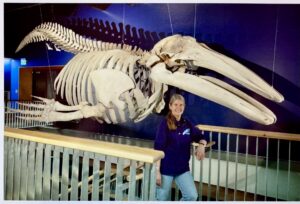
Stacy with completed whale skeleton in Kodiak visitor’s center, 2007. Photo by Jan Pennington.
The whale bone project that ensued took years to complete, but Stacy’s vision, relationships, and tenacity saw it through.
Cindy Trussel, who met Stacy shortly after arriving Kodiak in 2005 to chair the Natural Sciences Department at Kodiak College, put it this way. “Whenever she felt strongly about an issue, she would take it and run with it. Her professionalism and attention to detail meant you always knew things were in good hands.”
The story of how that whale became a collective community project has been told often, directly by Stacy when sharing the story at the visitor center or in this U.S. Fish and Wildlife Service video.
The project took seven years, at least 100 people, endless patience, and a good deal of logistical doggedness to get the whale bones from the beach in Pasagshak to the Kodiak National Wildlife Refuge Visitor’s Center.
Rather than remove the whale’s flesh by hand, they moved the body into a deep pit near where the whale washed up. It took four years alone for nature to do the work of decomposition. It took another few years for the bones to fully leach fats and be reassembled, and of course countless hours over many years to organize and coordinate resources and volunteers, work with the refuge staff, and consult with the building’s architect to make sure that the space made for the whale could hold its breadth with grace.
They finished installing the whale skeleton on the evening of Halloween, 2007. Outside in the dark, trick-or-treaters stood outside the window gazing into the brightly lit room with awe, as if wondering, “What manner of beast is that?”
Gordie the whale skeleton has inhabited the visitor center ever since.
A Kodiak aesthetic
Stacy kicked off retirement with the whale project underway, but she had plenty of other projects to do and roles to play, One book project involved documenting the plant life of the Kodiak National Wildlife Refuge. She spent ten summers from 2005 to 2015 doing field work, with her husband Mike doing bear watch duty, and the U.S. Fish and Wildlife Services providing support.
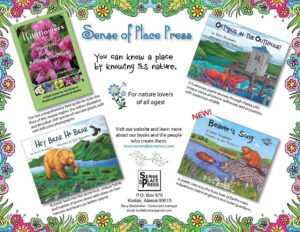
Stacy’s books! Photo courtesy of Stacy Studebaker.
“Botanists are on their hands and knees all the time, so you’ve got to have someone paying attention to everything else,” she said, “but we never had a problem with bears.”
In those days, the agency had funds, aircraft, and pilots to support that kind of field research, she said. “Again, I had lucky timing so I could explore the refuge, and we could land and make camp as I collected, pressed, and researched the plants.”
On the advice of another renowned field guide author, the late Verna Platt, who authored books on the Wildflowers of Alaska, Stacy created her own publishing company, Sense of Place Press, and released “Wildflowers and other Plant Life of the Kodiak Archipelago” in 2011. In the years that followed, she wrote three children’s books illustrated by Kay Underwood, including “Hey Bear Ho Bear,” “Octopus in the Outhouse!” and most recently “Beaver’s Song.”
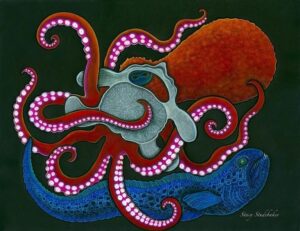
Stacy’s artwork sells in various places in Kodiak. Artwork courtesy of Stacy Studebaker.
But with a fine arts degree and lifelong love of making art, Stacy also brought her relationship with the coast into art. She had dabbled with paint, stain glass, and clay, but when she took a workshop with storied Alaska artist Ray Troll, she found her chosen medium in colored pencil on black paper.
Her vibrant prints of coastal life sell in Kodiak, including at the Alaska Geographic Store in the Kodiak Refuge visitors center and the Alutiiq Museum.
Sifting nourishment from mud
With a life spent with nature, it should come as no surprise that another of Stacy’s enduring legacies is her contribution to protecting the creatures and places she loves and embraces as family and depicts in her writing and art. She has volunteered throughout her life and donated to many groups, including to Trustees for Alaska since 1994.
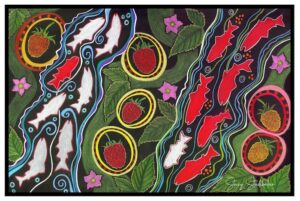
Fish and berries. Artwork by Stacy Studebaker.
Erik Munk met Stacy back in the early 1980s when at a mutual friend’s house in Kodiak talking about how to start a local Audubon chapter. Stacy served for a time as president of that chapter and as the conservation chair.
“When it comes to tackling conservation issues,” said Munk, “she is very focused, strategic, articulate, and reasonably relentless.”
Stacy has volunteered at the Kodiak Refuge visitor center and on Kodiak Refuge projects, including to help organize the Audubon collaboration with the refuge for World Migratory Bird Day after the refuge lost its avian biologist, noted Munk.
Stacy’s father Gordie, who died in 2009, also supported Alaska organizations and left a bequest to Trustees, and her family has contributed to education and conservation programs that benefit communities across the state.
“I am so dedicated to Earth,” she said. “My husband and I live on a cliff over a bay, and we can see sea lions and otters right outside our house. I dedicate myself to advocacy and education every day because they are our family, all these creatures, these places. I walk every day in the spruce forest and just saw a bear on the trail the other day. That’s my life. I rarely have my feet on anything that’s not natural.”
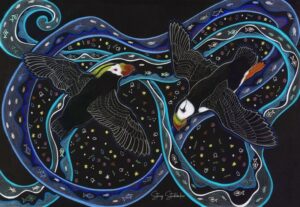
Stacy’s artwork features a variety of coastal marine life. Artwork by Stacy Studebaker.
A remote island life may sound primitive, even deprived, she said, “but we’re set up with resources, with 99 percent of our electricity through wind and hydro, so it’s sustainable. We fill our freezer with salmon and halibut, and my husband just got a deer this weekend, and I garden.”
In other words, it’s a life of abundance grounded in a relationship with the fullness of the community she calls home, from the island’s Coast Guard base and public land agencies to its fishing and arts cultures and, yes, bears, birds, and whales.
Trussel met Stacy while they both served on the Kodiak Audubon board and said that Stacy’s superpower, is the “unwavering belief that people can make a difference, and she truly lives her life that way. She is deeply passionate about protecting the natural world, particularly plants and birds, and ensuring their habitats are preserved so they can thrive.”
That belief doesn’t mean Stacy doesn’t worry about the future. These days, she ponders about a time when the whale skeleton she ushered into view at the visitor’s center will become an artifact.
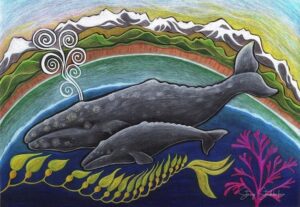
Stacy’s artwork centers on coastal life. Artwork by Stacy Studebaker.
“These whales are in trouble,” she said. “Estimates are hard, but from 2016 to now, the population has dropped from about 27,000 to 12,000, and it’s probably worse than that.”
As bottom feeders, gray whales feed closer to shore near human infrastructure and industry, scooping up mud that they filter for food. Many are dying of starvation due to climate change impacts in their Arctic feeding grounds. Their long migrations take a toll. Some die from collisions with ships, entanglement in fishing gear, the impacts of Navy sonar, predation by Orcas.
Stacy has set her mind to do everything she can to protect these whales, whatever lays ahead. For now, the gray whales return to their favored bay every summer to feed.
Stacy’s there, too, at her cabin, listening and keeping watch.