


Stopping an unconstitutional Mulchatna bear killing program before it reloads this spring
By Madison Grosvenor
Early this month, we filed an emergency motion asking the court to stop an Alaska Board of Game program that aims to kill an unlimited number of brown and black bears across roughly 40,000 square miles in southwest Alaska this summer. We challenged the Mulchatna predator control program as unconstitutional in late 2025; this month’s filing seeks a court order that prevents the gunning down of bears while that case moves through court.
Timing is everything. Without quick action from the court, the State could restart the aerial gunning down of bears in weeks.
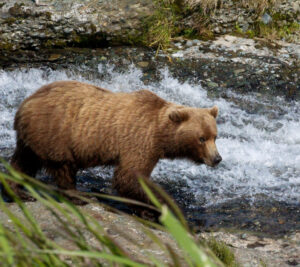
Bear looks up from McNeil River. Photo by Madison Grosvenor.
“The State is once again primed to gun down bears from helicopters this spring even though it still has no idea how many bears live in the targeted area,” said Michelle Sinnott, our lead attorney in the case, in last week’s press release. “The Alaska Constitution requires the State to manage bear populations sustainably. Instead of collecting credible scientific evidence of bear populations, the Board of Game once again gave the Department a blank check to kill bears across an entire region. That’s exactly the kind of unconstitutional, shoot-first management the court has already rejected.”
Unfounded in science and unconstitutional
This latest filing is a preliminary step in the lawsuit we brought in November 2025. Our case challenges the Board of Game’s decision to revive the program despite prior court rulings finding it unconstitutional.
At the heart of the case is a simple principle. Sustainable bear populations are constitutionally protected in Alaska. The Constitution requires the Board to ensure that bear populations targeted by predator control programs are managed sustainably. Over a year ago, the Court held that the Board needed credible scientific evidence documenting brown and black bear populations to comply with the constitutional sustained yield requirement.
The Board’s current program again fails to meet that requirement.
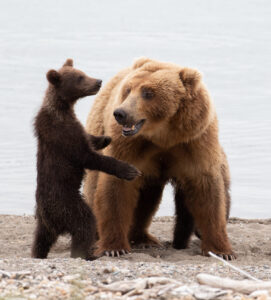
Brown bear and cub in Lake Clark National Park and Preserve. Photo by Peter Pearsall.
Instead, the Board has authorized a bear killing program — named after the Mulchatna caribou herd — that allows Fish and Game to gun down an unlimited number of bears without setting a minimum population baseline or any meaningful limits on how many bears will be gunned down.
Even more concerning, the program defines success only by how many caribou calves survive, not what’s needed to maintain the bear population. First, assuming calf mortality as only related to predation and, second, failing to meaningfully consider the impact on bear populations.
Several studies have identified habitat degradation and disease as significant contributors to the herd’s decline. Specifically, poor body condition in female caribou, indicative of nutritional stress, and the spread of brucellosis, a disease leading to reproductive failures, have been pinpointed as critical factors affecting the herd’s survival and reproduction. But for the State, habitat degradation and disease are hard issues to grapple with, it’s much easier to go out and slaughter a bunch of bears with no data.
A program founded in the constitutional sustainability requirement should look very different: it would include clear population targets for bears, along with regular monitoring, and safeguards to pause or stop the killing if bear numbers drop too low.
That’s simply not happening here.
Bad faith = bad policy
The Department of Fish and Game, operating under the 2022 Mulchatna bear control program, killed 175 brown bears and five black bears in 2023 and 2024.
Alaska Wildlife Alliance previously challenged that original program, and in March 2025 the Anchorage Superior Court struck it down as unconstitutional, in part because the Alaska Board of Game had not relied on credible scientific evidence of bear populations.
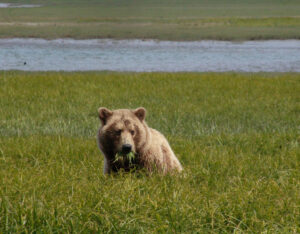
A brown bear feeds on sedge in the McNeil River area. Photo by Madison Grosvenor.
The court ruled that the program was “unlawfully adopted and, therefore, void and without legal effect.” But the Board shrugged off the court’s ruling.
A week after the court decision, the board doubled down and adopted an emergency regulation to reinstate the program. In mid-May 2025, the court struck down that emergency rule as a bad-faith attempt to circumvent its earlier order, but not before the department killed 11 more brown bears. Despite those rulings, the Board reinstated the predator control program again in July 2025 without collecting population data on brown or black bears in the control area.
“The court has already ruled that this program is unlawful and that last summer the State carried it out ‘in bad faith,’” said Nicole Schmitt, executive director with the Alaska Wildlife Alliance. “In response, the state wrapped this unconstitutional program in the same tired packaging, with the same legal flaws. The facts remain that this program is not based on science, has no legitimate measures of success, and has cost the state more than $1 million in program and legal fees.”
Where sanctuary ends
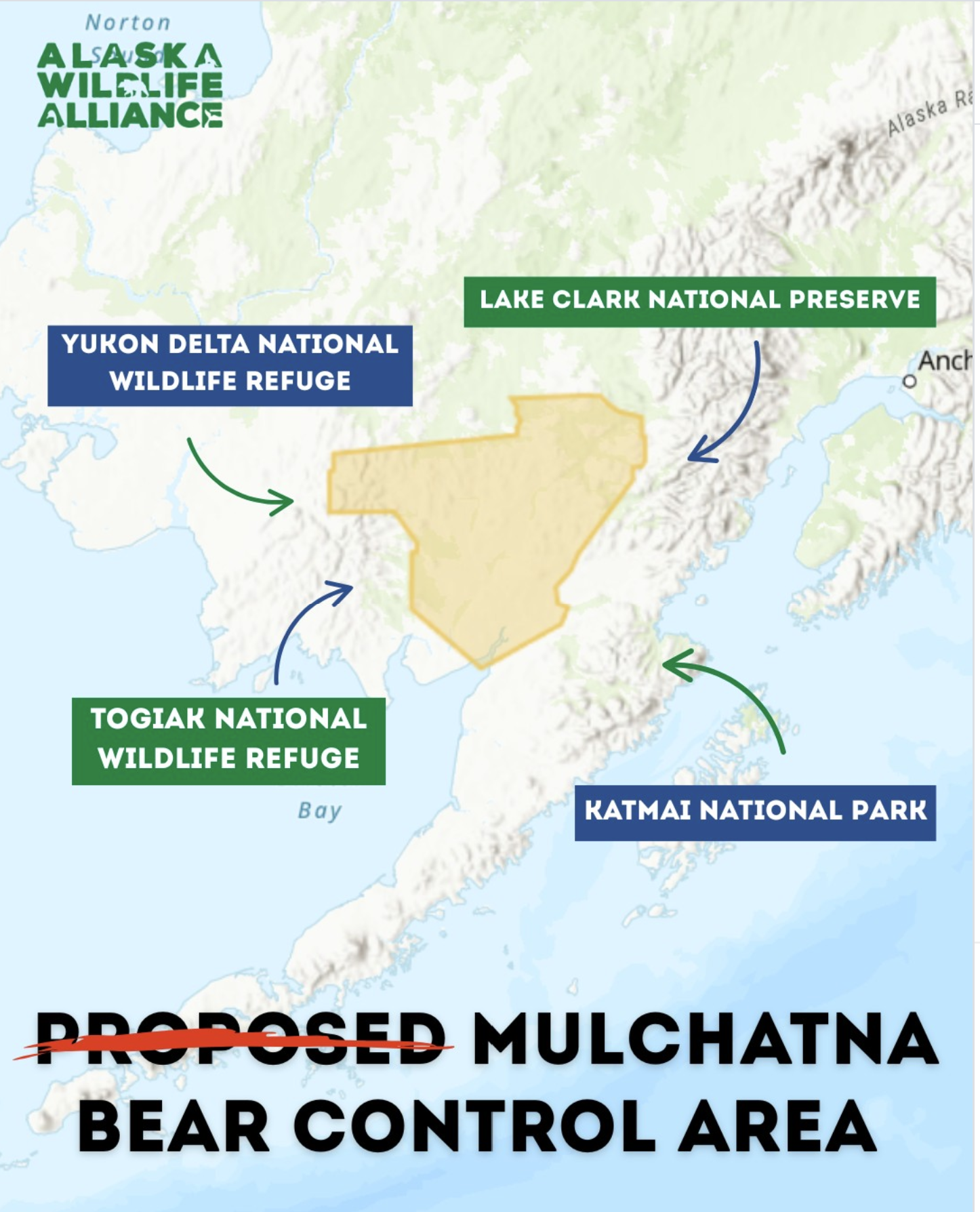
The Mulchatna Caribou Herd Predation Management Area sits between the Yukon Delta National Wildlife Refuge, Togiak National Wildlife Refuge, McNeil River State Game Sanctuary, Lake Clark National Park and Preserve, and Katmai National Park and Preserve, some of the most iconic bear habitat in the world.
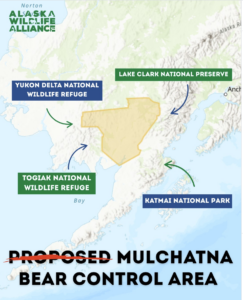
A map of the Mulchatna program area, including nearby public lands. Map courtesy of Alaska Wildlife Alliance.
People travel across the state, country, and world to see, learn from, and appreciate these bears and their place in the larger landscape.
These bears do not live in bounded lines. They can’t understand where the imaginary line is between being safely watched and where the helicopters move in to get their shot.
With the fate of entire populations of Alaska’s beloved bears potentially on the line, the stakes couldn’t be higher.
There is a better path, one grounded in science, transparency, and long-term solutions.
“Alaska needs to stop wasting public resources and make wildlife management decisions firmly rooted in science and sustainability. That’s what the constitution requires, and it’s also what will be best in the long run for bears, caribou and the entire ecosystem,” said Cooper Freeman with the Center for Biological Diversity.
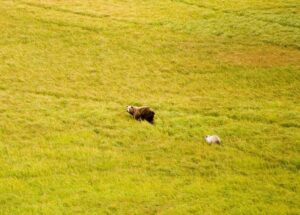
An aerial view of a female brown bear and her cub venturing through a green field. Photo by Ryan Hagerty, USFWS.
For now, the question is whether the court will step in before the helicopters take off and the guns bear down.
If you’re wondering what you can do, be there! Join us on Friday, May 1st at 2:00 PM for the oral argument on our preliminary injunction motion. It will take place in Courtroom 503 at the Nesbett Courthouse, 825 W 4th Avenue in Anchorage. There may be an option to join telephonically. To join by phone: call 1-
888-788-0099 and enter Meeting ID 796 584 6537 when prompted.