

The Alaska Board of Game blew off the State Constitution when advancing its plan to gun down every bear possible
By Madison Grosvenor
We took the Alaska Board of Game to court last week for authorizing an unconstitutional gunning program that allows the unlimited aerial killing of bears in southwestern Alaska. Trustees represents the Alaska Wildlife Alliance and the Center of Biological Diversity in the case.
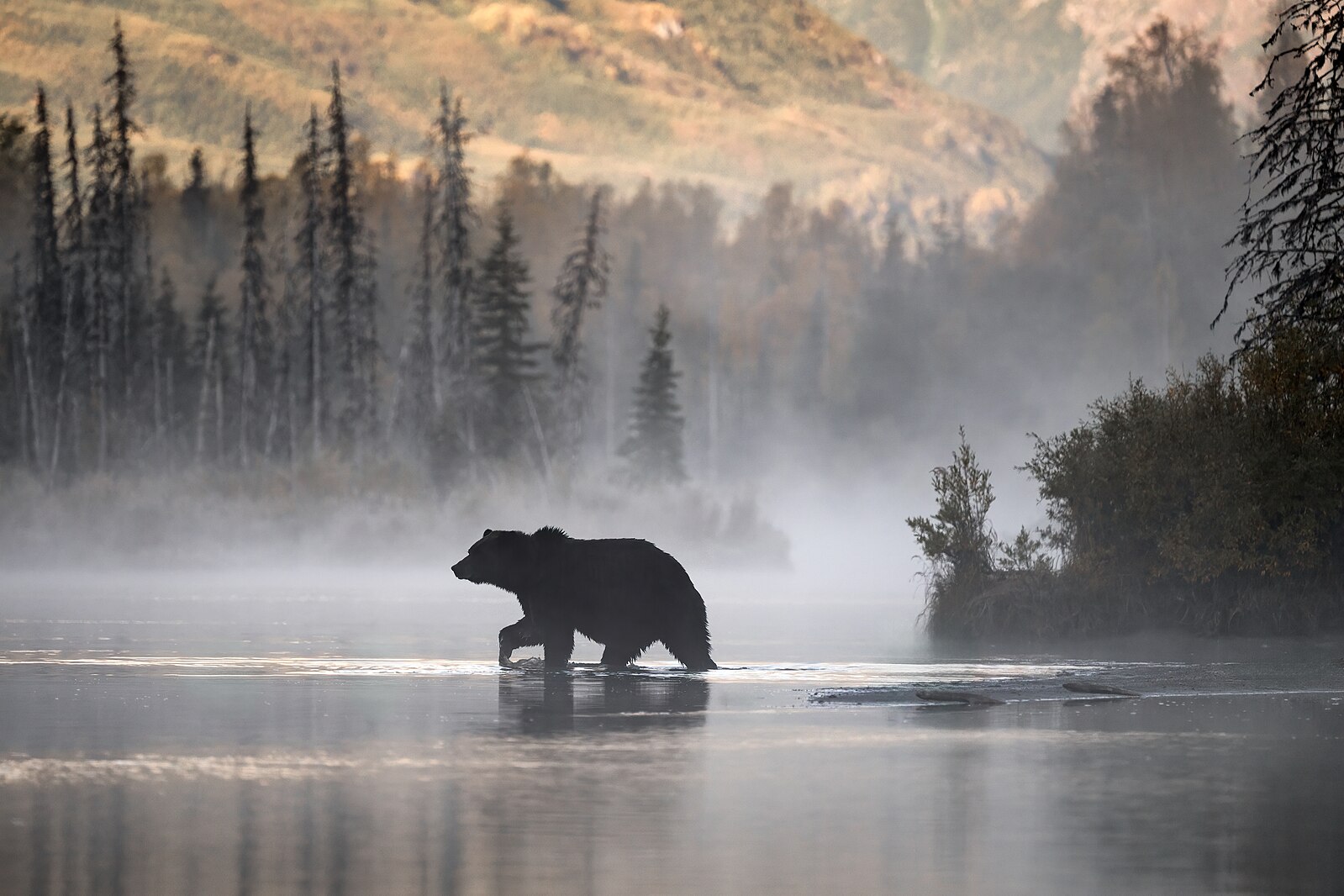
Bear walking in the morning mist in Lake Clark National Park and preserve. Photo by Eric Kilby.
“The program aims to kill as many bears as possible across an entire region of Alaska with zero awareness or concern for sustainability,” said Michelle Sinnott, the Trustees’ attorney leading the case. “The Board has ignored its constitutional obligations, prior court decisions and good sense in an all-out war on bears that reeks of needless brutality.”
The Alaska Supreme Court has already ruled that the sustained yield clause in the State Constitution applies to all animals including bears. Meeting that obligation requires that agencies, at a minimum, know the number of animals needed to keep the population healthy and to protect those numbers.
Instead, the gunning program the Board named after the Mulchatna caribou herd allows the killing of an unlimited number of bears across nearly 40,000 square miles — without setting population goals or limits. Instead of focusing on healthy bear populations, the program only measures success by how many caribou calves survive. That ignores the impact of the program on bears. If the Board had actually considered the sustainability of the bear population it would have set clear bear population targets, required regular monitoring, and established safeguards to stop the killing if bear numbers drop too low.
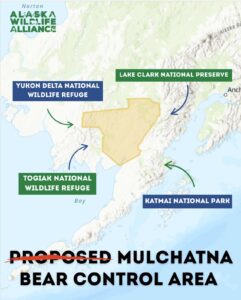
Map of program area surrounded by Alaska conservation lands. Courtesy of Alaska Wildlife Alliance.
“The Board of Game gave the Alaska Department of Fish and Game the authority to aerially shoot any bears of any age across 40,000 square miles (an area about the size of Kentucky) until 2028, with no population data or cap on the number of bears killed,” said Nicole Schmitt, executive director with the Alaska Wildlife Alliance, in our press release about the lawsuit. “The southeast border of the gunning program is only three miles from Lake Clark National Preserve, 30 miles from Katmai National Park, 50 miles from McNeil and Brooks Falls, and goes all the way west to the borders of Togiak National Wildlife Refuge and the Yukon Delta National Wildlife Refuge, which means this program threatens bears who move across vast stretches of public lands.”
That data is essential: a court has already ruled that credible scientific evidence on population numbers is a material factor in determining sustainability. Yet the Alaska Department of Fish and Game dismissed population studies as unnecessary, claiming that density and distribution “are not a requirement” for sustained yield management.
By ignoring key scientific data and rubber-stamping such a vast program, the Board has failed to meet its constitutional duty.
Where we left off
The State of Alaska launched the controversial bear-control program in the Wood-Tikchik basin in 2023, shooting bears from helicopters and spotting planes — despite opposition from dozens of biologists (including Fish and Game’s own) and the public.
The program was developed behind closed doors, with no opportunity for public comment.
Fish and Game killed 175 brown bears and 5 black bears in 2023-2024. The Alaska Wildlife Alliance challenged this original program. In March 2025, the Alaska Superior court struck down the original program as unconstitutional, in part because the Board of Game did not have credible scientific evidence of bear populations.
The court found the Mulchatna bear control program was “unlawfully adopted and, therefore, void and without legal effect.”
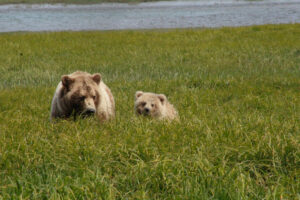
Brown bear sow and cub in McNiel River State Game Sanctuary, about 50 miles from the gunning program area. Photo by Madison Grosvenor.
A week later, the Board of Game moved quickly to pass an emergency regulation reinstating the program. It was the first predator control effort ever enacted by emergency petition.
Despite more than ten years of research to the contrary, Fish & Game continued to argue that predator control was essential, claiming that calf predation — not habitat or nutrition — was what held back the herd’s growth.
In mid-May, the court struck down the emergency regulation as a bad faith attempt to circumvent the Court’s order, but not before Fish and Game killed 11 more brown bears. At a Board of Game meeting in July, despite around 1,500 public comments in opposition and proposed amendments submitted by Alaska Wildlife Alliance, the Board unanimously voted to reinstate the program, once again granting Fish and Game the authority to gun down any bears, anytime, of any sex, of any age within the 40,000-square-mile area.
So, here we are, and here we go again.
Yes, it’s unconstitutional, but it also doesn’t work
State agencies continue to promote predator control as a quick fix for declining moose and caribou populations, but decades of research and on-the-ground results tell a different story.
In Alaska, for example, long-term studies show that intensive killing of wolves and bears has not produced lasting increases in prey herds. From 2010 to 2021, when Fish and Game actively shot wolves, fewer caribou survived. There is no consistent evidence that shooting predators is boosting caribou populations.
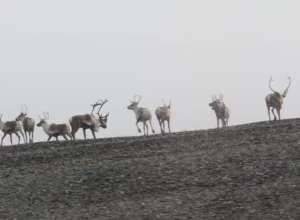
Mulchatna caribou herd on the move. Photo courtesy of Alaska Department of Fish and Game.
Data from the Fortymile caribou herd revealed that even with both lethal and nonlethal wolf control, calf mortality remained high at about 54 percent and adult female mortality around 9 percent. The herd’s growth was strongest before any control began and slowed once predator removal was implemented, suggesting that food availability and habitat quality, not predator numbers, were the real drivers of change.
At the same time, the Mulchatna caribou herd has plummeted from about 200,000 animals in the late 1990s to roughly 12,000 today, a decline more closely tied to habitat degradation due to climate change, along with poor nutrition and disease, not being killed by bears and wolves for food. In fact, in 2024, out of the 44 calf mortalities identified by Fish and Game, only 1 was attributed to a bear. The vast majority of calf mortalities were due to starvation and dehydration.
Studies show that female caribou are in poor body condition and that brucellosis, a disease-causing reproductive failure, is widespread. Yet state managers continue to focus on killing bears and wolves rather than acknowledging these deeper problems.
By ignoring the huge ecological roles that bears and wolves play—such as seed dispersal, nutrient cycling, and maintaining balance among prey species—these programs risk further destabilizing Alaska’s ecosystems.
Fat bears we love are up for grabs
This past September, the celebrated Fat Bear Week came across our feeds once again. Over 160,000 people worldwide cast their votes every year, voting for the biggest bear that has what it takes to survive the winter.
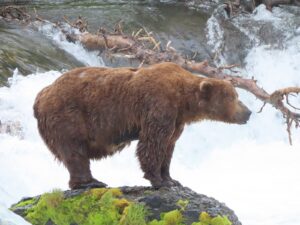
2025 fat bear champion, Chunk, at Brooks Falls. Photo by Katmai NPS.
The week celebrates some of the largest brown bears in the world returning to Brooks Falls in Katmai National Park to feast on the healthy salmon runs. It’s a rare and wondrous sight—a glimpse into one of the planet’s most intact ecosystems, where these bears can thrive.
Cameras click, live streams roll, and millions of people around the world marvel as these powerful creatures gorge themselves on salmon, splash in the water, and fatten up for hibernation.
But away from the cameras and livestreams, just fifty miles from Brooks Falls, one of these same bears can cross an imaginary line and instantly lose that protection. Beyond it, they can be chased down and shot from the air in the name of “predator control.”
No crowds. No cameras. No celebration. Only the hum of a plane engine overhead and the stark reality that in this part of Alaska, the same bear that was yesterday’s online hero can become today’s government-sanctioned target.
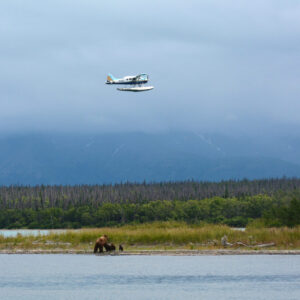
Float plane above sow and cub within Katmai National Park and Preserve. Photo by Paxson Woelber.
We flock to see these bears staking out Brooks Falls, clamming in Lake Clark National Park, pinning salmon along Mikfik creek and McNeil River, or ambling around the rolling tundra hills of the Togiak and Yukon Delta National Wildlife Refuges.
But just beyond those boundaries, state-sanctioned gunning zones erase any distinction between a beloved cultural and ecological icon and a target. It’s a jarring contradiction. Alaska celebrates its bears as symbols of our wild spaces and ecological integrity while simultaneously authorizing their extermination.
This double standard not only threatens individual bears but also undermines the credibility of Alaska’s entire wildlife stewardship and the public’s trust in it.
“There’s no excuse for the state of Alaska to be gunning down brown bears from helicopters,” said Cooper Freeman, Alaska director at the Center for Biological Diversity.
“This is a disgraceful misuse of public resources and a betrayal of the trust Alaskans place in their wildlife managers. State officials should protect all of our wildlife for future generations, not flaunt their power by orchestrating the mass killing of iconic bears with no scientific basis. The Mulchatna predator control program is an embarrassment, and it needs to end now.”
The law is clear, and so is the science: killing an entire region of predators is both unconstitutional and ecologically reckless.
At every turn, the State has chosen to ignore the law, its own scientists, and the clear will of the public. From the court rulings the State defied, to the data it dismissed, to the bears it gunned down just beyond the borders of protected lands, this story is one of disregard. Disregard for science, for sustainability, and for trust.
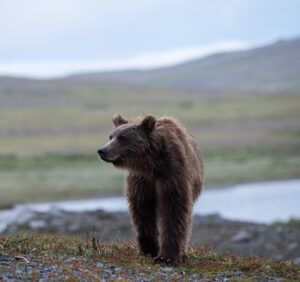
Brown bear walking in Katmai National Park and Preserve. Photo by F. Jimenez / National Park Service
These bears, the same ones that captivate the world each fall, deserve more than to be written off as collateral damage because the Board of Game thinks it can’t do the real work of addressing more entrenched causes like climate change so they call for helicopters and guns instead.
And so, we’re going to court to remind Alaska’s leaders that the State Constitution still applies, that wildlife management must be rooted in scientific evidence, and that the bears we revere deserve more than senseless open fire from above.