

We sued Interior for illegally trading away public lands in Izembek Refuge
By Dawnell Smith
While Alaskans faced job furloughs and worried about food and safe airline travel, Interior Secretary Burgum announced that he traded public land in Izembek National Wildlife Refuge to King Cove Corporation to make way for a long-sought-for road. A few weeks later, we took him to court.
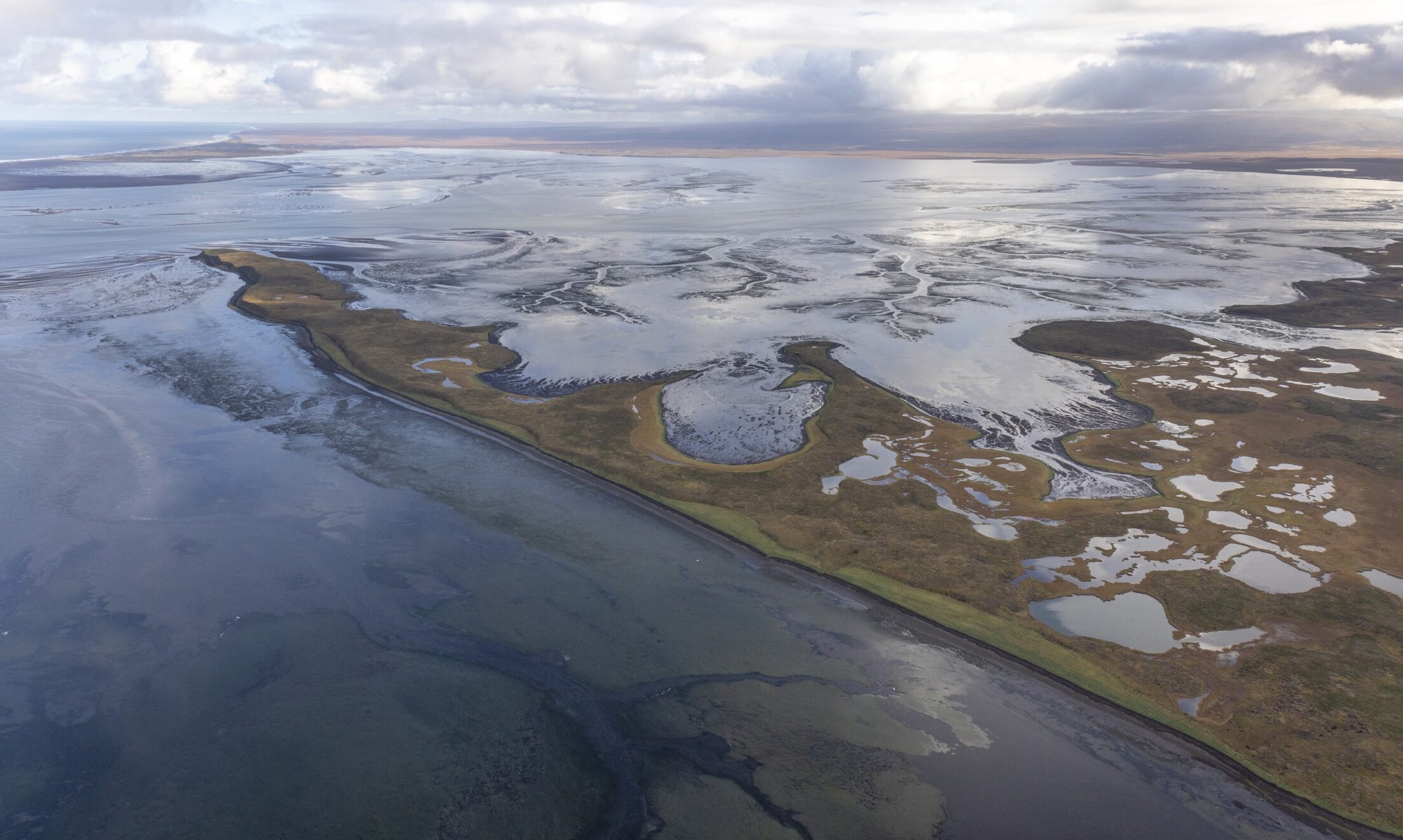
Izembek Lagoon from above. Photo by Zak Pohlen, USFWS.
We’ll talk more about our lawsuit soon but first a little background.
People have proposed a road over the narrow Izembek Isthmus for decades and in more recent years for a land trade to King Corp Corporation to make it happen. The original primary objective was posed as commercial transport for the fishing industry and later shifted to providing emergency medical access for King Cove via a road.
Whatever the story road proponents tell, a land trade by an Interior appointee does not align with the public purposes Congress established by law for Izembek National Wildlife Refuge and other conservation lands in Alaska.
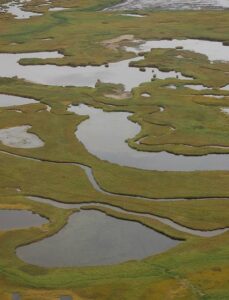
Izembek wetlands from above. USFWS, Kristine Sowl.
The fact is that medical access is an enduring challenge for people and communities across the state’s remote regions. Vast distances along with storms, terrain, persistent wind, snow, and other conditions make emergency transportation difficult, whatever the method of travel.
More to the point, this latest land swap does not limit the use of any road to medical access or even require that the land be used for a road or only a road. Interior just handed King Cove a patent to irreplaceable federally protected lands with a big blank “to be determined” page on what exactly will happen to these lands or how and when.
Interior did not finish the environmental review process initiated in 2023 and in the associated 2024 draft supplemental environmental impact statement. Any road would impact animals, habitat, and western Alaska communities that rely on Izembek to nourish migratory birds important as food and part of their culture.
There’s a lot the October land exchange doesn’t do or make clear, but there’s one thing it does clearly do: It demonstrates that this administration will recklessly hand over public lands to private interests without public or Congressional involvement or oversight.
Let that sink in for a minute.
Our court claims
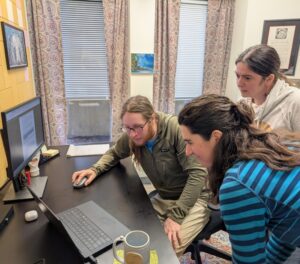
Some of the Trustees legal team filing the Izembek case. Photo by Christin Swearingen.
The lawsuit we filed November 12th on behalf of Friends of Alaska National Wildlife Refuges and four other groups centers on the Alaska National Interest Lands Conservation Act. The first claim challenges Secretary Burgum, the Interior Department, and other federal actors with failing to undertake the mandated steps for approving a road (a transportation system) inside of Izembek Refuge (a conservation system). The fact is, ANILCA contains a process for authorizing a transportation system through designated Wilderness, but Interior ignored that process. Instead, the administration went about disposing of Izembek lands by circumventing this very specific and rigorous process.
Even if Interior could use a land exchange as an end-run around this process, it failed to meet the requirements of a land swap by failing to meet the conservation and subsistence purposes of Izembek Refuge as outlined in ANILCA .
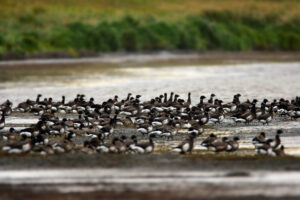
Black brant in Izembek Refuge. Photo by Ryan Hagerty.
It’s important to note here that Izembek contains the globally significant Izembek-Moffet-Kinzarof Lagoons Important Bird Area and is named a Wetland of International Importance. These designations matter because people near and far recognize Izembek’s outsized importance to the health of an entire region of living beings and communities, birds and people alike.
Our lawsuit also challenges Burgum and Interior for violating the Administrative Procedures Act by not adequately justifying the agency’s reversal in position from prior secretaries who rejected a road, and challenges Interior for violating the National Environmental Policy Act by failing to conduct required analysis of the impacts of the road before signing the land exchange agreement.
“This administration’s priorities are telling since it aggressively expedited its role in building a private road through Izembek as people were scrambling for income and food during a government shutdown,” said Siobhan McIntyre, Trustees’ lead attorney on the case. “Whatever Interior’s side negotiations and deals under cover of agencies that had gone dark to the rest of us, the fact remains that it’s illegal for Interior to do this without public process or the authorization of Congress.”
We thrive because we protect places like Izembek
About a year ago we talked about Izembek in terms of the law and why Congress created protections in the first place. In that piece, we talked about a “tradeoff” mentality that has only gotten more entrenched and dangerous, with a “winner/loser” approach to Alaska that ignores the intersection between people, animals, landscapes, generations, and all communities of life, from algae and eelgrass to Emperor geese and seals.
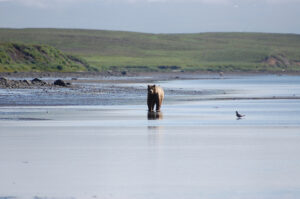
Brown bear in Kinzarof Lagoon in Izembek. Photo by Kristine Sowl.
As one of our clients, Marilyn Sigman, president of Friends of Alaska National Wildlife Refuges, explained why her group joined the lawsuit. “Friends supports the purposes of all 16 of Alaska’s national wildlife refuges, which for Izembek is the conservation of not only waterfowl and shorebirds but also salmon, brown bears, and the caribou herd that migrates across the isthmus,” she said. “Trading the ownership of refuge lands that Congress designated for conservation is a terrible precedent for the privatization of public lands.”
Izembek thrives because of the relationships between plants and animals, water and land, and people with these landscapes. It thrives because Congress protected it.
The people and other beings who rely on places like Izembek already face challenges due to the warming climate and its impact on weather patterns, coastlines, the diversity of life, and human communities. We have seen western Alaska villages devastated by the recent typhoon, communities grappling with flooding and wildfires, the decline of salmon runs and caribou populations, lower survival rates in migratory bird populations, and changing migration patterns.
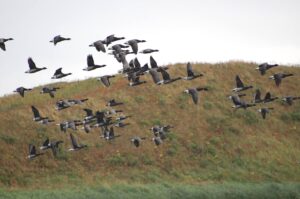
Pacific black brant take flight at Izembek National Wildlife Refuge. Photo courtesy of USFWS.
Nearly all North American brant geese who use the Pacific Flyway stop in Izembek to eat so they can continue their migrations to and from Alaska, where they and other migratory birds play a crucial role as food for people in western Alaska during the shoulder seasons. Up to a third of these Pacific brant have even started overwintering in Izembek, according to research.
When we talk about “a canary in a coal mine,” we’re talking about their health in connection to our own. We’re talking about our relationships with each other. We’re talking about the places that hold us and sustain us all. More than ever, we need to protect places like Izembek to ensure that all of us can thrive for generations to come.