


On beings and biomes—wolves
By Madison Grosvenor
“We reached the old wolf in time to watch a fierce green fire dying in her eyes. I realized then, and have known ever since, that there was something new to me in those eyes – something known only to her and to the mountain. I was young then, and full of trigger-itch; I thought that because fewer wolves meant more deer, that no wolves would mean hunters’ paradise. But after seeing the green fire die, I sensed that neither the wolf nor the mountain agreed with such a view.”
—Aldo Leopold, A Sand County Almanac
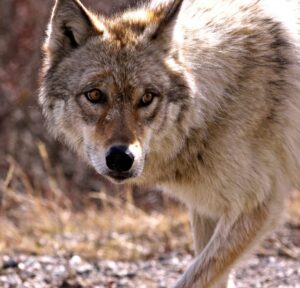
Close up of wolf in Denali National Park. Photo by Nilesh Patel.
For generations, wolves have occupied a fearsome place in the human mind. The wolf dressed in grandmother’s clothing, wolves in sheep’s clothing, wolves huffing and puffing and blowing houses down, children crying wolf, humans transforming into wolves under the full moon.
Wolves occupy a fearsome place in folklore and stories. They represent danger and trickery, wildness and loyalty, magic and menace. They frighten us and behave like us.
Our mythologies around wolves translate to the real world, shaping how we perceive these pack animals and, in turn, how we treat them. Here in Alaska, humans share the landscape with these canines. They live in vast landscapes, including in the park lands where we recreate, the outskirts of towns, and even in our backyards.
Behind the fairytales and legends lies a much more complex animal, one deeply social and bound by intricate family relationships of communication and care.
Family bonding
“We have marveled at each individual wolf’s intelligence and been fascinated by observing each unique personality, but the family bond shared among these wolves is what we have admired the most.”
— Jim Dutcher, The Wisdom of Wolves
A wolf pack can range from six or seven wolves to groups of 20 or more, often consisting of parents, offspring, siblings, and extended family members. Some groups may bring in unrelated wolves who join the group. At the center of many packs is a breeding pair, typically the parents of the other wolves.
In Among Wolves, authors Marybeth Holleman and wolf biologist Gordon Haber recount decades of research on wolf group relationships, with Haber explaining that “the wolf isn’t just one animal. It usually can’t survive for long alone. It is 10 or 20 animals — typically an extended family — all acting as one in order to survive.”
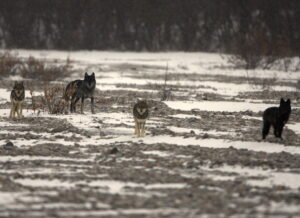
7-mile wolf pack in Denali National Park. Photo courtesy of NPS.
The idea of a dominant, merciless alpha wolf is yet another myth derived from studies done on captive wolves thrown together with no shared kinship. Wolves in fact operate as family units, with older and more experienced animals guiding younger members. Adults and older siblings raise pups collectively, bringing food back to the den and teaching them through play. They chase one another, wrestle, pounce, and play-stalk, behaviors that strengthen social bonds while helping young wolves develop the coordination and skills they will eventually need to hunt.
Wolves maintain meaningful relationships with each other. They often show distress when separated from companions and the death or disappearance of a pack member can affect family behavior and stability.
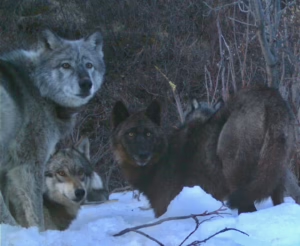
Riley and the members of the Riley Creek Pack. Photo courtesy of NPS.
Family groups can persist across generations, carrying learned knowledge about migration routes, hunting grounds, seasonal conditions, and the surrounding landscape. In an environment as demanding and unpredictable as Alaska, this accumulated knowledge can be invaluable.
One of the most famous packs in Alaska was the Riley Creek pack of Denali National Park, led by the female wolf 1202, known as Riley. Riley was born in 2009, into the East Fork pack. She eventually split from the pack, forging into the Denali wilderness on her own. She found a mate and chose a den site close to the park road where they started their own family.
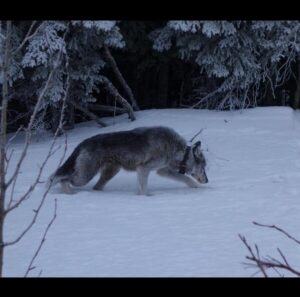
Riley spotted on a trail cam in 2019 in Denali National Park. Photo courtesy of NPS.
The Riley Creek pack grew to 14, winning scraps with rival packs and continuing to grow. It peaked in 2017 with 17 members. The following winter, Riley’s mate died near a known trapline, and that was the beginning of the end. The pack began to dwindle, and by the following winter, the pack size dropped to 7. Riley persevered, even rearing new pups the same year, despite even having a broken leg that never healed.
In her last years she was seen with a group of 2 to 3 wolves who may or may not have been family members. Her vast knowledge of the region kept the pack going. She died in 2020 at 10 years old, quite old for a wild wolf, as the last known member of the wolf pack.
Riley’s story gained wider attention through the 2024 documentary A Good Wolf, which featured her and chronicled the decades-long dispute over wolf management in the Stampede Corridor near Denali National Park. Her story became part of a larger conversation about the challenges wolves face in and around the park.
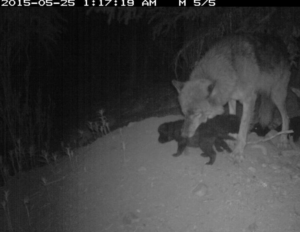
Riley and pups spotted on trail cam. Photo courtesy of NPS.
Wolf families can change dramatically following the loss of a parent, food shortages, disease, or of younger wolves leaving the family. When an important individual disappears, the consequences can ripple outward.
“The intimacy between wolves in a family group, which enables them to cooperate closely, also means that each is keenly aware of the identity and presence or absence of others,” wrote Gordon Haber in Among Wolves. “From what I have seen, the intimacy of a family group is often comparable to, and sometimes exceeds, the degree of intimacy found within a typical human family. Wolves will go to great effort to remain with their families.”
Nowhere are wolves’ family relationships put to the test more than on a hunt.
The howls and the hunt
“The wind sweeps through and the hunched wolf shivers. It howls you cannot say whether out of agony or joy.”
— Ted Hughes, The Howling of Wolves
A successful hunt begins long before the chase.
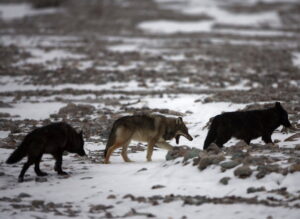
Wolf family unit on the prowl in Denali National Park. Photo courtesy of NPS.
Wolves’ ability to communicate, coordinate, and respond to one another allows them to pursue animals much larger than a wolf could take down alone.
Wolves make important choices when hunting for food. The breeding pair leads the pack and decides where and when to hunt. The others follow their lead. Throughout the hunt, they use an array of communications to coordinate tactics, including rallying howls, growls, and whines to share information about the location of the animal, where other wolves are, any potential dangers.
Another enduring myth is the image of wolves lifting their heads to the night sky, howling in eerie unison at the moon. Rather, these haunting calls help strengthen family bonds, announce their presence within their hunting territory, coordinate hunting activities, and keep pack members connected and oriented as they move through the wilderness. Rather than a mystical serenade to the moon, a wolf’s howl is a powerful rallying call.
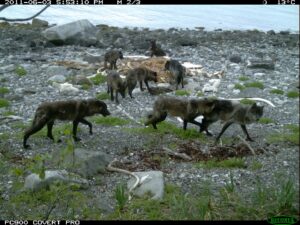
Wolves visit a carcass in Glacier Bay National Park. Photo courtesy of NPS.
If lucky enough to hear wolves howling nearby, remember what they’re telling you. We are here.
Through these means of organizing around the hunt, wolves can use different strategies. They can pursue a prey animal over long distances, taking turns at the chase so others can conserve energy. They can use terrain to their advantage, stalking from behind vegetation or other visual obstacles. They can even test a herd of animals on their approach, looking for vulnerable animals, such as the young, old, sick, or injured, and assessing the animal’s condition by observing its movements, gait, and overall health.
Some wolves will also approach animals head on while others move around to the flanks to cut off escape routes. Once the hunting group gets in position, the lead wolves will rush toward their target.
A successful cooperative hunt of a large animal like a moose or caribou can feed the whole pack. In fact, the relationships that allow a wolf family to hunt successfully and care for each other also help steward the entire landscape.
River changers, caribou movers
“Wolves enliven the northern mountains, forests, and tundra like no other creature, helping to enrich our own stay on the planet simply by their presence as other highly advanced societies in our midst.”
— Gordon Haber, wolf biologist and co-author of Among Wolves
Wolves live throughout Alaska from Southeast Alaska to the North Slope, with about 7,000 to 11,000 statewide, according to estimates.
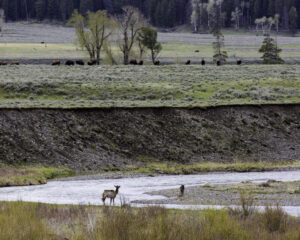
A cow elk stands in a river while a black wolf watches her from a gravel bar. Photo by Neal Herbert.
As apex predators, wolves occupy an important position in Alaska’s ecosystems.
You may have heard how wolves changed the rivers in Yellowstone National Park. Before their reintroduction to Yellowstone in 1995, elk populations and their grazing patterns placed considerable pressure on certain areas of vegetation, including willow and aspen stands along riverbanks. Without sufficient vegetation with roots to stabilize the banks and provide habitat, some riparian environments had degraded.
When wolves returned, they began influencing where and how elk grazed. The risk of encountering a wolf changed where and how elk moved, and in some areas, reduced their use of exposed river valleys and other vulnerable locations. Vegetation in these areas recovered and as willows and aspens regenerated, they helped stabilize riverbanks and provide habitat and food for other animals. Beavers, which depend on willow and other woody vegetation, moved into these recovering habitats. Their dams created wetlands that in turn provided habitat for fish, amphibians, and birds, while also influencing water retention and nutrient cycling.
The changing landscape attracted a greater diversity of wildlife. When a predator at the top of a food chain influences the abundance and behavior of other wildlife in an environment, we call it a trophic cascade. This happens in Alaska, too. Wolves influence moose and caribou behavior, preventing overgrazing and allowing vegetation to recover. By hunting large herbivore animals, wolves keep these big herds moving so as not to decimate a particular area’s vegetation.
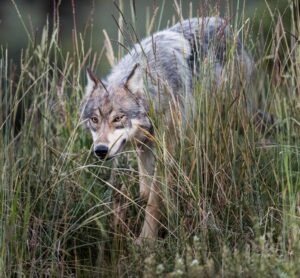
Wolf steps out of the grass in Denali National Park. Photo by Kent Miller.
The resulting plant growth allows other beings to move in, as the new growth of plants benefits birds, insects, and small mammals who use these plants for food and as homes. The increased vegetation improves soil stability by preventing erosion, improving water quality, and promoting nutrient cycling in the habitat. Enhanced plant growth even contributes to greater carbon storage, helping to mitigate the effects of climate change.
Wolves contribute to the ecosystem in another important way, too. They leave behind the remains of prey animals that become an important food for scavengers like ravens, eagles, rodents, foxes, and bears, and again cycle energy and nutrients through the ecosystem.
People and wolves
“We have doomed the wolf not for what it is, but for what we deliberately and mistakenly perceive it to be –the mythologized epitome of a savage ruthless killer – which is, in reality, no more than a reflected image of ourself.”
— Farley Mowat, Never Cry Wolf: The Amazing True Story of Life Among Arctic Wolves
Across the country, wolves have long faced persecution, fueled by fear and a misunderstanding of how wolves belong in a healthy landscape, and perpetuated in the stories we tell of wolves as monsters and pests, often founded in conflicts with people keeping animals as livestock in the Lower 48.
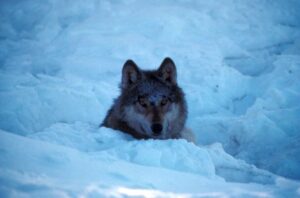
Wolf lays in the snow in Kenai National Wildlife Refuge. Photo courtesy of USFWS.
In Alaska, animosity to wolves has taken the form of decades of contentious predator killing programs aimed at increasing populations of moose and caribou.
We recently filed an amicus or “friend of the court” brief in a case brought by a longtime Alaska wildlife advocate and retired attorney, Kneeland Taylor, challenging a wolf killing program on the Kenai Peninsula. The purpose of an amicus brief is to provide relevant information and expertise to the court.
The Kenai wolf killing program was originally approved by the Board of Game in 2012 to boost moose numbers for hunters, but the program was never implemented because the moose populations stabilized. The Board of Game reinstated it in 2023, despite the continued stability of moose populations.
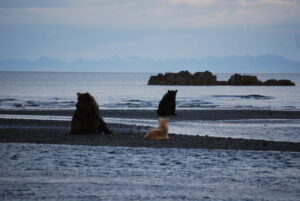
Two bears and a wolf resting on the beach. Photo by Katie Moest.
As with our Mulchatna litigation, the Board of Game never took a hard look at wolf populations when reapproving the Kenai program. In fact, the Board failed to take a hard look at any information about the affected wolves, relying only on information that moose populations and harvest objectives were being met. In other words, a wolf killing program was not necessary. The only information on wolf numbers they noted came from the 2012 proposal, which estimated the population of wolves as from 40 to 75.
The Alaska Constitutional requires that animals like bears and wolves be maintained in accordance with the sustained yield principle. This principle requires wildlife populations—including moose, caribou, bears, and wolves—to be managed in a way that maintains their long-term stability and sustainability.
Not taking a hard look at relevant or current populations of wolves prior to enacting this program is unconstitutional. The Board of Game has consistently failed to provide and consider current population estimates of bears and wolves when authorizing programs that kill them. The State continues a long legacy of adopting aggressive and reckless killing programs unfounded in sound science.
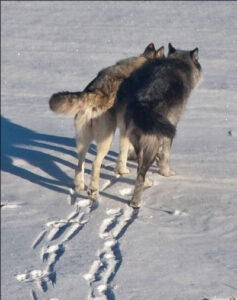
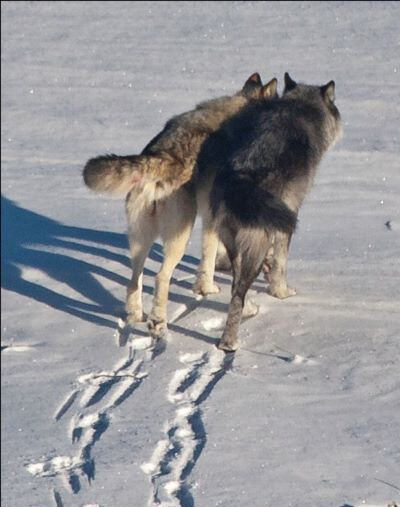
Gray wolves walk side by side. Photo by Gordon Haber.
State killing efforts do not happen in a vacuum, but within a much longer history of scapegoating and villainizing animals like wolves. Here, human fear and false assumptions ignore wolves as intelligent, social beings in close-knit communities that play important roles in their ecosystems.
This kind of thinking seeks the elimination of wolves rather than real science and solutions. This shapes a troubling legacy for Alaska, one where wildlife management policies treat science-based solutions as an obstacle to their view of wolves as expendable.
Wolves are a lot like us. The loss of even one member of a wolf family sends ripples through the entire social group, disrupting deeply rooted relationships, shifting established roles, and forever changing the dynamics of those left behind. Their lives are built around many of the same relationships that shape our own.

Wolf print next to human hand. Photo by Paxson Woelber.
How we choose to manage wolves reflects what we believe about them, but also the kind of relationship we want to have with the natural world.
It’s time we stop allowing policies founded on stories about the big, bad wolf and start demanding real solutions for the health of all animals.