

Our common cause is each other—Alaska News Brief October 2025
Earlier this month, the remnants of a typhoon that originated in the northern Philippine Sea thrashed Western Alaska and devasted villages in the Yukon-Kuskokwim Delta. One person died, two others are missing, and over a thousand people have been displaced, with hundreds flown to Anchorage for temporary shelter. The communities of Kipnuk and Kwigillingok near the Bering Sea were hit especially hard with water levels more than six feet above the high tide line.
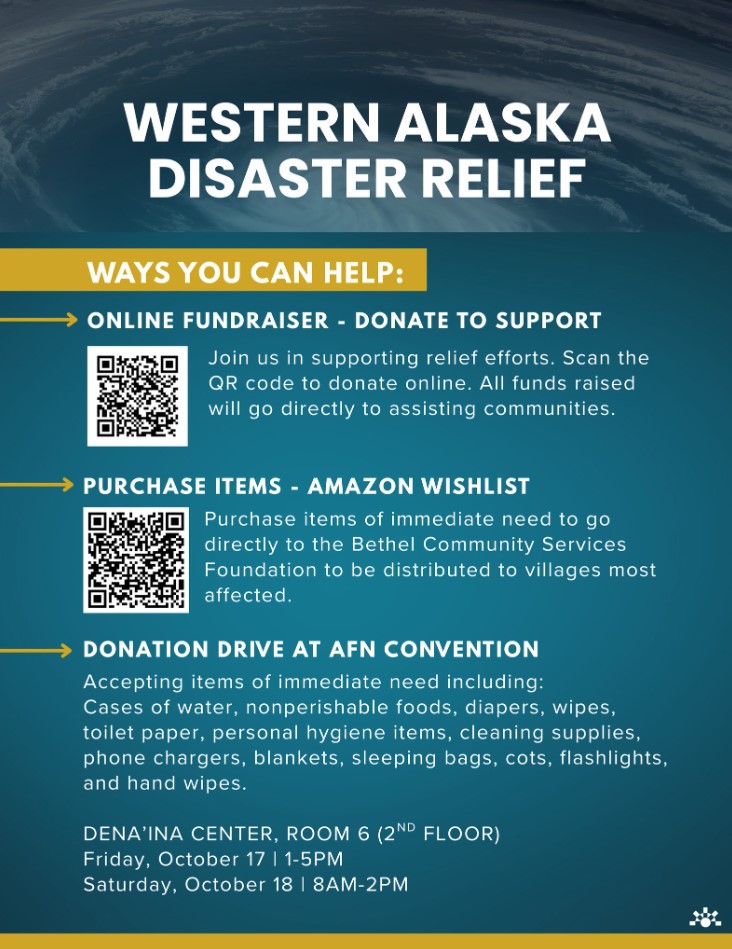
Learn how you can support the Western Alaska Disaster Relief Fund.
Alaskans pride themselves on helping each other and they do. The Alaska Community Foundation quickly created the Western Alaska Relief 2025 Fund, and the donations poured in, but the need will only grow in the weeks and months to come. If you can donate, we hope you do. The impact of this storm, like the one before it in 2022, will reverberate through these villages and the entire state.
Individual people stepping up to help matters in profound ways. Communities in Alaska (and throughout the country) simply do not have and do not get resources they need to protect themselves from floods, storms, wildfires, public health threats, and more, so they need emergency resources in the wake of storms like typhoon Halong.
They also need support before these disasters. Kipnuk got a grant to do just that, but months ago, the U.S. Environmental Protection Agency cancelled that $20 million grant for flood protection, calling it and similar grants “no longer consistent” with the agency’s priorities. The agency’s head even alluded to them as “wasteful DEI and Environmental Justice grants” in social media. This is heartbreaking, not because that grant alone could prevent the impacts of a typhoon, high surf and flooding, but because it sends a message about priorities.
Environmental considerations and protections have always centered people’s reliance on and relationship with natural landscapes. Many of us lived through the burning rivers and polluted skies of the 1970s when landmark environmental laws gained ground. Many Alaska communities have already fought and endured the impacts of toxic waste left behind by extractive industries and military sites. They continue to face the existential hardships of industrial pollution and it’s fueling of a warming climate that creates infrastructure instability due to permafrost thaw, coastal erosion, flooding, and more.
The erosion of environmental concerns and protections within Trump administration policies and actions consistently prioritizes identity politics, industry, and billionaire cronies over we the people. When agencies completely erase the voices of Tribes, local people, and the public from their decision-making processes, as recently happened when the Trump administration announced a wholesale approval of the industrial Ambler road south of the Brooks Range, they devalue public participation. They de-prioritize communities. They treat people as roadblocks.
With the Ambler decision, the Trump administration further hailed its new investment in a foreign mining company that aims to benefit from hundreds of miles of a road subsidized by Alaskans without a word about the people along the road corridor—the people who would suffer polluted air and water, the loss of food sources, and the social violence that industrial man camps bring. In this area of rural Alaska, survival is at risk.
The cutting of corners and doing as little as possible when evaluating the impacts of huge industrial proposals along with the erasing of prior agency analysis and decisions, the ignoring of the concerns of those most impacted by industrial exploitation—these are the tactics of an administration that doesn’t care about people.
This administration sees Alaska as a legal testing ground for trashing anywhere it chooses, of acting as if local concerns don’t exist, let alone matter, in its reckless, destructive, illegal, and inhumane actions.
Careless decisions don’t just have economic consequences—industry CEOs and shareholders get richer while local communities grapple with public health, diminished food security, and social and cultural impacts—but also life and death consequences.
The carbon that the mining and oil and gas industries produce, the carbon they burn and churn out for others to burn, creates the conditions for the massive typhoons and hurricanes, deadly floods and wildfires, and the weather disasters experienced by people from the Western Arctic to Puerto Rico. And the pace is accelerating.
When the administration claims the climate crisis doesn’t exist and isn’t caused by humans, it’s not expressing an opinion—it’s employing a tactic to silence the facts and impacts.
It’s fair to feel angry, frustrated, heartbroken, even powerless in the face of the decisions and actions of an administration that discounts—and profits from—the loss, the grief, the suffering that people experience.
But I believe that we, the people, still have power too. We can be there for each other. We can listen. We can lend a hand. Wherever we land on the political spectrum, we can care and be human to each other.
I don’t know about you, but the enrichment I seek includes everyone, honors the land and water, and takes care of the living communities that nourish our bodies, traditions, cultures, and future.
I believe we have a common cause and that’s each other.
In solidarity,
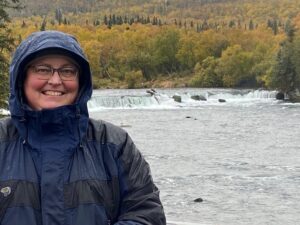
PS. Thanks to supporters like you, we can continue fighting to protect Alaska’s land, water, air, wildlife and people.
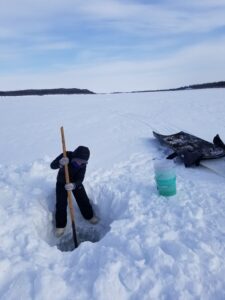
China Kantner chipping a water hole on the Kobuk River downriver from Ambler. Photo taken by Seth Kantner.
The Ambler con job
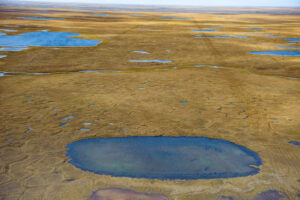
Seismic scars left on the arctic tundra west of the Arctic Refuge on the north slope of Alaska. Photo by Florian Schulz.
Winter is coming—and the threat to the Arctic is seismic
On beings and biomes—wetlands as the center of our everything