


Mining companies profit and you pay the price—updates on the Ambler and Mat Su industrial roads
By Dawnell Smith
The Trump administration has recently pushed for two major industrial projects that would benefit global mining conglomerates at the expense of Alaska’s water, wildlife, and communities.
In late September, the Trump administration opened a comment period concerning a mine proposal in northeast Alaska called the “Arctic mine.” Canadian and Australian mining companies own Ambler Metals, the permit applicant, and the proposal and mining operation requires completion of what would be a taxpayer subsidized Ambler industrial haul road that’s been proposed by the Alaska Industrial Development and Export Authority.
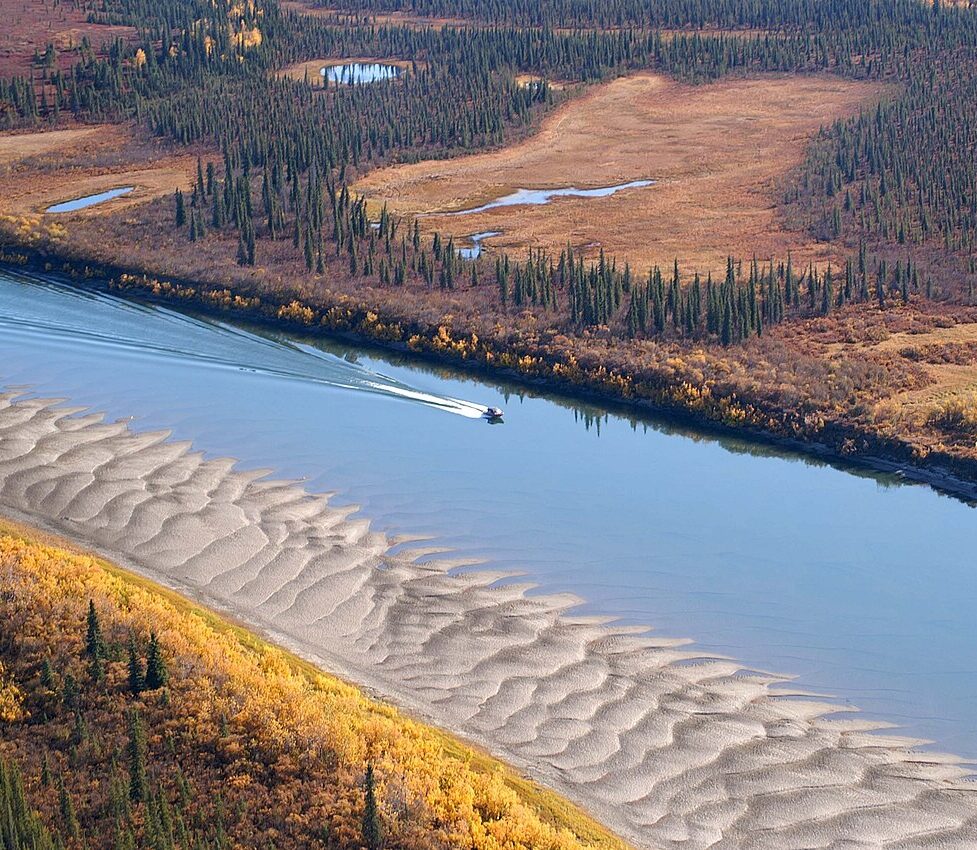
A motor boat cruises on the Kobuk. The proposed Arctic mine is near the Kobuk Wild and Scenic River. Photo courtesy of NPS.
Right now, the U.S. Army Corps of Engineers is accepting input on the scope of its analysis, including environmental, cultural, economic, subsistence, ecological, and community impacts resulting from the proposed mine. Clearly, any thorough review of the Arctic mine proposal needs to look closely at all impacts of the mine as well as the closely related Ambler road.
Your participation can make a difference. You can sign on and personalize your views using the Defend the Brooks Range action page or submit your comments directly to the Army Corps by Nov. 2. Check out this guidance from the Northern Alaska Environmental Center for more information.
Western Arctic caribou herd crosses the Kobuk. Photo courtesy of NPS.
One key point to make is that the agency needs to look at the cumulative impacts of the mine and all roads and infrastructure, including road construction and maintenance, short and long-term storage of toxic water and waste materials, and the intensive use of the Ambler road for moving upwards of 11,000 tons of ore per day via a 211-mile gravel road to the Dalton Highway and then to Fairbanks, and then by train to Anchorage and by boat to out of state and overseas smelters.
There is no narrow way to think about this mine proposal—its harmful impacts would be vast and enduring across a landscape that is vital to Arctic communities and the wildlife that nourish them.
The fox “fixing” the hen house
When the Trump administration re-authorized the Ambler road proposal about a year ago, it invested $35.6 millions of taxpayer dollars to gain a 10 percent shareholder interest in Trilogy Metals of Canada, the 50 percent owner of Ambler Metals. South 32 of Australia is the other 50 percent owner.
In other words, one of the investors in a mining company that has proposed the Arctic mine—the U.S. federal government—is reviewing the proposal and making the decision about issuing permits to a mining company it partially owns.
If this feels off, it’s because it is. Because industry and political players view Alaska as a place to extract from, most of the money made also heads out of state, even as local communities, wildlife, habitat, and public lands pay the price.
Evening light in the southern foothills of the Brooks Range. Photo by Lisa Hupp/USFWS.
Mine proponents and the Trump administration claim it will provide 650 temporary construction jobs and over $407 million in state revenue during its life without acknowledging upwards of $2 billion cost of the Ambler road, the cost of maintaining it, the cost to the health of the region when mines expand across the landscape, the cost of polluted waterways and air, the cost of doing harm to caribou populations and fish that feed communities along the Southern Brooks Range, and the cost to public health, ways of life, and future generations. That doesn’t seem to pencil out.
As with many “jobs” arguments used by giant extraction conglomerates, the real jobs local people want and need rarely come, though the consequences of environmental and community harm do. Further, mining-related jobs typically only last for a decade or two, until the ore is mined out, at which point local communities are left with fewer economic opportunities on top of a degraded and polluted landscape.
Pulling the fire alarm to get out of doing the work
The Army Corps also announced an extremely short public comment period to fast track permits for an 80-mile portion of the proposed West Susitna industrial gravel road under the false guise of an “emergency.” (Check out our piece about agencies eroding public comment opportunities here.) Like the proposed Ambler road, construction of the West-Su road would primarily benefit large foreign mining companies while harming the environment, recreation, and subsistence.
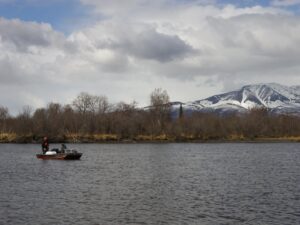
Researchers float along Alexander Creek in the Susitna Basin near the route of the proposed road. Photo by Adam Sepulveda.
West Susitna business leaders, Chickaloon Village Traditional Council, and Defend the West Su responded to this truncated comment period in a September press release: “Rushing through permitting for the road will cut Alaskans out of decisions around our public lands, waste tens of millions of Alaskan and U.S. federal taxpayer dollars, if not more, and could forever negatively impact outdoor-based economies, salmon habitat, and hunting and fishing opportunities in the West Susitna region — all for a false ‘emergency’ to get to non-Alaskan and foreign-owned gold mining claims.”
The attempt at “emergency” permitting skirts the National Environmental Protection Act, the Clean Water Act, and Tribal consultation requirements, and keeps Alaskans out of the decision-making process. Public participation must provide enough time for people to read through and understand the information provided, search for and evaluate missing information, contemplate and share views and concerns, and learn about the comment period in the first place.
The project and permit applicant, the Alaska Industrial Development and Export Authority, simply do not qualify for these emergency procedures. The Trump Administration’s so-called “energy emergency” is a thinly disguised effort to boost industry profits and cut the affected public out of government decisions. And while the Army Corps has some legitimate “emergency” powers, these are only available when there is an immediate and unacceptable risk to life or property. AIDEA did not note any of those risks.
Trustees submitted lengthy comments to advocate for a full, adequate environmental review, identify concerns and potential impacts, and correct AIDEA’s claim that the road will only affect a few acres of waterways protected under the Clean Water Act.
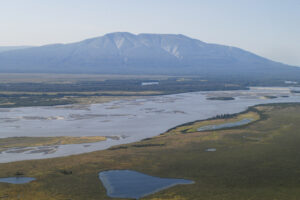
The Susitna flats and Susitna River mouth. Photo by J Schoen.
The West Su road could cause profound damage to water quality, fish, and wildlife. The gravel haul road would cross dozens of documented anadromous streams—waterways where fish spawn—and over 100 streams with resident or spawning fish populations. When roads cross streams and wetlands, salmon populations suffer. When salmon populations suffer, so do people and other animals, and so do the livelihoods and ways of life of communities.
The absurdly short comment period in the “emergency” review process already ended, but there is another West Su-related comment period open right now concerning public funding via the Statewide Transportation Improvement Program or STIP. The State has proposed using hundreds of millions of federal dollars on projects that benefit private interests.
You can let the State and federal agencies know that you want this important public funding to go to the many important transportation needs throughout the state, not to pet projects that would subsidize industry while threatening the health and sustainability of fish, wildlife, subsistence foods, outdoor economies, and Alaska ways of life.