

Wilderness with a capital W
By Madison Grosvenor
Everyone understands what wilderness means until you ask them to define it. Is wilderness a place without people, or does it require people? Is a lived on, traveled upon, cared for landscape wilderness? Does wilderness begin where human footprints end?
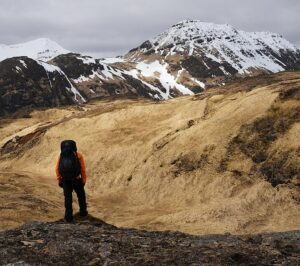
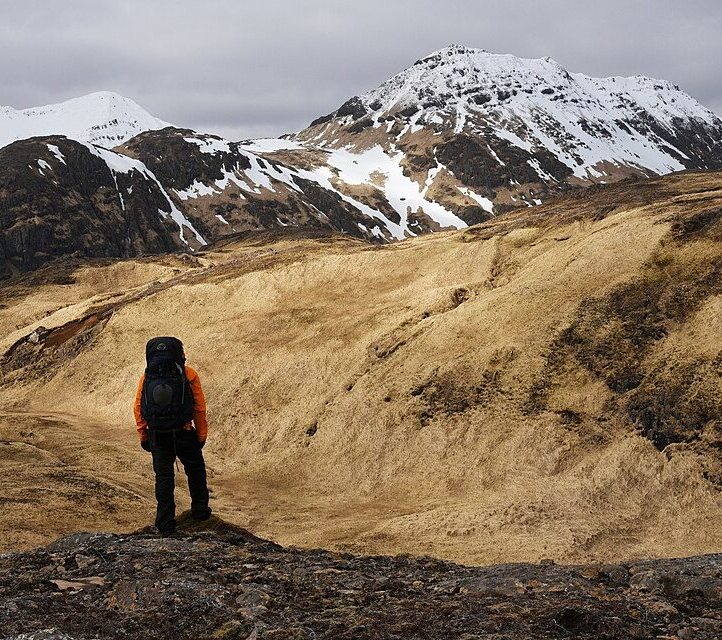
A backpacker in Adak wilderness on Adak Island. Photo by Paxson Woelber.
Merriam Webster has many definitions, from “a tract or region uncultivated and uninhabited by human beings” and “an area essentially undisturbed by human activity together with its naturally developed life community” to “a wild or uncultivated state,” “a confusing multitude or mass,” and “a bewildering situation.”
Perhaps “bewildering” says it all, for wilderness means many things: an ecological landscape of relatively intact natural systems; a cultural concept shaped by history, values, and Indigenous relationships to land; an imagined space of escape or the unknown; an experiential place that offers solitude, freedom, and the challenge of outdoor recreation; or a philosophical idea of nature beyond everyday human control. It may even be perceived as an untouched natural space, even when carefully managed as public land.
The closer you look, the more the idea of wilderness begins to unravel into contradictions. Is wilderness defined by the absence of people, or by the presence of nature, or the presence of both?
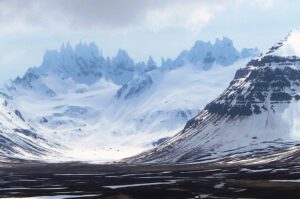
Aghileen Pinnacles in Izembek Wilderness. Photo by Kristine Sowl.
For many, Alaska represents wilderness.
Immense mountain ranges, braided rivers stretching for hundreds of miles, forests without roads, tundra disappearing into the horizon, wildlife that seems to outnumber people–if there is anywhere that fits that popular imagination of wilderness, it is Alaska.
But that picture is incomplete.
Those same landscapes are the home of Indigenous communities, their hunting grounds and the source of their subsistence traditions and culture. The concept of wilderness has really never described a place but rather reflects the perspective of the people using the word.
When wilderness became a proper noun
Despite its messiness (perhaps a wilderness in and of itself), the U.S. government has defined wilderness in legal terms–wilderness with a capital “W.”
A former Wilderness Society head, Howard Zahniser, drafted the Wilderness Act in 1956 to protect some of the nation’s last intact wild spaces.
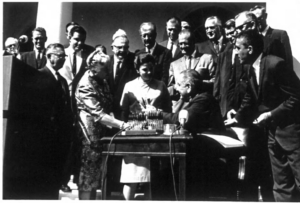
President Lyndon B. Johnson signs the Wilderness Act in the White House rose garden in 1964. Photo courtesy of USFWS.
Interests in mining, logging, building roads, and drilling had accelerated significantly throughout the 20th century, creating urgency around protecting large areas of wild unindustrialized land.
After several years and lots of debate, The Wilderness Act was signed into law by President Lyndon B. Johnson in 1964, establishing the National Wilderness Preservation System. The legislation created a legal definition for wilderness and protected 9.1 million acres of federal land from extractive practices while laying out long-term processes for establishing more designated wilderness in the future.
In the act, designated wilderness is defined as, “an area where the earth and its community of life are untrammeled by man, where man himself is a visitor who does not remain.”
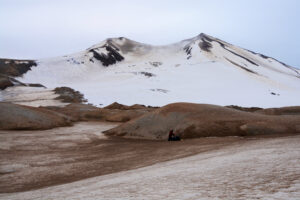
Katmai Caldera in Katmai National Park. Photo by Paxson Woelber.
Wilderness is further defined as “an area of undeveloped Federal land retaining its primeval character and influence, without permanent improvements or human habitation, which is protected and managed so as to preserve its natural conditions.,”
There are certain qualifications a piece of land must meet under the National Wilderness Preservation System aside from “untrammeled by man”.
Wilderness can only be designated by Congress. Federal land management agencies follow a specific process to identify areas for recommendation as designated wilderness, which begins with conducting a “wilderness review” to determine if an area is eligible and “suitable” for designation. The area must be largely shaped by natural forces, with little visible evidence of human activity. It should offer opportunities for solitude or primitive recreation, be at least 5,000 acres or large enough to be preserved without harming its natural character, and may contain significant ecological, geological, scientific, educational, scenic, or historical features.
The areas that meet these requirements and pass through Congress become designated wilderness managed by the four federal land management agencies—the U.S. Forest Service, National Park Service, Fish and Wildlife Service, and Bureau of Land Management.
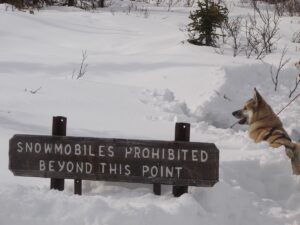
Much of Denali is federally designated wilderness, where motorized vehicles like snowmachines are prohibited. Photo courtesy of NPS.
Once Congress designates land as wilderness—defined by boundaries and meeting the designation’s requirements—it becomes illegal to conduct any commercial enterprises or construct permanent roads within the area, including for timber harvest, new grazing or mining activity, and any other type of industrial activity.
Additionally, the Wilderness Act states that there shall be no temporary roads, no use of motor vehicles, motorized equipment, no motorboats, no landing of aircraft, no forms of mechanical transport, and no structure or installation within designated wilderness areas.
Alaska—the wilderness exemption
While the Wilderness Act established a national framework for protecting America’s wild lands, it was built around the idea that wilderness should remain largely untouched by modern encroachment and industry.
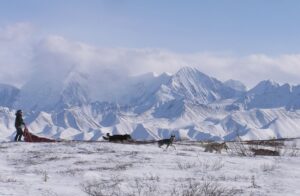
Dog mushing in Denali wilderness near Turtle Hill in Denali National Park. Photo courtesy of NPS.
Alaska presented a different set of challenges. Alaska’s remote landscapes are intertwined with rural communities, subsistence traditions, transportation needs, and a scale of wilderness unlike anywhere else in the country.
As efforts to designate and protect lands in Alaska expanded, it became increasingly clear that applying the 1964 Wilderness Act without modification would create conflicts with the realities of remote life in Alaska.
These tensions shaped the Alaska National Interest Lands Conservation Act of 1980, which preserved tens of millions of acres while establishing carefully crafted exceptions to Wilderness Act prohibitions to allow Alaskans to continue living, traveling, and sustaining their communities within and around designated wilderness. At the same time, ANILCA tripled the amount of land in the U.S. designated as wilderness.
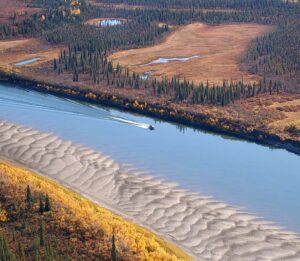
Motor boats are an essential way for village residents to travel, hunt and do other subsistence activities along the Kobuk River in Kobuk Valley National Park. Photo courtesy of NPS.
What sets ANILCA apart from many conservation laws is its recognition of Indigenous peoples’ long stewardship of what we call wilderness of one kind or another. The law gives rural residents, especially Alaska Natives, priority for subsistence, allowing hunting, fishing, and gathering for food, clothing, shelter, transportation, and making handicrafts, and for survival and cultural traditions in and around federal lands.
Rather than treating wilderness as a place entirely separate from human life, ANILCA recognized that people have long been part of these landscapes. The law therefore balanced preservation with continued human use, creating exceptions for activities such as subsistence and access that might otherwise conflict with the more restrictive framework of the 1964 Wilderness Act.
Drawing lines around wilderness
When an area is designated as wilderness, it has a specific legal status.
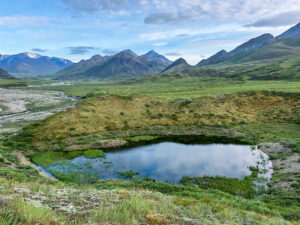
Mollie Beattie Wilderness in Arctic National Wildlife Refuge. Photo by Daniella Brigida.
In Alaska, designated wilderness can occur within larger federal conservation units, such as national parks, national wildlife refuges, and national forests. The Arctic National Wildlife Refuge contains the second largest area of designated wilderness in the country with nearly 40 percent having that designation. This designated area becomes a proper noun—Arctic Refuge Wilderness.
The Tongass National Forest, at nearly 5,756,000 acres, contains 19 distinct areas designated as wilderness, accounting for about one third of the forest.
Izembek National Wildlife Refuge was the first wildlife refuge in America to be designated wilderness, with 97 percent of the refuge protected at that highest level.
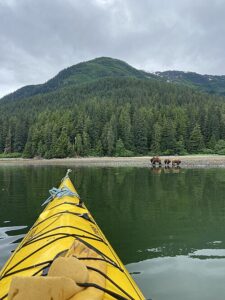
A kayak commute in Kootznoowoo Wilderness at Pack Creek Viewing Area in the Tongass. Photo by Mackenzie Schultz.
Other federal lands in Alaska, including national park lands, may have wilderness characteristics, such as being roadless and unindustrialized, but have not yet met the requirements for designation or have not been designated by Congress.
As a part of the National Wilderness Preservation System, the National Park Service categorizes park lands into five categories: designated wilderness; eligible wilderness or lands that meet the criteria but have not yet been formally designated; proposed wilderness or lands that have undergone the formal park service study and are recommended for designation; recommended wilderness or lands that have been recommended by the Department of the Interior to the President; and potential wilderness or lands that meet most Wilderness Act criteria but have temporary non-conforming conditions such as roads, structures, or mining claims that prevent immediate designation.
Take a look at this map to see the types of wilderness areas across the United States.
The value of the wild
Wilderness designation raises the question of whether preserving land means preserving it from the people or for the people. These lands aren’t free from human activity. We hunt, fish, camp, conduct research, and travel through designated Wilderness.
There’s a careful balancing act between preservation and use and assigning a Wilderness Act designation is assigning value on a particular bounded landscape for long-term protection.

Refuge sign of Izembek NWR. Ryan Hagerty, USFWS public domain.
Perhaps the problem with defining wilderness is that the definition is not solely or even mostly about land. Every attempt to draw boundaries around wilderness also draws a boundary around what people believe and value about that land, what we fear losing, what we are willing to protect, and what we are willing to give up to do so.
Wilderness areas are being threatened everywhere we look. Izembek Wilderness within Izembek Refuge is threatened by the construction of a road over the narrow Izembek Isthmus, the result of the Interior Secretary’s approval of a land exchange.
Whatever story the proponents of a road tell, a land trade made by an Interior appointee does not align with the public purposes and protections that Congress established by law for Izembek Wilderness and other areas of designated wilderness in Alaska.
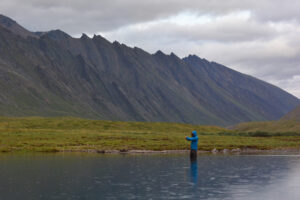
Fishing for Dinner in Thunder Valley. Gates of the Arctic National Park, Brooks Range, Alaska. Photo by Paxson Woelber.
Wilderness is also threatened in the Brooks Range. The Ambler road, a proposed 211-mile road, would stretch west from the Dalton Highway to mining claims. Along the way, the road would slice through Gates of the Arctic National Preserve, passing close to the wilderness area boundary. In addition, it would cut through nearly 3,000 streams, 11 major rivers, 1,700 acres of wetlands, and major caribou migration routes.
There are countless other threats to wilderness across the country.
Interior is moving forward with an ominous “review” of wilderness management policies that could open countless wildlands to extraction and unregulated motorized vehicle use. Designated wilderness, recommended wilderness, proposed wilderness, eligible wilderness and potential wilderness, all at stake. Many of these lands have not yet received designated wilderness status from Congress but have still been identified by experts as meeting eligibility requirements for protection and deserve appropriate management.
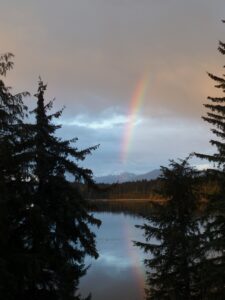
Kootznoowoo Wilderness, Tongass National Forest, Alaska. Photo by Don MacDougall.
Big Bend National Park is being bulldozed and wildlife poisoned within designated wilderness to prop up commercial grazing operations. Roadless protections are being targeted in the Tongass. Layoffs and cuts are impacting wildfire mitigation in wilderness areas and surrounding communities and continued widespread attacks on public lands are well underway.
Whether or not these areas of land were congressionally designated as wilderness with a capital “W” does not erase the need to defend and protect them.
Wilderness is not something we find. It is something we decide.
The mountains, rivers, caribou, bears, tundra, forests, and the communities that live within these landscapes existed long before we bewildered the word “wilderness” into a federal designation.
Wilderness is a human idea with all the inconsistencies and assumptions that come with ideas. As William Cronon points out in “The Trouble with Wilderness,” there is a deep irony in the history of the idea: the concept of wilderness came to reflect the very civilization its devotees wanted to escape. For many of the people who celebrated wilderness in the 19th and 20th centuries, wild country was an escape from the cities and industrialized world, but that vision often depended on ignoring and violently treating the people who already lived on and used those lands.
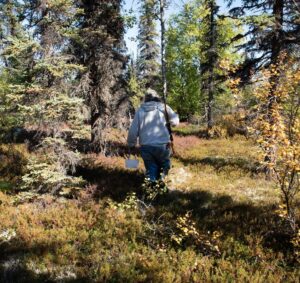
A subsistence hunter walks through the woods in Lake Clark National Park. Photo by D. Khalsa.
The history of setting aside national parks and wilderness areas is intertwined with the displacement of Indigenous people, “in which the prior human inhabitants of these regions were rounded up and moved onto reservations so that tourists could safely enjoy the illusion that they were seeing their nation in its pristine, original state.”
This history of removing people to revere “wilderness” without people presents an important question: Whose relationship to the land gets recognized, whose relationship gets restricted, and who gets to decide what a place is supposed to be?
To create designated wilderness, people with power drew boundaries, Congress approved the definition, agencies determined what lands qualify, and communities, Tribes, conservationists, hunters, recreationists, and industries argue over what those boundaries do and mean.
But wilderness does not hold value because of a designation. The value rises from the people who have stewarded the land since time immemorial, from the caribou who cross the rivers and streams and feed on the plains, from the bears who scour the streams for salmon, and from the birds who travel thousands of miles to feed and nest on the shores.
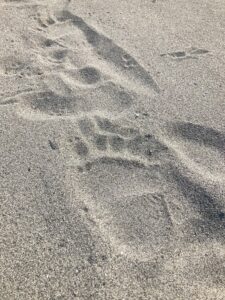
Bear, wolf, and human prints in Glacier Bay National Park. Photo by Dawnell Smith.
The Wilderness Act and ANILCA created powerful ideas and legal tools for conservation—tools we use every day.
The history of wilderness in Alaska should remind us that the protection of land cannot be separated from people.
As Alaska’s wild lands come under increasing pressure from the oil and gas industry, mining interests, climate change, and competing demands for access, it is important to recognize that the true value of these lands always comes from the profound experience of and connection to them.