


Beings and biomes—life in the subnivean zone
By Madison Grosvenor
The snow is finally falling in Southcentral. I have eagerly awaited skiing on fresh snow, watching my dog bunny-hop through the deep banks, and curling up at home under a blanket to watch the big flakes float down.
But I am not the only one who has long awaited a snowy winter.
Beneath the fresh white blanket spreading across Alaska’s forests and tundra, a hidden world is coming to life. Known as the subnivean zone, this narrow layer of space between the ground and the snowpack becomes a critical refuge for winter living.
What’s under the snow
In children’s books, I was always fond of the illustrations of little woodland creature dwellings hidden beneath the snow — tiny teacups on tiny tables, mice curled into armchairs, all of it glowing warmly around a miniature fireplace.
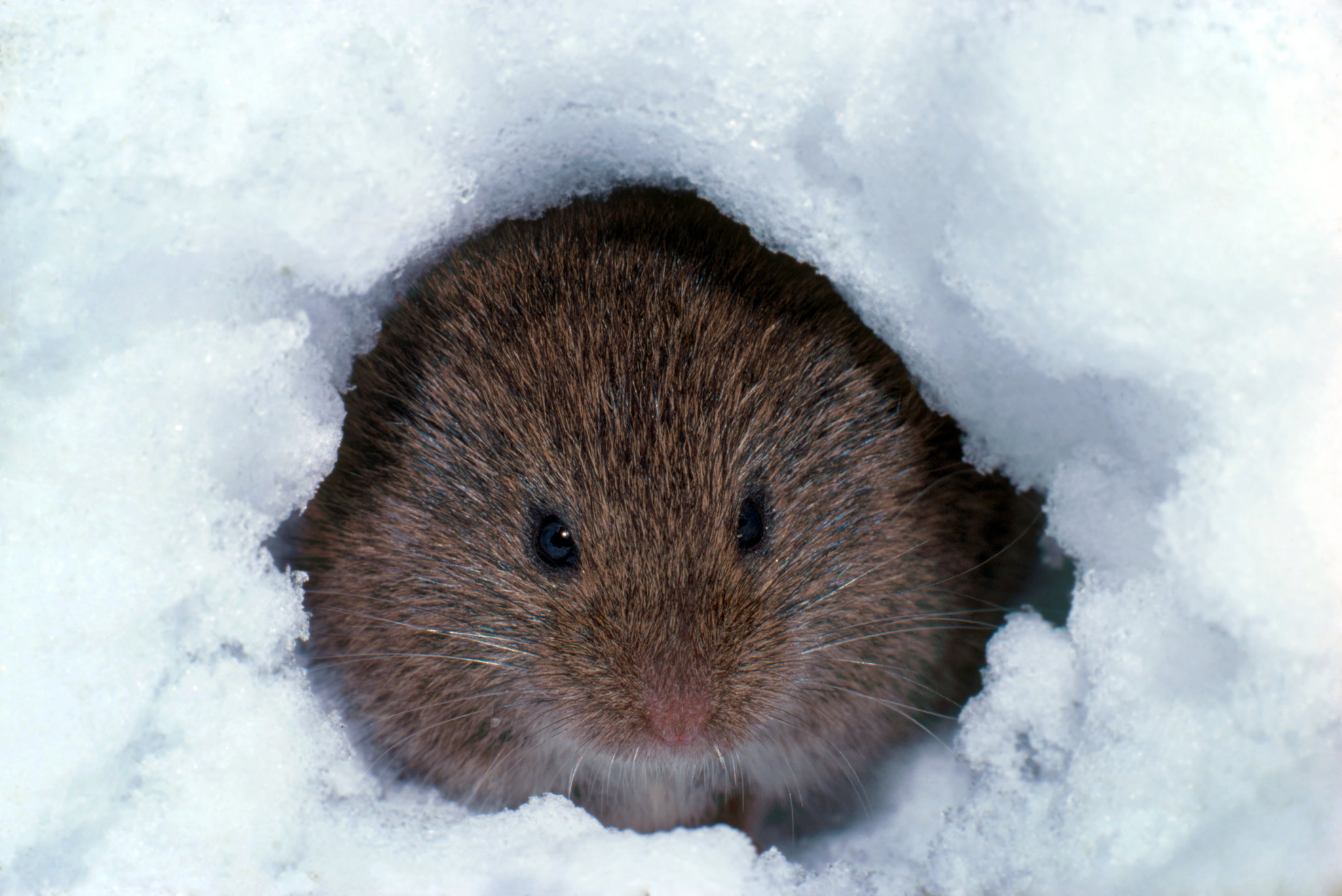
A vole pokes its head out of a tunnel in the snowpack. Photo courtesy of U.S. Fish and Wildlife Service.
That imagined coziness has a real-world counterpart: the subnivean zone, which forms when winter snowfall settles over uneven ground, vegetation, and rocks, trapping pockets of air beneath the snowpack and creating a sheltered space below.
As more snow falls, it insulates these spaces, trapping heat from the ground and preventing the lowest layer of snow from compacting. This results in a stable, warmer layer of air between the ground and the snow where small beings can thrive.
Small mammals like voles and mice spend much of the winter under the snow. This hidden world provides much needed protection from the cold weather and hungry predator animals.
Voles and mice create extensive tunnel and pocket networks through grasses, mosses, and leaf litter, allowing them to move, forage, and nest while remaining protected from predators and wind.
Voles will actually carve out complete underground quarters with an eating room, bathroom, and sleeping room.
Their small bodies with high metabolisms and thick fur help them generate and retain heat, while food caches and plant material under the snow remain unfrozen for them to constantly graze, which sustains them through the dark months.
A shrew travels on top of the snowpack. Photo by Colin Canterbury.
Shrews, which have even higher metabolic demands, also depend on the subnivean zone but must hunt almost continuously.
Unlike rodents, shrews eat insects, worms, and other invertebrates that remain active beneath the snow. Their incredible senses of smell and touch allow them to locate prey in tight spaces, and their ability to remain active year-round is crucial for their survival.
These small animals benefit entirely from the snowpack itself. Deeper, fluffier snow provides better insulation and protection, creating more stable conditions beneath the surface and supporting a healthier, more active subnivean microbiome.
Foraging grounds
Ptarmigans are the primary bird species active within the subnivean zone. They occasionally burrow into the snowpack to stay warm on harsh winter days and find sustenance under the snowpack.
Willow ptarmigans create specialized foraging tunnels that allow them to reach willow buds, twigs, and catkins that would otherwise be inaccessible beneath deep snow.
Plant growth and accumulated organic material form the foundation of the subnivean food web. This layer sustains overwintering rodents, birds, and larger grazers, like moose and caribou that eat plants and seeds buried beneath the snowpack.
Caribou dig up the snow to forage for lichens buried beneath the snowpack. Photo courtesy of Kyle Joly.
In turn, animal fecal matter and the decomposition of plant material nourish bacteria and microbes including fungi and algae, cycling nutrients back into the soil and promoting further plant growth, supporting the entire community beneath the snow.
In the fall, many trees lose their leaves, carpeting the forest floors with dead plant material. Throughout the winter, under the snowpack, tiny organisms transform forest floors carpeted with leaves and other plant material into rich, fertile soil.
Throughout the winter, this activity of subnivean wildlife, fungi, and microorganisms contributes to soil health. The lush green of spring depends entirely on the unseen recycling of nutrients that support growth and life all year.
The subnivean dinner bell
Beneath Alaska’s winter snow, the subnivean zone becomes an underground stage for predator–prey interactions. While small mammals travel through this insulated layer in relative safety, predator animals like foxes and weasels have evolved remarkable strategies to hunt what they cannot see.
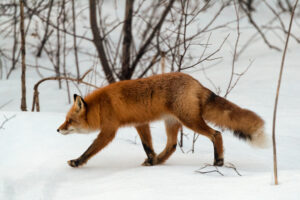
Fox stalks above the snowpack, listening for the rustling of rodents below. Photo by Eric Kilby.
On the surface of the snow, in what’s called the supernivean layer, animals like foxes, coyotes, lynx, and even wolves pause across snowy landscapes, heads tilted as they listen for the faint rustle of life below.
Red foxes have an incredible sense of hearing, able to hear a mouse squeak from up to 150 feet away.
In a sudden burst, foxes will leap or dive into the snow headfirst, breaking through the surface to reach their prey hidden in the tunnels beneath.
Above them, great gray owls and snowy owls strike with precision by sound alone through thick snow to snatch the small rodents moving just out of sight.
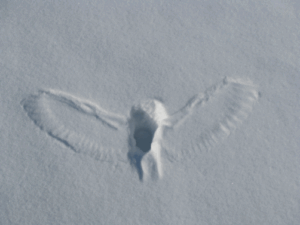
An owl dives into the subnivean zone, leaving an imprint in the snowpack. Photo courtesy of U.S. Fish and Wildlife Service.
The nature of the snow itself determines the outcome of these hunts. Deep, soft snow provides better insulation and protection for subnivean animals, allowing them to move freely and remain concealed.
When snow becomes sparse, dense or crusted, tunnels can collapse and movement becomes restricted, leaving prey more exposed to the animals above the pack.
Hunting animals above the snow are not the only ones small mammals contend with. Weasels and ermines also hunt small mammals, but they do so from within the snowpack.
Weasels, with their small size and long bodies, can effectively navigate the vast networks of tunnels and clearings.
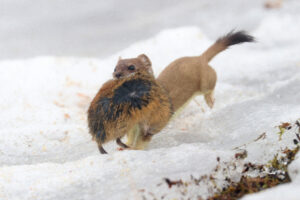
An ermine runs with a lemming in its mouth after a successful hunt. Photo by J. Mills.
In this way, predator animals like foxes and weasels, must not only responding to the animals below but to the snowpack as well, making the subnivean zone a boundary where winter conditions shape the balance of the biome.
As the season warms, and spring arrives, the subnivean zone wildlife will alter their strategies to adapt to the changing season. This begs the question… what will happen to the subnivean zone if the snow continues to disappear in our warming world?
The disappearing ecotone
Climate change is making winters warmer and snowpack less reliable. As a result, winters are bringing generally thinner and more inconsistent snow cover that reduces the insulating blanket that shelters small mammals and supports winter food webs.
Without adequate snow cover, subnivean inhabitants are increasingly exposed to harsh winter conditions, and the loss of this seasonal refuge has the potential to alter how the larger ecosystem functions year-round.
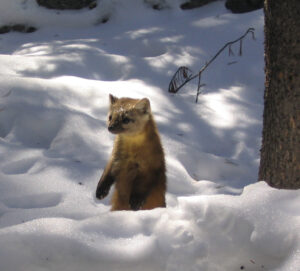
A pine marten pokes its head out of the snowpack. Photo courtesy of the U.S. Department of Agriculture.
Warmer winters are also marked by greater temperature variability. Colder extremes combined with more frequent freeze–thaw cycles can damage plant tissue both above and below ground, increasing plant mortality.
Thinner, denser, or more frequently melted snow exposes these animals to colder temperatures and increases their risk of predation, leading to lower survival and reproduction rates. As populations of small mammals decline or become more variable, predators such as foxes that depend on them for food face reduced access to food, in turn lowering reproductive success and forcing shifts in foraging behavior.
These effects can cascade further, influencing larger mammals and the broader food web, as changes in the dynamics between hunting animals and competition for food alter ecosystem balance across Arctic and subarctic landscapes.
These unstable conditions force animals living within the subnivium to expend more energy to survive, further stressing populations already adapted to stable winter environments.
If carbon emissions continue to rise at current rates, the global duration of the subnivium could decline from an average of 126 days per year to just 110 days by 2100, according to a 2019 study on snow-cover-dependent organisms.
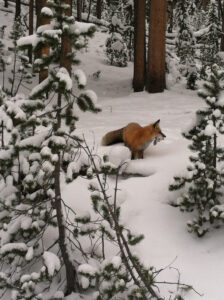
Fox has a successful hunt within the snowpack. Photo courtesy of Dan Smith.
In addition to these climate-driven changes, extractive land-altering practices such as road construction, seismic trucks and equipment crossing landscapes, oil and gas drilling, and other land disturbances alter vegetation and compact soils, disrupting the conditions necessary for the subnivean zone to form.
Together, climate change and landscape exploitation are reshaping an environment that many species have long relied on for winter refuge and survival.
It can be easy to forget that there is an entire hidden landscape beneath the snow we see as we leave our own tracks over the blanketed landscape.
Mushrooms continue to push through the soil. Plant matter decays and feeds the earth. Voles and mice build sleeping rooms and pantries, ermines slip through tunnels to feast in the next air pocket under snow, ptarmigan burrow away from the cold, and foxes pounce from the other world above.
This hidden world is alive and intricately connected to the communities of life on top of and below the subnivium, sustained by the steady shelter of winter snow.
And it is disappearing.
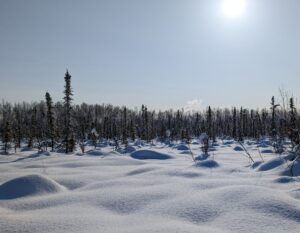
Snow blankets the Taiga near Fairbanks. Photo courtesy of the National Snow and Ice Data Center.
An ecotone is a place of transition between biological communities, often richer because it binds two worlds together. The subnivium is a sort of ecotone itself, bridging life above the snowpack with life below it, linking seasons, species, and survival itself.
We often talk about protecting habitats. We select specific places on a map for saving, clearly defined and easily named. But what about the spaces unseen and temporary, the quiet thresholds that exist solely within seasons and between ecosystems, unseen but just as essential?
The subnivean zone reminds us that survival doesn’t depend only on the landscapes that we can see, but on the fragile spaces of connection that hold them together.
This is the twelfth piece in our “Beings and biomes” series. You can find previous articles below:
- On beings and biomes–the wolverine
- On beings and biomes—the boreal forest
- On beings and biomes—keystone and indicator species
- On beings and biomes—a year in the tundra
- On beings and biomes—an intertidal abundance
- On beings and biomes—beluga whales
- On beings and biomes—caribou and their migrations
- On beings and biomes—the perpetual homecoming of migratory birds
- On beings and biomes—wetlands as the center of our everything
- On beings and biomes–eelgrass is the sexiest plant alive
- On beings and biomes—sea ice is everyone’s business