


Alaska News Brief July 2025—The real Moby Dick story
The true story that inspired the iconic book “Moby Dick” tells a tragic tale of people not thinking ahead. It makes sense, of course, that folks who are totally obsessed with their quest or just trying to survive can’t plot out the second and third order of consequences of their actions.
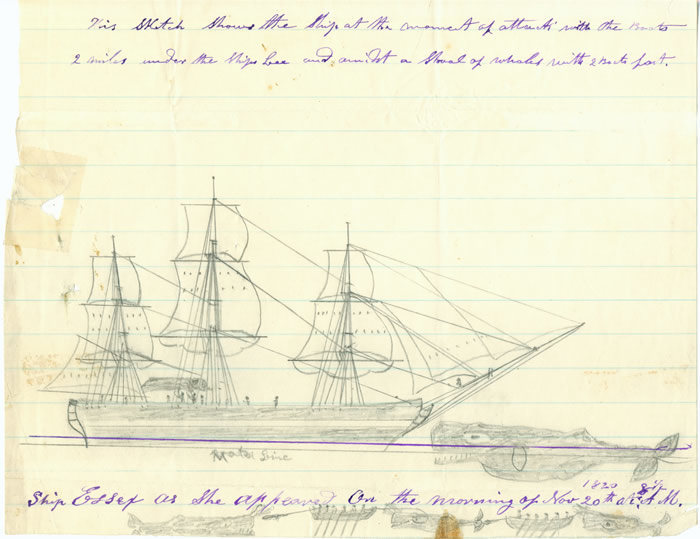
Drawing by Thomas Nickerson who was on the Essex when the whale rammed it.
The real story begins with the whaling ship, the Essex, and the whale that broke it. “In the Heart of the Sea,” the 2000 National Book Award winner in nonfiction by Nathaniel Philbrick, speculates that the sperm whale who rammed the Essex did so accidentally. I’m inclined to think that bull whale sank that ship to defend its pod from harpoons, but I suppose I’m speculating/anthropomorphizing too.
What happens next, though, is a tale of bad luck and bad decisions.
There were twenty crewmen on the ship from Nantucket, many in their teens, who jumped onto smaller whaleboats after the Essex sank. Those whaleboats were in bad shape. The crew drifted on those small boats for months in the Pacific Ocean, more than 1,000 miles from land. Without wind, they couldn’t get to South America and without food and fresh water, they suffered dehydration and starvation. When some died, others ate them.
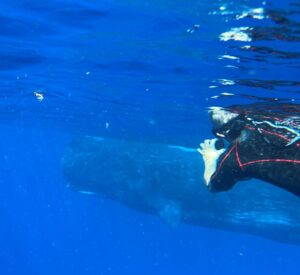
Vicki swimming alongside sperm whales off the coast of Dominica. Photo courtesy of Vicki Clark.
Earlier in the voyage, the crew landed on Charles Island (Floreana) in the Galapagos to hunt tortoises. A crew member started a fire on the small volcanic island as a prank, and that fire burned across the entire island. Another crew member visited years later and found the island still decimated, along with the Floreana giant tortoise, classified as extinct, and other endemic species like the Floreana mockingbird.
Like I said, it’s hard to think forward when you’re a kid playing pranks, or you can’t find food or water for survival. It’s hard to focus on long term consequences when you’re living paycheck to paycheck. Thinking ahead needs to happen a step ahead of a crisis.
Unfortunately, billionaires and industrial CEOs and consortiums with tons of resources for looking ahead aren’t trying to avoid bad consequences, they’re trying to hide them. They know that oil and gas is a finite resource and that a lot of people don’t want to spit more carbon pollution into the atmosphere, so they’ve been planning for petroleum’s future for some time—about how to leverage oil and gas in new ways, dirtier ways, more entrenched ways.
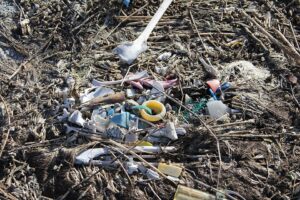
An Albatross carcass surrounded by plastic marine debris. Photo courtesy of USFWS.
Would we live in a plastic world—one with plastics filling and killing the stomachs of birds and marine life, collecting in giant rafts of trash, passing through our bodies and into our brains and the newborn babies—if we understood what plastics do?
Plastic production is part of the oil and gas industry’s “portfolio” of sustaining profits at the expense of a sustainable planet and the health of all who live on Earth. Plastic bags, bottles, car parts, dental materials, clothes, furnishings, to-go packaging, food storage, construction materials, toothbrushes, electronics, you name it, they’re part of making it,
The oil and gas industry knew about climate change, and they knew about the dangers of plastics. They withheld what they knew as far back as the 1970s—that plastics would never be recycled effectively.
Yet in the 1990s, companies like Exxon (yes, it knew), Chevron, DuPont and others paid tens of millions of dollars for ads with a “green” message about recycling plastic bottles and generally “promoting the benefits of a product that, for the most part, was buried, was burned or, in some cases, wound up in the ocean,” according to an NPR and PBS investigation.
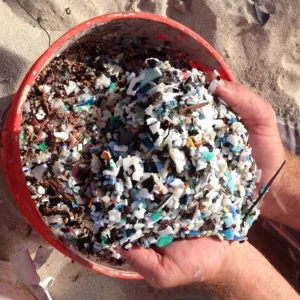
Plastic debris found in the Pacific Ocean. Photo courtesy of NOAA.
When this administration clearly hopes to maximize the sell-off of public lands to oil and gas leasing without regard to health, the future, or even good decision-making practices, that’s because Big Oil lobbyists have entrenched into the political body as nefariously as plastics have entrenched in supply chains, in products and materials, in our very tissue.
Oil and gas companies don’t give us a healthy future. They rip it out from under us. They do so because the systems of money and power that feed that industry and all its wrecks hold a lot of wealth and power.
The thing is, we are the body of Moby Dick. We live with the catastrophic and toxic consequences of their greed and lies.
If we want to put an end to a careless industry’s influence on the health of our bodies, our communities, and all living beings for generations to come, then we need to make our collective power heard—together, like waves, who cannot be silenced, who cannot be stilled.

PS. Thanks to supporters like you, we can continue fighting to protect Alaska’s land, water, air, wildlife and people.
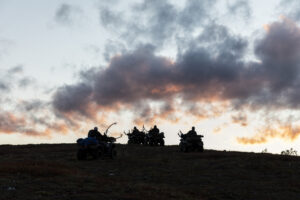
Gwich’in subsistence hunters in the Refuge. Photo by Keri Oberly.
The big bad budget bill and what Alaska stands to lose
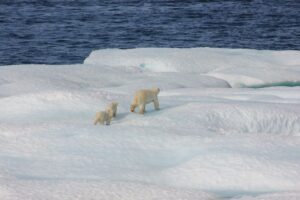
Polar bear and two cubs on ice floe. Photo by NOAA.
What does the Endangered Species Act do?
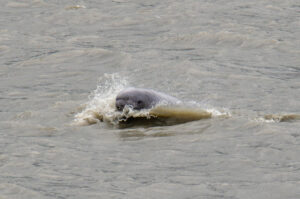
A beluga calf surfaces in the Turnagain Arm. Photo by Madison Kosma.