

Arctic news—threats loom over the Arctic Refuge and Southern Brooks Range
By Madison Grosvenor
A series of federal actions and legal developments this month set the stage for agency and court decisions that could reshape the Arctic region.
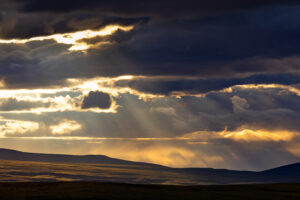
Sun rays through clouds light up the coastal plain north of the Brooks Range. Credit: Lisa Hupp/USFWS.
First, the U.S. Bureau of Land Management initiated the first step toward holding an oil and gas lease sale in the Arctic National Wildlife Refuge. The Bureau already announced a lease sale in the western Arctic on March 18 and has made the entire Arctic a target of aggressive and needless exploitation.
Second, threats to the coastal plain of the Arctic Refuge continue to mount, as U.S. Fish and Wildlife Service released a draft environmental assessment in late January for a proposed snow road through the refuge, as well as an additional sea ice route along the coast.
Third, we went back to court in late January with an updated complaint challenging the Trump administration’s 2025 decisions to reinstate unlawful 2020 permits for the proposed Ambler road.
Auctioning off public and sacred lands
The Bureau announced in early February a call for nominations for a lease sale on the coastal plain of the Arctic Refuge. This process basically asks for input from stakeholders like oil and gas companies, local communities, and of course you, to identify what sections of the coastal plain should or should not be included in the lease sale. Not only does this process demean the integrity of the coastal plain by cutting it up into parcels, but it also sets up a future lease sale with real consequences on the ground.
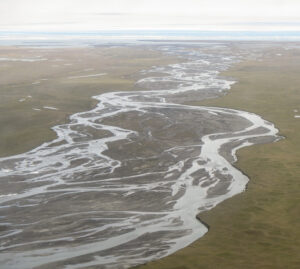
Aerial shot of the Arctic Refuge Coastal Plain. Photo by J Schoen.
This call for nominations is also the only remaining public comment period before the lease sale is scheduled. We encourage you to comment. You can let the Bureau know that no parts of the coastal plain should be leased to oil and gas interests. You can build the record by sending comments directly to the Bureau via mail or email. The comment period ends March 5th.
For decades, the Gwich’in of Alaska and Canada have stood united in opposition to industrial exploitation of the Arctic Refuge, and they continue to do so in the face of yet another push to put oil and gas interests on lands sacred to them.
“The Trump administration is hung up on oil and gas leasing in the Arctic Refuge because they cannot admit that the original Trump leasing plan–established following the 2017 Tax Act–was a complete and utter failure,” said Kristen Moreland, executive director of the Gwich’in Steering Committee, in a statement. “We condemn these actions and encourage officials in the Trump administration–and our representatives in the Alaska delegation–to acknowledge and accept what we as Gwich’in know, and what the majority of the American people agree on: the Arctic Refuge is no place for drilling.”
The first Arctic Refuge lease sale in 2021 drew little interest and yielded less than one percent of projected revenue; a second in 2025 drew no bids.
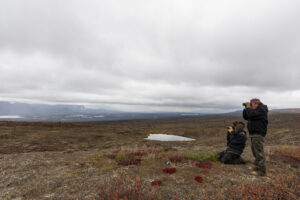
Greg Gilbert and Raymond Tritt scouting for caribou from the Porcupine herd. Photo by Keri Oberly.
The Porcupine caribou herd relies on the coastal plain of the Arctic Refuge to birth and nurse young and get relief from insects and predation, and Gwich’in in turn rely on the caribou for their identity, culture and food. Industrial activity threatens the Gwich’in way of life and the health of the region. Gwich’in Traditional Knowledge as well as Western science shows that intrusion along caribou migration routes and calving grounds harms herd health and reduces population numbers.
In December, we filed an updated complaint in our 2020 lawsuit challenging the Trump leasing program, challenging both the original 2020 plan and the Trump administration’s 2025 readoption of it. Our current lawsuit addresses those decisions, as well as the profound legal problems with the leasing program at large and with the reinstatement of the Alaska Industrial Development and Export Authority’s illegal leases.
“Plowing ahead with an unlawful leasing sale won’t make it legal, viable, or anything but a reckless land grab for the oil industry, but it does track with the administration’s ongoing disregard for the law, local communities, and good sense,” said Suzanne Bostrom, senior staff attorney with Trustees.
A snow road threatens the tundra
The U.S. Fish and Wildlife Service released a draft environmental assessment in January for a proposal by Kaktovik Iñupiat Corporation to build two winter road routes through the Arctic Refuge: an onshore snow road across the coastal plain along with a sea-ice route along the coast. The corporation’s proposal, tied to a 2021 application for a 20-year right-of-way, says it seeks improved access for the community of Kaktovik.
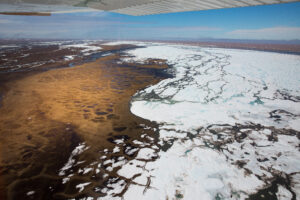
Arctic Refuge coastal plain and the canning river. Photo by Lisa Hupp.
Many Alaska communities grapple with affordable and reliable access to materials from outside Alaska, however Fish and Wildlife Service’s decision to process this application under Alaska National Interest Lands Conservation Act Section 1110(b) stretches the statute beyond its intent and would set a dangerous precedent—one that could open national wildlife refuges, parks, and wilderness areas across Alaska to similar road proposals.
There are also serious environmental and legal concerns with this proposal.
Constructing an onshore snow road in a low-snow, fragile tundra landscape would require repeated use of heavy equipment, risking long-term damage to permafrost, vegetation, and wildlife, including the Porcupine caribou. Also of note, species protected under the Endangered Species Act, including polar bears, seals, and spectacled eiders, live and move through the coastal plain and could be negatively impacted by this proposal.
“We cannot overlook the potential for short and long-term damage to fragile ground in the coastal plain and to the porcupine caribou herd that would result from the construction and use of a road,” said Moreland in a Gwich’in Steering Committee statement. “Our traditional knowledge tells us to always consider future generations, which is why we maintain our steadfast commitment to protecting the calving grounds from development that would fracture the migratory route and health of a herd that has endured for millennia.”
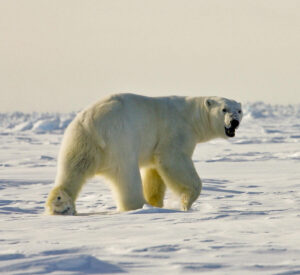
Polar bear wanders the coastal plain. Photo by Mike Lockhart, USGS.
Given the project’s scale, complexity, and foreseeable long-term impacts, the National Environmental Policy Act requires preparation of an environmental impact statement, not the limited environmental assessment the agency has drafted, along with a rigorous analysis of reasonable alternatives such as continued reliance on existing air and marine transportation.
Most concerning, the draft assessment itself acknowledges that the road could persist beyond the project’s lifespan and be used as a primary route for oil and gas transportation of heavy equipment, effectively opening the door to permanent industrial corridors across the coastal plain.
The assessment itself states, “In addition, it is reasonable to assume that this trail may be used as a primary route for oil & gas related overland travel that would allow further access to individual leases.” Despite that, the Fish and Wildlife Service did not analyze the impacts of using the snow road for oil and gas activities.
Trustees for Alaska submitted comments during the 15-day public comment period, outlining our concerns with the proposed routes.
What’s being considered here isn’t just whether one snow road is allowed, but whether the guardrails protecting Alaska’s refuges, parks, and wilderness areas still mean what Congress said they mean.
The Ambler déjà vu
Last month, Trustees, on behalf of ten conservation and community groups, filed an updated complaint challenging the Trump administration’s 2025 decision to reinstate permits for the Ambler Road—a 211-mile industrial gravel road through Northwest Alaska.
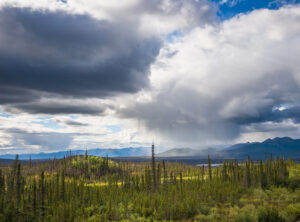
A rainstorm hits the southern foothills of the Brooks Range. Photo courtesy of BLM.
The project would subsidize foreign mining companies seeking access to copper and zinc open-pit mining as well as areas to potentially hundreds of smaller mining claims. The industrial road would cut through the Brooks Range and Gates of the Arctic National Preserve, cross nearly 3,000 rivers and streams, damage tundra wetlands, and disrupt one of the longest intact wildlife migration routes on Earth.
This fight isn’t new. In 2020, the Trump administration illegally approved the road. After Trustees filed suit in 2021, the court paused the case so the U.S. Department of the Interior could address legal flaws through a supplemental environmental review. That process led the Bureau of Land Management to deny the right-of-way in 2024, concluding that the road’s impacts to communities, food resources, and public lands were too severe.
Despite that finding, the Trump administration reinstated the permits in October 2025, claiming authority under the Alaska National Interest Lands Conservation Act— without fixing the original legal violations or addressing the project’s harms.
The amended complaint argues that the Bureau of Land Management, National Park Service, and Army Corps of Engineers exceeded their authority and violated multiple federal laws, and that President Trump unlawfully directed the project’s reapproval.
“Ramming through approvals for this destructive industrial road without even trying to address the harms it will do to communities, and the lands and waters across a vast stretch of the Arctic shows just how reckless this administration is,” said Suzanne Bostrom, senior staff attorney with Trustees for Alaska.
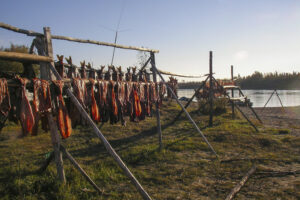
Subsistence fish on drying racks along the Kobuk river. Photo by Seth McMillan.
The southern Brooks Range and Gates of the Arctic are some of the last truly intact wilderness landscapes in Alaska. Clean rivers and sprawling landscapes support caribou, salmon, moose, birds, and the subsistence traditions of Alaska Native communities.
In a new documentary, Arctic Alchemy, scientist Roman Dial travels deep into this landscape, studying a troubling phenomenon already reshaping the Arctic. Remote rivers that once ran clear are turning a startling orange as climate-driven permafrost thaw releases heavy metals into surrounding watersheds.
These toxins threaten fish populations and the Alaska Native communities downstream who depend on them.
Rather than responding to these warnings, the proposed road would compound them. The industrial corridor would fragment caribou habitat, pollute pristine waters, and disrupt hunting, fishing, and cultural lifeways. It would permanently damage public lands like Gates of the Arctic National Park and Preserve.
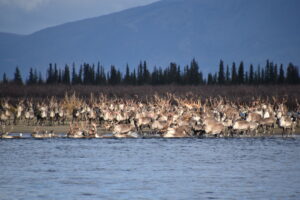
Caribou herd beginning to cross river near Gates of the Arctic National Park and Preserve. Photo by Kyle Joly.
The road’s route slices directly across the Western Arctic caribou herd’s migration corridor, creating a barrier to seasonal movement. This herd has already declined significantly, from nearly 500,000 animals in 2003 to just 121,000 in 2025. While herd numbers do fluctuate over time, these declines are dramatic.
Local opposition to the proposal has been clear. Seventy-four Alaska Tribes, fourteen Canadian First Nations, four major tribal consortiums, and 486 Tribes in the Lower 48 all oppose the proposed Ambler road.
In ignoring every local voice, every threatened caribou migration, every climate change red flag already visible in Alaska’s rivers, and every law in the book, the Trump administration is once again fast-tracking foreign mining profits at the direct expense of Alaskans and the land they depend on.
Who pays the price for the Ambler Road
The damage wouldn’t stop with the land and the people. The project’s price tag has ballooned past $1 billion, with no guarantee mining companies, not Alaskans, will pay for construction, upkeep, or long-term impacts.
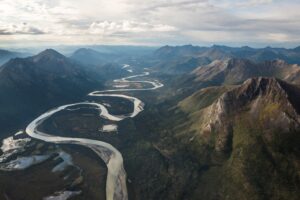
The Alatna River, photo by Sean Tevebaug.
Public money continues to flow into the project, raising the risk that Alaskans could be left subsidizing a private road for foreign mining interests. If mines never materialize, or shut down when profits dip, the state could be stuck with the bill and the communities stuck with the toxic consequences.
“This administration prioritizes the bank accounts of foreign mining companies over standing up for local communities and Alaskans. We’ll continue doing everything we can to protect clean water and air, local ways of life, and the health of the region,” stated attorney, Suzanne Bostrom.
We continue to stand up for the Brooks Range, the Western Arctic caribou herd, and the communities who have lived off this land for generations.