


Beings and biomes—Arctic raptors
By Dawnell Smith
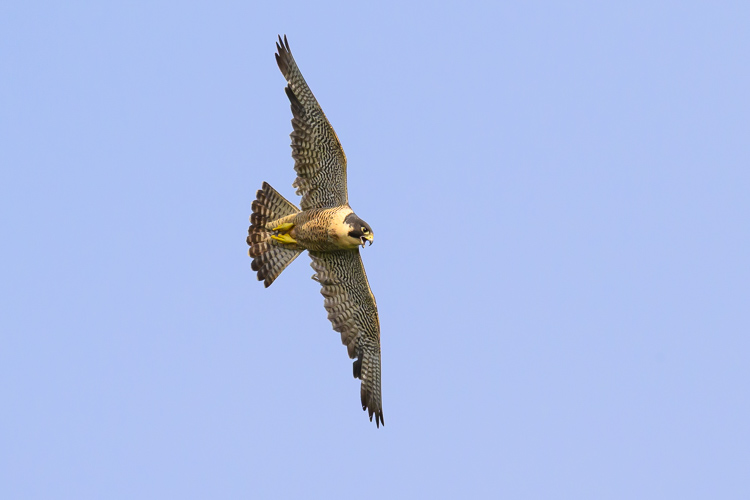
A peregrine falcon pivots from soaring majesty to plummeting projectile when diving up to 200 mph toward a chosen meal. The fastest animal on earth, the peregrine can snatch songbirds, waterfowl, and shorebirds at high speed, leaving a trail of feathers behind.

A peregrine falcon soars above the Colville River Delta. Photo by Gerrit Vyn, Cornell Lab.
This epic hunting style known as the “stoop” can blow your mind, but it’s not the only way raptors get their food. They fly low and fast to surprise other birds from behind. They ambush small animals in woody areas. They use their keen eyesight and hearing to locate small mammals on the ground.
The Arctic falcons of the Colville River—the Arctic peregrine, rough-legged hawks, and gyrfalcons—hunt and nest in their own ways, but they all depend on the Colville’s abundance to nest and nourish their chicks.
Fly fast, fly long
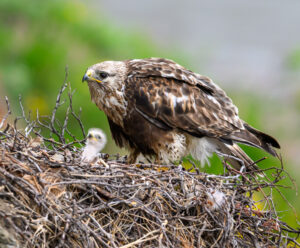
Rough-legged hawk and chick in the Colville River Special Area. Photo by Gerrit Vyn, Cornell Lab
Many people know about the storied bar-tailed godwit who flew over 8,000 miles from Alaska to Australia over 11 days without rest, or about the shorebirds and waterfowl who travel from their Arctic birthplace to all seven continents, but some folks might not realize that raptors also wander far and wide. In the winter, Arctic peregrines go as far south as Argentina. Rough-legged hawks head to southern Canada and the northern Lower 48 states. Gyrfalcons do the snowbird thing in the northern Lower 48 states occasionally too when ptarmigans populations drop during Arctic winter months.
These birds may go separate ways in the summer but all return to the Colville River to raise their chicks.
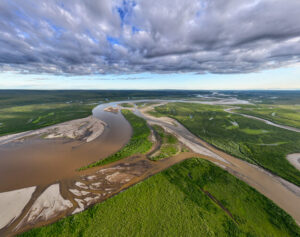
The Colville River, from above. Photo by Gerrit Vyn, Cornell Lab.
The Colville, the largest river in Alaska’s Arctic region, provides a uniquely ideal nesting area that stretches hundreds of miles and contains a variety of foods for birds of prey.
When working with the Cornell Lab of Ornithology, Gerrit Vyn made a short film focusing on the importance of the Colville to raptors. A photographer and cinematographer now working on a multi-year project to document the varied habitats and wildlife in the western Arctic, Vyn wants to fully expose and recognize the full beauty and diversity of the region for the first time.
Until he traveled to the Colville, he didn’t realize how far and thick the willows went along the river course, he said, “and just the abundance of nesting songbirds there. In those willow gallery forests along the water there are the bluethroats, the arctic and yellow warblers, northern waterthrushes, and this whole other convergence of global Arctic birds who go to Africa, Asia, the neotropics and other continents. And the density of raptor populations—every good stretch of cliffs is occupied.”
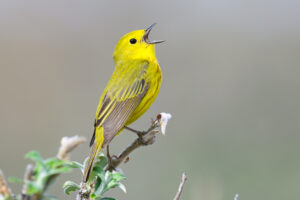
A yellow warbler in the brush of the Colville River Special Area. Photo by Gerrit Vyn, Cornell Lab.
These raptors rely on these thrushes and warblers for food. Peregrine falcons hunt for these songbirds as well as tundra shorebirds, while rough-legged hawks eat mostly voles and lemmings, with songbirds as a rare meal. Gyrfalcons prefer larger birds like ptarmigan.
Though raptors usually seek isolation from other birds of prey, especially when nesting, the Arctic-born ones from the Colville River share the cliffs where there’s bountiful space and plenty of food.
What makes an area special?
The Colville runs across the southeastern border of the poorly named National Petroleum Reserve-Alaska, the largest unit of public land in the country. The Reserve got its name because of the officials who named it and what they wanted to extract, but the region fundamentally and inherently nourishes life, with the area’s raptors part of a larger community of birthing, nesting, growing, blooming beings from tundra cottongrass, Arctic lupine and reindeer moss to wolves, caribou and golden eagles.
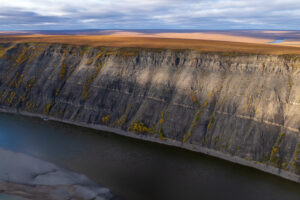
Cliffs of the Colville River Special Area. Photo by Gerrit Vyn, Cornell Lab.
When the oversight of the Reserve transferred to the U.S. Bureau of Land Management in 1976, people understood the importance of certain areas and designated them as “Special Areas” protected from industrialization.
Until a recent Trump administration decision, there were five designated Special Areas within the 23-million-acre Reserve: The Colville River, Teshekpuk Lake, Utukok River, Kasegaluk Lagoon, and Peard Bay.
If you ask Vyn, each of these areas deserves a name that aligns with their inherent, natural role in the Arctic—the Colville River Special Area should be called The Colville River Raptor Reserve, for example, and the Teshekpuk Lake Special Area should be named the Teshekpuk Lake International Migratory Bird Reserve.
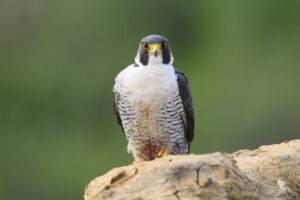
A peregrine falcon stares down the lens. Photo by Gerrit Vyn, Cornell Lab.
The Colville River Special Area had followed the river for more than three hundred miles in a corridor covering 2.4 million acres, including two of its main tributaries. Keeping industrial projects out of this area had protected arguably the most diverse and dense accumulations of nesting raptors in the circumpolar Arctic, along with an array of wildlife. But the Trump administration adopted a plan that eliminates the Colville River Special area entirely.
Many groups including Trustees are pushing back. Safeguarding these places matters. Arctic peregrines were once listed as endangered under the Endangered Species Act but were delisted in 1994 because of the strength of the Colville population.
A raptor’s alarm
Raptors don’t talk much, but when they do, it’s because they’re defending their nests. Unfortunately, Colville raptors can’t show up in hearings and courtrooms to defend their home cliffs from bad agency decisions and industrial projects, so we speak up for them.
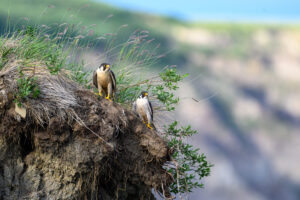
Peregrine falcon pair perched on the river side. Photo by Gerrit Vyn, Cornell Lab.
We filed a lawsuit last month challenging the Trump administration’s land management plan eliminating protection of the Colville River area.
There are huge problems with the management plan. The agency decision even claims it can allow lease sales of Reserve lands to the oil and gas industry until 2045 or beyond without looking at impacts on wildlife, landscapes, and people.
If it took over two decades for the Colville River Arctic peregrine population to grow large enough to help the subspecies numbers stabilize and be delisted from endangered status, what would two decades of unfettered industrialization look like for these birds?
The encroachment of industrial roads, structures, noise, pollution, and the ensuing landscape destruction that crushes and crumbles wildlife habitat poses a deep threat to Colville raptors and all the birds and wildlife along the river corridor and delta.
It’s true that the Colville River flows far from most people’s lives and attention, but Colville birds fly everywhere. When you hear these raptors “kak” and wail and whine somewhere else around the world, think of them as reminding you about the Arctic river cliffs thousands of miles away where they were born and where they will bring new life, just like the songbirds, shorebirds and waterfowl who return home every year.
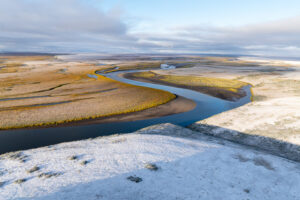
Colville River Special Area’s winding rivers and tributaries. Photo by Gerrit Vyn, Cornell Lab.
“I think people think of these places as homogenous, as snowy barren landscapes with little life, but now that I’ve been to most of these Special Areas, I see how each of them is so different and unique,” said Vyn. “The Colville River and those tributaries that flow into it are some of the most remote, spectacular wild land that you can step onto in this country.”
This is the latest piece in our “Beings and biomes” series. You can find previous articles below:
- On beings and biomes–the wolverine
- On beings and biomes—the boreal forest
- On beings and biomes—keystone and indicator species
- On beings and biomes—a year in the tundra
- On beings and biomes—an intertidal abundance
- On beings and biomes—beluga whales
- On beings and biomes—caribou and their migrations
- On beings and biomes—the perpetual homecoming of migratory birds
- On beings and biomes—wetlands as the center of our everything
- On beings and biomes–eelgrass is the sexiest plant alive
- On beings and biomes—sea ice is everyone’s business
- Beings and biomes—life in the subnivean zone
- On beings and biomes—the translucent bear