


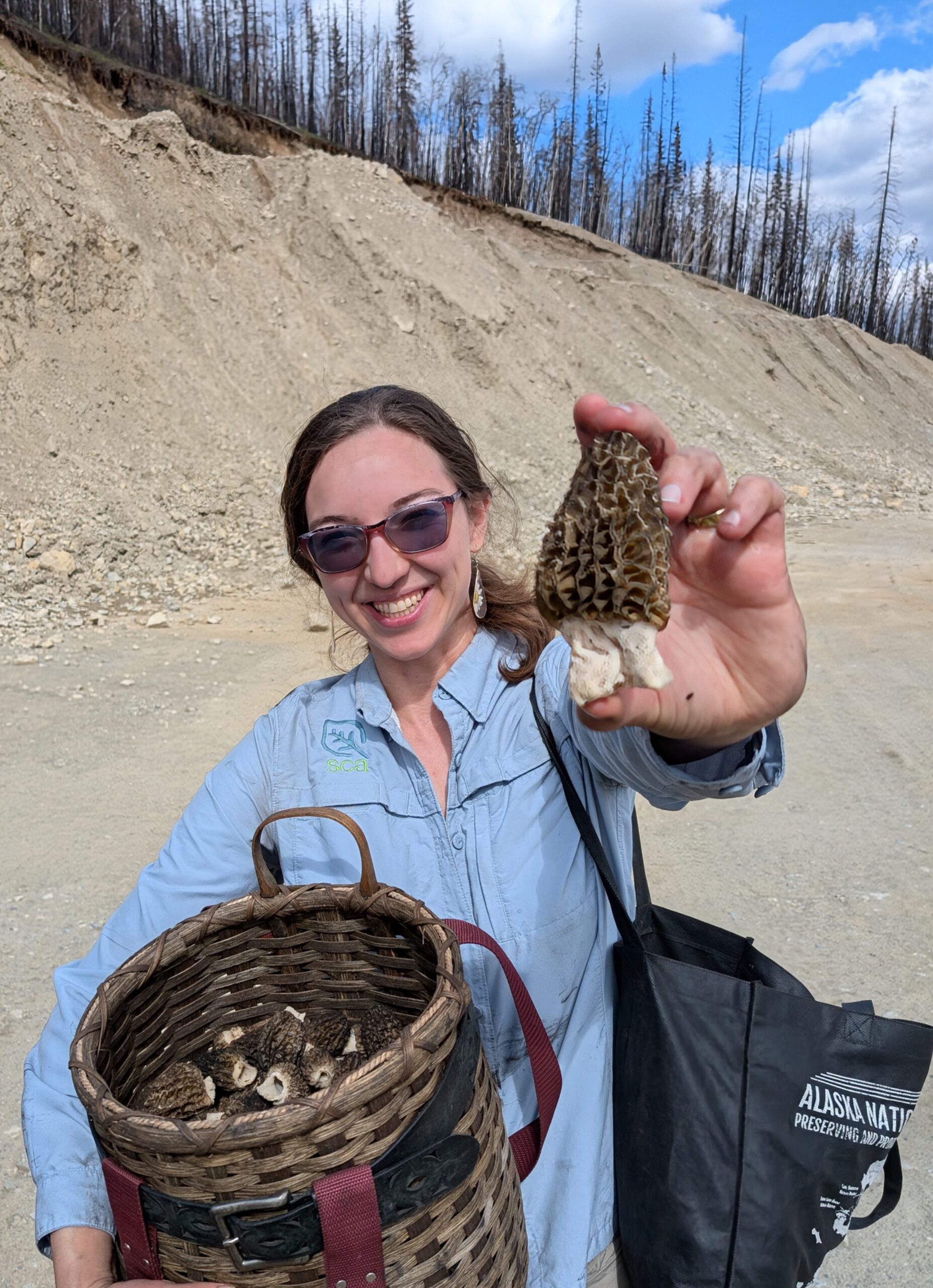
Being and biomes—the mighty morel
By Christin Swearingen
Walking through the burned forest, between black, bare trunks, my shoes covered in ash, I scour the ground for fleshy, honeycombed caps. These morel mushrooms, genus Morchella, look very much like spruce cones. They have a meaty, earthy flavor with texture like tripe or thinly sliced steak, with a hint of smoke, and are perfect for soaking up cream sauce (recipe at bottom of page).
These mushrooms live in intimate relationship with fire, and their emergence propels the nutrient recycling and root connections necessary for plant and tree growth. To know their importance, aside from in our food, it’s helpful to know basic mycology.
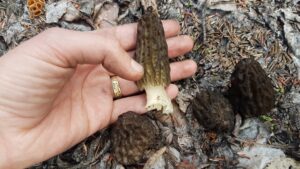
Christin finds fire morels along the forest floor. Photo by Christin Swearingen.
Fungi basics
Morels belong to the kingdom fungi, along with other mushrooms, molds, rusts, and yeasts. Fungi are more closely related to animals than plants and have a similar need for oxygen and food, which they absorb through tiny pores in their cell walls. Fungal cell walls are made of chitin, the same thing that comprises shrimp and crab shells.
Mushrooms are the fruiting bodies of an underground network of threadlike cells called a mycelium. If you’ve ever broken a rotten log and seen fluffy white strands running through it, or seen a patch of mold on an orange, that is mycelium. The mycelium grows through a substrate, and when conditions are right, forms mushrooms which release spores.
Most mushrooms only last for a few days or weeks before rotting, but the mycelium can continue to live for years, as long as it has substrate to consume and the right balance of moisture and oxygen. The oldest known example of a single mycelium is an Armillaria in Oregon that spans three square miles and is estimated to be around 8,000 years old!
The great recycler
Morels can play different roles in the environment. Morels that emerge from the intense heat of wildfires are thought to form facultative mycorrhizal (my-koh-RYE-zal) relationships with conifers, which means that if the right trees are nearby, they will partner up to trade nutrients for sugars. Mycorrhizal fungi have a special friendship with plants, their mycelium connects to the tips of plant roots and exchange dissolved nutrients and minerals for photosynthetic sugars.
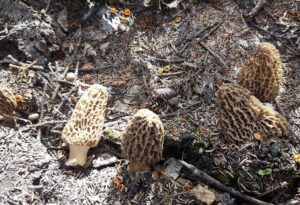
Fruiting bodies along the forest floor. Photo by Christin Swearingen.
They could also act as decomposers if needed. Decomposer fungi break down dead organic matter as the single cells that make up a mycelium—called hyphae–exude digestive enzymes and soak up nutrients.
Morels also have an interesting trick to survive extreme temperatures. The mycelium forms hard, walnut-size growths called sclerotia deep beneath the organic layer of soil. The sclerotia overwinter and then make more mycelium in the spring.
In the event of a severe forest fire where the duff layer between the top undecayed forest floor and deeper mineral layer burns away, the morel’s host trees die, and the sclerotia switch to making fruiting bodies we know as morels. Morels will be found for a few years during the spring after a fire, but after the sclerotia are depleted, they will stop showing up.
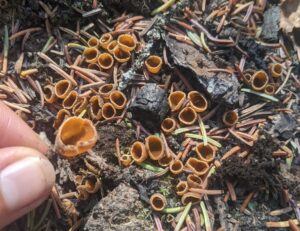
Geopyxis carbonaria or the “charcoal pixie-cup”. Photo by Christin Swearingen.
Some morels can be found fruiting in non-burned areas in the spring but are much less abundant than “burn morels.”
Other species of fungi besides morels are “pyrophilous” or fire-loving. Some facilitate the recovery of plants by forming mycorrhizal relationships right away with plant seedlings. Others, like Geopyxis carbonaria, the charcoal pixie-cup, bind the soil with spreading mycelial mats that reduce erosion and nutrient runoff.
A bounty of morels, a threatening future
Back again in the forest searching for those delicious caps, I look for sunny slopes where the fire was so intense that it burned away all of the moss and decomposing plant matter, exposing light-colored mineral soil. There, clustered under a blackened aspen trunk, is a bouquet of velvety grey-brown mushrooms. I cut close to their base to leave most of the ash in the ground, taking all but a few old ones that will spread their spores.
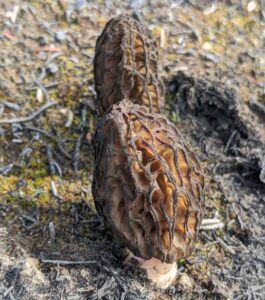
Morel pair grows in the charred soil. Photo by Christin Swearingen.
Morels can sometimes be found growing as singles or twos in undisturbed forest but to fruit in large numbers like this, they require fires that used to happen once every 100 years. Now those massive fires are happening more intensely and frequently due to the changing climate. I have had success foraging morels four of the past five years because of these devastating fires. But that seemingly bountiful outcome also means that the forests morels rely on face a dire future.
I think back to the Swan Lake Fire that severely burned 170,000 acres on the Kenai Peninsula in 2019. When I foraged for morels following that fire, I found bones from moose and other animals who didn’t escape.
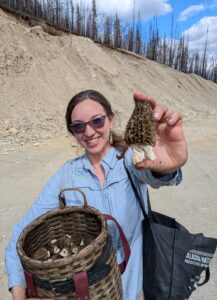
Christin holds up a morel find! Photo by Karlin Swearingen.
There is a possibility, as summers become hotter and drier, that black spruce forests will not recover. Climate scientists predict grassland eventually replacing the forest habitat, and Interior Alaska converting to a grassland steppe (Alaskan dry grasslands). With the loss of black spruce would come the loss of the entire community of life within that ecosystem, including valued fungi like morels and chaga, as well as the cultural practices that rely on them.
For now, I’m grateful for the earthy gifts I can bring home and make into meals—meals that bring us together and help us remember our relationship with nature. May we all eat heartily and recycle that nourishment into our commitment to protect Alaska forests.
Morel Cream Sauce
- 1 tablespoon olive oil
- 1 tablespoon butter
- 8-oz wild morels, fresh or rehydrated in warm water for 20 minutes
- ¼ c. finely chopped shallots, or onion
- 2 cloves garlic, minced
- Handful of raisins (optional)
- 2/3 cup morel soaking water or veggie broth
- 2/3 cup dry Marsala wine
- 2/3 cup heavy cream
- 2 teaspoons chopped fresh thyme
- 2 tablespoons chopped fresh Italian parsley, for serving (optional)
- Salt and pepper
In a steel or nonstick pan, melt the butter and olive oil. Add the mushrooms and cook, stirring frequently, until the mushrooms begin to brown, 3 to 4 minutes. Add the shallots, garlic, and 1/4 teaspoon of salt; cook for 1 to 2 minutes more. Add the broth, Marsala, heavy cream, thyme, and pepper; use a wooden spoon to scrape any brown bits from the pan into the liquid. Bring the liquid to a boil, then reduce the heat to medium and gently boil, uncovered, until the sauce is reduced by about half, slightly thickened, and darkened in color, 20-30 minutes. Sprinkle with parsley and serve on a bed of fresh fettucine.
More about Christin:
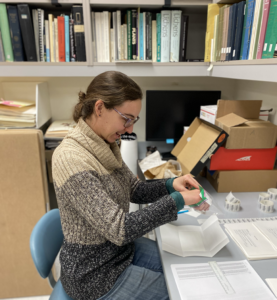
Christin packaging a fungi specimen. Photo by Cam Webb.
In my free time, I am a community mycologist. I volunteer for the Fungal Diversity Survey, a national nonprofit dedicated to the documentation of mushrooms in North America, and I have coordinated the West Coast Rare Fungi Challenge for five years (fundis.org). The study of mycology lags behind botany and zoology, such that there isn’t enough information about where mushrooms grow and their ecology to make conservation decisions. The West Coast Rare Fungi Challenge works to change that by “challenging” the public to document rare or under-documented species and then use those data to make assessments of species rarity using the International Union for Conservation of Nature Red List.
Locally, I help coordinate the Fairbanks Fungi Festival coming up on Aug. 30, 2026, teach mushroom identification classes in the fall, and am a volunteer curator of the University of Alaska Fairbank’s first fungarium in collaboration with the Museum of the North’s herbarium staff.