


Beings and biomes—Alaska’s iconic brown bear
By Ashley Donovan, legal fellow
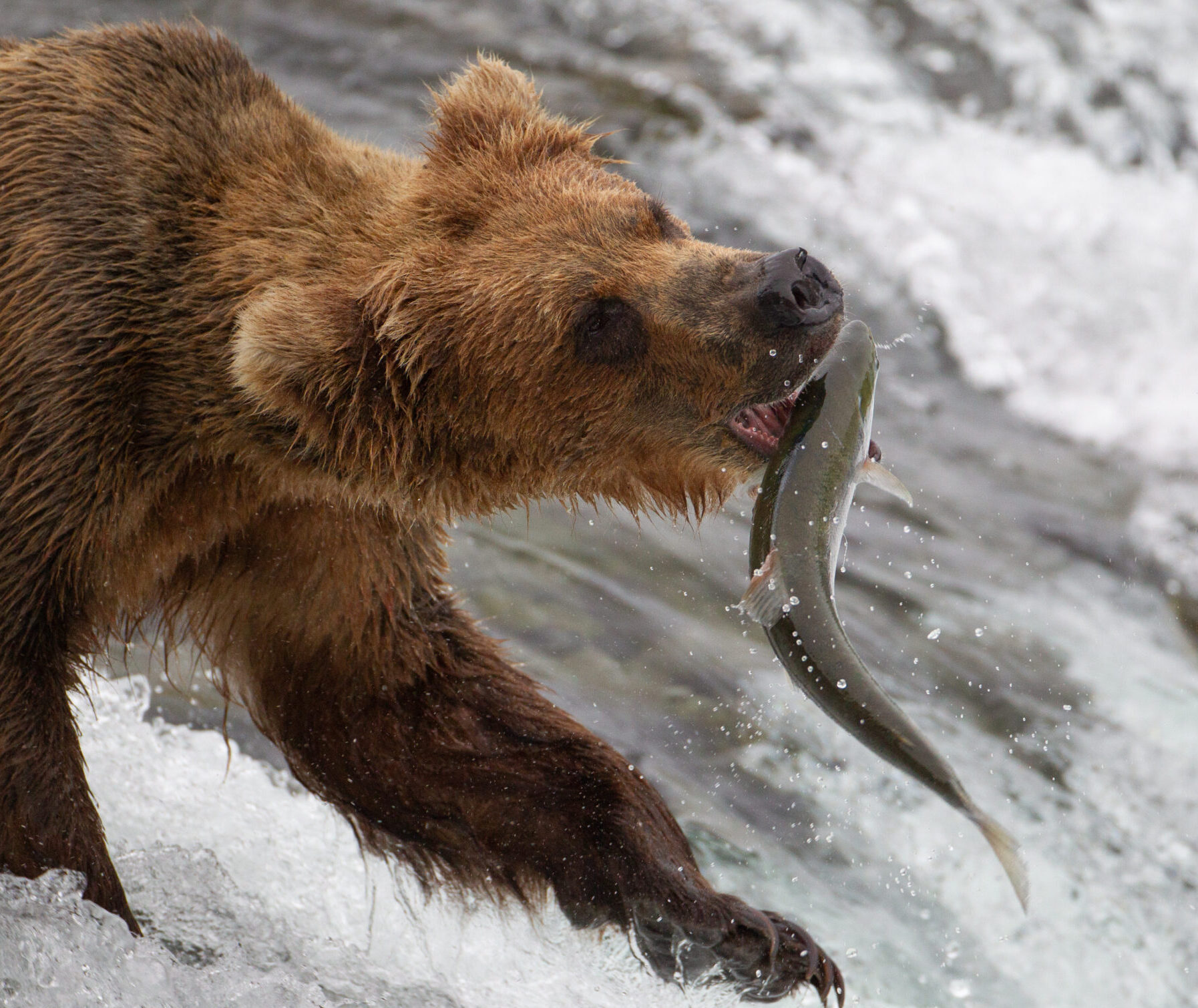
Every summer, dozens of massive, powerful brown bears converge along the braided rivers, waterfalls, and tidal flats of Alaska’s southwestern coast. Salmon returning to spawn race upstream, surging through rushing water and flinging their bodies over waterfalls. Bears straddle these watery highways, snatching salmon to fill their bulging bellies.
Brown bear at Brooks Falls. Photo by Peter Pearsall.
As playful, fluffy cubs tumble and wrestle along the shore, sows fiercely defend them from threats. Posturing boars jockey for the best fishing spots, challenging one another for dominance and occasionally exploding into an intense, powerful flurry until the victor pins his opponent.
The rotund brown bear fishing for spawning salmon is one of the most iconic symbols of Alaska. These coastal brown bears are among the most powerful land mammals in the world and a driving force for Alaska’s tourism industry.
More than that, these bears are vital to the ecosystems they live in and move through. In Southwest Alaska, such as in the Katmai and Lake Clark national parks, brown bears occupy an essential ecological role by cycling nutrients, regulating prey species, and dispersing seeds.
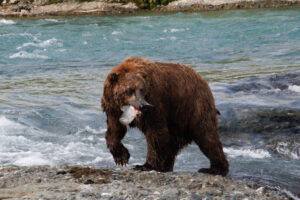
A brown bear with its catch at McNeil Falls. Photo by Madison Grosvenor
As an indicator species, the brown bear’s presence or absence is representative of the overall health of their environment. These bears are sensitive to environmental change as they rely on abundant salmon runs and have expansive ranges. Climate change, industrial development, and State of Alaska policies threaten these vital and beloved creatures.
Healthy bears, healthy ecosystems
Mainland Alaska has two distinct brown bear subspecies: the grizzly bear of Interior Alaska and the coastal brown bear inhabiting the Alaska Peninsula and Southcentral Alaska. Weighing between 400 to 1200 pounds, the coastal brown bear is larger than the grizzly, who weigh a “mere” 300 to 1000 pounds. Diet explains the difference. While inland grizzly bears eat mostly plant foods like roots and berries, the coastal brown bear’s diet consists mostly of fatty, protein-rich salmon.
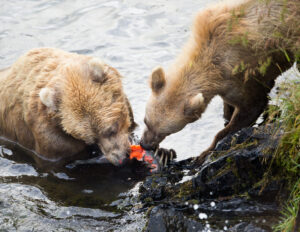
A mother and cub share a breakfast of salmon. Photo by Lisa Hupp, USFWS.
During summer and early fall, coastal brown bears congregate along rivers to fish. They often chow down on the most calorie-dense parts of the fish, specifically the skin, brain, and eggs, building the fat reserves necessary to survive winter hibernation.
After catching salmon, bears often discard the half-eaten carcass into nearby forests. In doing so, they transport marine-derived nutrients—nitrogen, phosphorus, and carbon—into terrestrial ecosystems.
The fish carcasses feed birds, wolves, foxes, and invertebrates. As these salmon remains decompose, they fertilize soils and enhance plant growth. About 25 percent of the nitrogen in the foliage of trees within 500 yards of salmon streams comes from the ocean, and these trees grow three times faster than those farther away. These healthier trees and plants provide shade, prevent erosion and sedimentation, and house insects. In this way, healthy bear populations boost forest health and productivity.
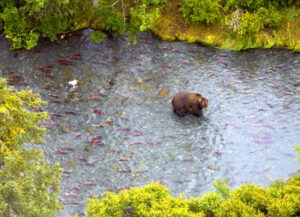
A brown bear is surrounded by salmon in Kenai National Wildlife Refuge. Photo by Steve Hillebrand.
Brown bears are an indicator species, meaning their presence reflects the health of the entire ecosystem. The salmon they eat are born in freshwater streams, migrate to the ocean, and return years later to spawn. Salmon survival depends on clean rivers, productive marine feeding grounds, and stable ocean temperatures. When salmon runs decline due to overfishing, warming oceans, pollution, or habitat destruction, bears feel the effects.
Reduced salmon availability can lead to lower bear body weights, decreased reproductive success, and increased competition among bears.
Vegetation feels the ripple effects, too, as that potent source of nitrogen from discarded salmon carcasses becomes scarcer. Additionally, bears in search of alternative food may wander closer to humans, increasing the likelihood of conflict.
The bear’s burden in a warming world
Climate change impacts bear’s behavior and physiology. Rising ocean temperatures alter salmon’s migration timing and abundance. In some parts of coastal Alaska, salmon are now arriving earlier due to warmer waters. In other places, higher temperatures cause berries to ripen earlier, concurrently with this salmon migration.

A grizzly bear sow and her cub eat berries and roots from the edge of the Toklat River. Photo by Emily Mesner.
Researchers have observed changes in bear foraging behavior, with bears sometimes choosing to feed on berries rather than fish when both are available simultaneously. In such cases, bears have less fat for hibernation and are not dragging salmon into the forest, contributing nitrogen to the soil.
Climate change is also impacting the timing of bear hibernation. Reduced food availability may cause bears to hibernate earlier, while a warm winter may give bears an early wakeup call, causing them to rise from their dens before their food sources are available.
Should they wander into areas with people, conflicts are likely to increase as humans do not expect to see bears year-round.
Alaska’s bear populations are also facing threats from extractive industries. Coastal regions of Alaska face pressures from mining, logging, and other industrial activities. Road construction fragments bear habitat, intersecting movement corridors and interfering with access to resources. The construction and operation of industrial projects degrade water quality and salmon spawning habitat. Such impacts may lead to declines in cub survival, reduced body mass, or altered distribution patterns.
Bears in the crosshairs of state policy
Brown bears are directly threatened by the State of Alaska’s policies. For decades the Alaska Board of Game has systematically targeted bear populations by authorizing more aggressive hunting practices and implementing predator control programs, all of which are designed to decimate predator populations.
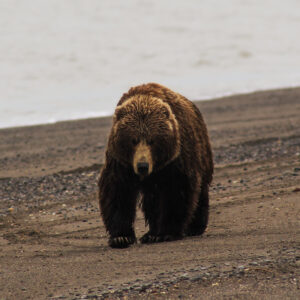
A brown bear ambles down the beach near Lake Clark National Park and Preserve. Photo by Madison Grosvenor.
In 1994, the Alaska Legislature passed the Intensive Management Statute. The explicit goal of that statute is to maintain, restore, or increase the abundance of big game populations for human consumptive use. Where the Board determines that populations of animals, such as moose and caribou, are not high enough to meet consumptive uses, the Board cannot take other conservation measures unless it also implements an “intensive management” plan. The statutory definition of “intensive management” makes clear that the State’s wildlife management objective is to increase populations of caribou and moose for human harvest by reducing predator populations. The State has done this through broadening sport hunting regulations and implementing predator control programs.
The Board has become increasingly aggressive in its efforts to increase ungulate populations by promulgating sport hunting and trapping regulations designed to increase the killing of bears and wolves. Most of Alaska is designated as “important for human consumption of ungulates” and managed to keep the numbers of bears and wolves low under the simplistic and unsubstantiated notion that by reducing predation on caribou and moose, their populations will increase, while ignoring the role of habitat degradation and disease.
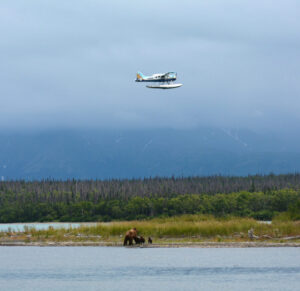
A float plane flies above a sow and her two cubs in Katmai National Park. Photo by Paxson Woelber.
The Board has authorized same-day airborne tracking, created unlimited bag limits and unlimited seasons for the hunting and killing of bears, eliminated the need for hunters to obtain or purchase hunting tags or permits (monetarily incentivizing hunting of bears and wolves), authorized bear baiting, reclassified black bears as furbearers to allow for trapping, and allowed the hunting of sows and cubs.
These techniques for killing bears and wolves are inhumane, not consistent with the concept of “fair chase,” and disruptive to bear behavior, not to mention questionable in terms of achieving the Board’s stated goals.
Shoot first and ask no questions
Additionally, the Board seeks to increase ungulate abundance by authorizing the Alaska Department of Fish & Game to kill bears and wolves through predator control programs. In 2011, the Board authorized the Mulchatna Caribou Herd Intensive Management Plan authorizing Fish and Game to kill wolves in southwestern Alaska with the goal of increasing the Mulchatna herd’s population. In 2022, Fish and Game scientists presented research showing that this program was not working to increase the herd’s population and that predation was not the leading challenge facing the herd.
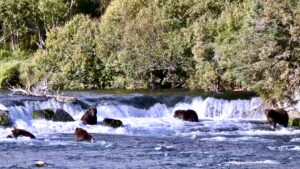
Brown bears gather at Brooks Falls in Katmai National Park. Photo by N. Boak.
However, instead of admitting that the program was unsuccessful, the Board doubled down and added both black and brown bears as targets. The Board authorized Fish and Game to aerially shoot and kill an unlimited number of bears, including cubs and sows, in a 40,000 square-mile-area of southwestern Alaska. The boundaries of the area are adjacent to public lands, including Katmai National Park, where the famous Brooks Falls is and where those iconic fat bears fish.
What’s more, the Board lacked any scientific data about the bear population of the area, and it did not set a population threshold to ensure the bears’ sustainability. Under this program, Fish and Game killed 191 bears. The Board reauthorized the program in 2025. Not only are these programs undertaken without evidence that they are likely to achieve their goal of increasing ungulate populations, but they are cruel and have the possibility of upsetting ecosystem dynamics by depleting predator animals, who play key roles in the environment.
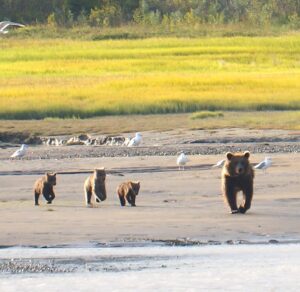
Brown bear family fishes in Lake Clark National Park. Photo courtesy of NPS.
We have repeatedly taken legal action to protect brown bears in Alaska, including in our current litigation challenging the Mulchatna bear killing program as violating the Alaska Constitution. Stopping bad policy before it causes irreversible harm to brown bears and the places in which they thrive—and to which their presence is vital—matters for Alaska’s environmental health.
In Alaska’s wild river valleys and coastal forests, robust brown bear populations provide people with more than viewing opportunities of one of nature’s most charismatic megafauna; these bears signal that the intricate and dynamic functions are working to build a healthy, resilient ecosystem.
As these formidable yet awe-inspiring creatures face threats on multiple fronts from climate change, industrialization, and State-sponsored massacre, protecting this essential species and its habitat becomes all the more important.
This is the latest in our “Beings and biomes” series. You can find previous articles below:
- On beings and biomes–the wolverine
- On beings and biomes—the boreal forest
- On beings and biomes—keystone and indicator species
- On beings and biomes—a year in the tundra
- On beings and biomes—an intertidal abundance
- On beings and biomes—beluga whales
- On beings and biomes—caribou and their migrations
- On beings and biomes—the perpetual homecoming of migratory birds
- On beings and biomes—wetlands as the center of our everything
- On beings and biomes–eelgrass is the sexiest plant alive
- On beings and biomes—sea ice is everyone’s business
- Beings and biomes—life in the subnivean zone
- On beings and biomes—the translucent bear
- Beings and biomes—Arctic raptors