


The season of care—Alaska News Brief May 2026
The month of May tends to make people happy and keep them busy with fruitful tasks, like gardening and clearing out the garage. In Alaska, we look to May to fulfill the promise of more sunlight and no snow, and it does.
It’s the season of tending, caring, and growing.
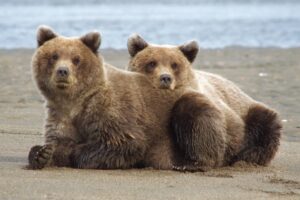
A brown bear cuddle puddle in Lake Clark National Park. Photo by K. Lewandowski.
Birds who fly from the Lower 48 or from as far as Australia and Antarctica—Arctic terns, semipalmated sandpipers, long-tailed ducks, bar-tailed godwits, and more—return to the Arctic to nest and nurture their chicks. Caribou migrate to their birthing and nursing grounds. Bears forage and moose give birth. Morels begin to show, and green-up begins.
At my house, I see more birds in the branches and notice the rhubarb emerge like pink bulbs. Soon, it will erupt into giant leaves.
It’s time for me to do some tending too. In the garden and in my heart.
I’ll be honest, the first week of May brought us heartbreaking news here at Trustees. Despite our team’s pointed and well-framed claims and argument, the court denied our request for an emergency order to stop the State of Alaska from killing every bear it can find in a 40,000-acre area of western Alaska. The case isn’t over, and we will continue arguing our case challenging the Mulchatna bear shooting program, but in the meantime, the State can keep killing brown and black bears who move through a vast region that includes places like McNeil State Game Sanctuary and Katmai National Park.
In its ruling, the court deferred to the State’s agency as the experts, but the State does not know the number of bears in the area or the sustainability of their population under a program that aims to kill every bear seen, let alone the broader ecological consequences of the mass killing of bears.
Vicki sitting amongst the bears at the falls on McNeil River. Photo courtesy of Vicki Clark.
I have been to McNeil several times, always awed as I silently watch bears gorging on salmon in the rain, in the sun, in the moment. I learn something every time. About myself, about what it means to live.
People go to places like McNeil to see and experience landscapes where bears and other animals thrive. They go because they care about these places, about other living beings, about their lost and found relationship with all of Earth’s living communities. They go because they understand we’re all connected. They go because they need that connection, that belonging.
These days it feels like grievance and cruelty dominate our human world, piercing the integrity of our friendships, our conversations, our hearts. I feel this deeply, and I’m not even on social media.
It’s easy to forget what we have in common when so much of what’s said and done by the people with power and money, and bullhorns and arsenals turn us against each other. I see more people move through the days long faced and exhausted, answering the question, “How are you?” with a listless shrug, and I wonder how to change that for myself, how to practice care in as many moments as I can.
Maybe I’m projecting, but it gets tiring feeling sick and tired.
So, I started to smile more when passing by strangers, in the hallway at work, at the dog park. I’m not inherently a bubbly person quick with a toothy smile, and I definitely don’t force smiles on anyone, but it’s my small way, my simple practice, to connect during a tsunami of division and distrust.
Who knows, maybe I will sing more and dance, too!
I know we cannot individually and alone disrupt the powerful systems that have baked propaganda, slogans, lies, exploitation, greed, and carelessness into the structures of our lives, but I want to hold onto this practice that honors gestures of care—to try to embody care and caring so I don’t forget how to use it, why it matters, how it strengthens and nourishes us.
I have a neighbor who plows people’s driveways and sidewalks in the winter and always carries a pile of dog treats to hand out when walking his dog around the block. All the dogs know him. All the folks on the block and the next ones over know him, too.
He’s not a bubbly person either. I hear the barking when he comes around and I smile. He is doing the work of care, too.

PS. Thanks to supporters like you, we can continue fighting to protect Alaska’s land, water, air, wildlife and people.
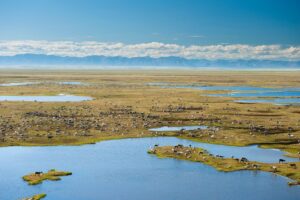
The Porcupine Caribou Herd. Photo by Florian Shulz.
Help protect the Arctic Refuge. Write your “Dear Big Oil” letter now
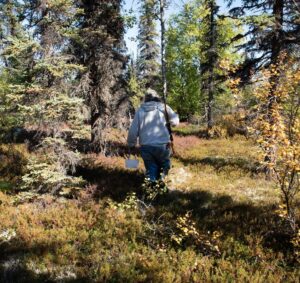
A hunter walks through the woods near Lake Clark National Park. Photo by D. Khalsa.
Litigation 101: What are declarations and why are we preparing so many right now?
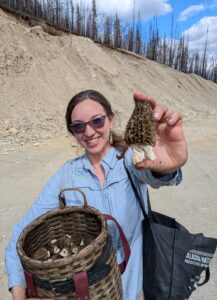
Christin holds up a morel find! Photo courtesy of Christin Swearingen.
Being and biomes—the mighty morel